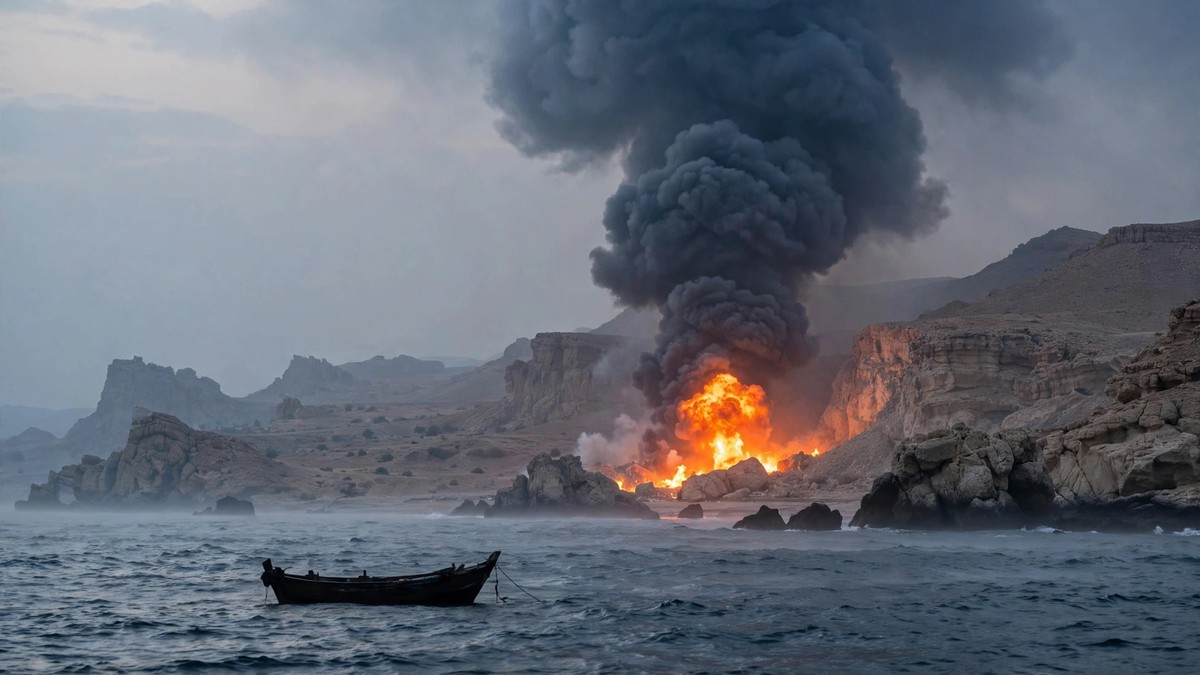
Two missiles reportedly struck Iran’s Qeshm Island in the Strait of Hormuz on Saturday, Iranian media said, hours before Tehran claimed it had shot down an American drone over the same island.
Key Points
- Iran’s semi-official Tasnim news agency said on Saturday that initial reports indicated two missiles had struck Qeshm Island, with no official information yet on possible damage.
- State agency IRNA reported that local witnesses said two projectiles hit the Suza area of the island after the sound of an aircraft was heard overhead.
- Hours after the reported explosions, Iranian state media said its air defences had shot down a US MQ-9 drone over Qeshm Island on Saturday; the United States has not confirmed the claim.
- US Central Command described the situation around Qeshm as “relatively calm” and said it would make an announcement concerning Iran later on Saturday.
- Qatar denied reports that US-Iran talks to end the war had collapsed, saying mediation continues and both sides are still working toward an agreement.
What happened
Iran’s semi-official Tasnim news agency said on Saturday that initial reports indicated two missiles had struck Qeshm Island, adding that there was no official information on possible damage. Tasnim said further details would be released once the relevant authorities had confirmed the incident.
The state news agency IRNA had reported earlier that local witnesses said two projectiles had struck the Suza area of Qeshm Island in southern Iran after the sound of an aircraft was heard over the island. No official Iranian statement on casualties or damage had been issued in the first hours after the reports, and no side had been identified as responsible for firing the missiles.
It was not immediately clear whether the impacts reported on Saturday were the same explosions heard over the island on Friday evening. The Wall Street Journal reported that explosions were heard on Qeshm on Friday evening after what a US official described as small-scale strikes, and that the United States has carried out several such strikes in recent weeks while saying they did not signal a return to full-scale combat.
Hours after the reported explosions, Iranian state media said the country’s air defences had intercepted and destroyed an American MQ-9 drone over Qeshm Island on Saturday. The Islamic Revolutionary Guard Corps had also claimed on Friday that its air defences destroyed a US MQ-1 drone over the island. The United States has not confirmed either claim.
US Central Command, asked about the reports, said the situation around Qeshm Island was “relatively calm”. An official indicated that Central Command would issue an announcement concerning Iran at 8:30am Eastern time on Saturday, without disclosing its content.
Why it matters
Qeshm is Iran’s largest island and sits at the mouth of the Strait of Hormuz, the narrow channel through which about a fifth of the world’s oil and liquefied natural gas normally passes. Anything that happens on the island is therefore read far beyond Iran’s shores — by shipping companies, by oil traders and by the governments trying to end the war.
The reports land at a moment of open division inside the Trump administration over what to do next. The Wall Street Journal reported that Defence Secretary Pete Hegseth and Central Command chief Adm. Brad Cooper have backed a return to major combat operations in recent briefings, while Secretary of State Marco Rubio and Treasury Secretary Scott Bessent have argued for tightening sanctions and keeping the naval blockade, and Vice President JD Vance and special envoy Steve Witkoff have pressed for diplomacy. Israel’s prime minister is still pushing for renewed strikes, while Gulf allies are more sceptical.
At the same time, the diplomatic track has not stopped. Qatar’s International Media Office denied circulating reports that the United States and Iran had failed to reach an agreement to end the war, describing those reports as false and misleading. It said Qatar’s prime minister had affirmed that both sides continue to work toward an agreement, and that mediation efforts are ongoing in close coordination with Washington and Tehran. Iranian officials are expected to return to Doha in the coming days, possibly as early as Saturday, to discuss a prospective deal that would move almost immediately into nuclear negotiations.
What happens next
The most immediate question is what Central Command says in its announcement later on Saturday, and whether it confirms, denies or stays silent on both the missile impacts and the claimed drone shootdown. Iranian authorities have promised further details once the incident is confirmed, and the first official word on damage — or on who fired — will shape how far this escalates.
Beyond Saturday, the direction of the war may be decided in Washington and Doha rather than on Qeshm. President Trump told reporters on Thursday that a decision was coming soon, saying he would rather not destroy the rest of the country “if possible, but maybe I will have to”. The deal under discussion would shrink the timetable for preliminary talks from 60 days to two days, moving almost immediately into nuclear negotiations — a sign that mediators are trying to lock in a settlement before the fighting widens again.
For now, the missile reports remain unconfirmed by any official source, and the drone claim rests on Iranian state media alone. What is certain is that the strait — and the island at its entrance — is again at the centre of the war.
Sources: Reuters, 7 November 2026; The Jerusalem Post, 7 November 2026; The Times of Israel, 7 November 2026; Al Jazeera, 7 November 2026; The Wall Street Journal, 7 November 2026. Published 7 November 2026.