Paraguay president Santiago Peña was removed from office by the Senate on Friday and placed under house arrest, hours after the collapse of Ueno Bank froze the savings of nearly three million people.
Key Points
- Paraguay’s Senate voted 44-0 on Friday 6 November to remove President Santiago Peña from office over the collapse of digital bank Ueno.
- Police placed Peña, 47, under house arrest on suspicion of breach of trust. Prosecutors say the charges are still being decided and could include influence peddling.
- Vice President Pedro Alliana, 52, was sworn in as Paraguay’s 53rd president hours later and will serve until August 2028.
- Ueno Bank had about 3 million customers in a country of 6.5 million people. Its collapse froze accounts holding about $850 million in public money.
- Peña resigned on Thursday, hours before the lower house voted 78-0 to impeach him. He denies wrongdoing.
What happened to Paraguay’s president
On Thursday Peña posted a video on X announcing he would quit, saying the move would safeguard national stability and democratic institutions. In the video he apologised — “I want to apologise to the people if at any point I failed” — without taking blame for the bank’s failure.
The lower house acted within minutes of the video, voting 78-0 to impeach him and send the case to the Senate. The speed of the vote showed how completely Peña had lost the backing of his own conservative Colorado Party, which had turned against him as the crisis deepened.
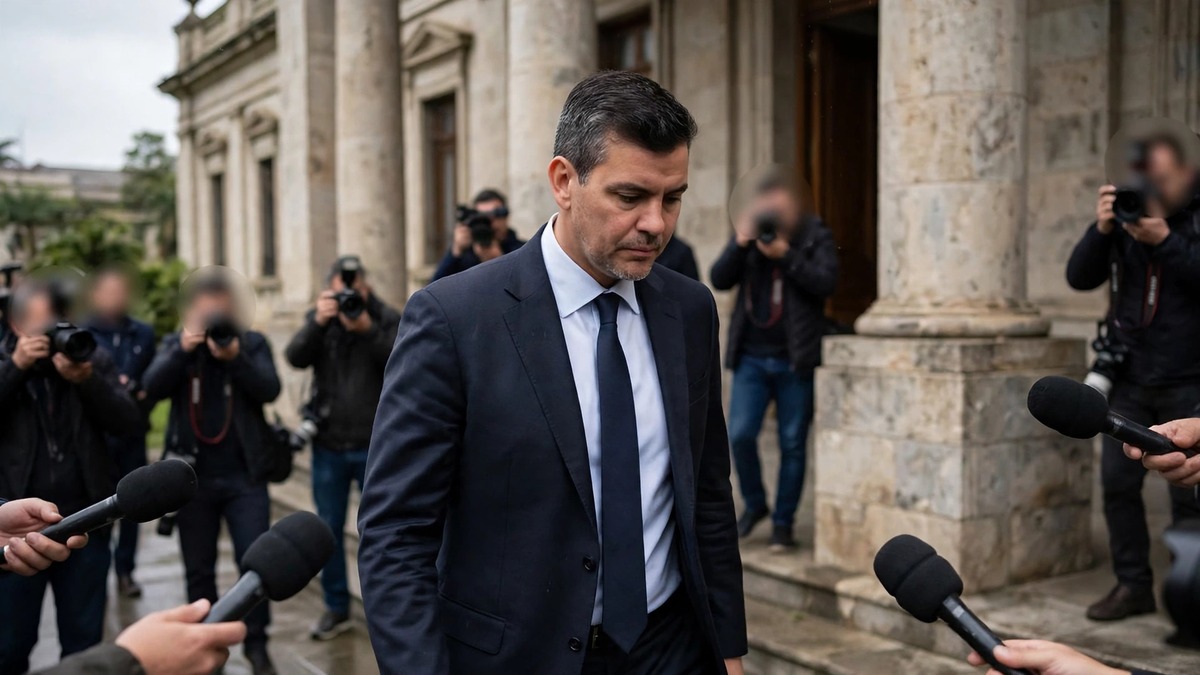
On Friday, the Senate resumed the proceedings and voted to remove him. Every one of the 44 senators in the chamber voted to remove him; a single senator was absent. Senate President Basilio Núñez read out the verdict: guilty of poor performance in his duties. The ruling also takes away Peña’s immunity as a former president and his lifetime Senate seat.
Within the hour, police put the former president under house arrest. Outside Peña’s house, prosecutors told reporters they had not settled the charges yet, though influence peddling was among the possibilities, and ordered him to front up to the prosecutor’s office on Saturday morning. A judge will rule on where he is held while the case moves ahead.
The attorney general, Emiliano Rolón Fernández, has launched three separate inquiries — into Peña and other officials, into the regulators who were meant to police the bank, and into how public money ended up deposited there.
Alliana, 52, took the oath on Friday as Paraguay’s 53rd president. The head of Congress, Basilio Núñez, draped the presidential sash over Alliana, who now serves out the term ending in August 2028. Lawmakers chose not to pursue impeachment against Alliana himself — although, according to the Associated Press, he is also under investigation in connection with Ueno’s collapse.
How Ueno Bank collapsed
Ueno started as a tiny finance house and, in under five years, became a name every Paraguayan knew, signing up more than three in five adults in the country. By June the bank counted roughly 3 million customers in a nation of 6.5 million, and it was looking after about $850 million of public money — pension and health-system cash among it, plus deposits from the firms running Paraguay’s big hydroelectric plants.
On Tuesday the central bank took control of the lender, after its own checks showed the bank no longer met the minimum capital rules. When regulators examined the bank’s lending to firms connected with its owners, they found loans with thin paperwork and costs booked as if they were assets. With the figures put right, the bank’s capital cushion had shrunk to 5.56 percent — under half of the 12 percent the rules demand.
Savers found the bank’s app, cards and transfers dead and its branches shut, with no way to reach their money. Moving those accounts to other banks has put the whole system under strain and knocked out several other banks’ apps along the way, the central bank said.
Eight senior figures from the bank are in custody, among them founder Miguel Vázquez and bank chief Juan Manuel Gustale, who gave themselves up after warrants were issued.
Lawmakers zeroed in on Peña’s old business connection to Grupo Vázquez, the group behind Ueno Bank. Peña says he held shares in Grupo Vázquez until March 2025, then sold them, while Ueno insists he was never a shareholder or investor in the bank itself. He had also put Carlos Carvallo, who once ran Financiera Ueno, the forerunner of Ueno Bank, in charge of the central bank. Carvallo stepped down the same Tuesday, once the central bank had placed Ueno in resolution — the toughest step available before outright liquidation.
For three days, crowds filled the streets of Asunción calling for Peña to go, clashing with riot police while lawmakers debated his fate.
Why it matters
No Paraguayan president has been thrown out this way since the return of democracy in 1989 — Peña is only the second. And his fall was astonishingly fast: a bank seized on Tuesday, a resignation on Thursday, removal and house arrest on Friday.
He was also one of Donald Trump’s closest partners in the region, hosted in Washington only a few weeks earlier. Trump has stood by embattled allies before — he publicly backed his defence secretary this week even as advisers discussed replacing him — but no outside backing could save Peña once his own party abandoned him. For Trump’s backing of his defence secretary, see our report: https://worldpulsewire.com/2026/11/05/trump-hegseth-future/
The scale of the damage sets this crisis apart. Close to one Paraguayan in two held an account with Ueno, and the money frozen includes public funds that pay pensions and healthcare. The failure has dented trust in an economy long seen as one of the region’s steadiest and left millions of people waiting to learn whether their savings will come back.
And the crisis is not over. The man who replaces Peña is himself under investigation over the same bank, and the criminal cases now open will examine not only Peña but the regulators who were supposed to watch Ueno and the officials who put state money into it.
Impeachment is also the word hanging over American politics, where Senator Ted Cruz has warned Donald Trump to expect years of investigations and impeachment votes from the new Democratic majorities in Congress. For Cruz’s warning, see our report: https://worldpulsewire.com/2026/11/05/cruz-impeachment/
What happens next
Peña has been ordered to front up to the prosecutor’s office on Saturday morning, and a judge will rule on where he is held while the case moves ahead. Prosecutors will also settle the final charges against him.
Alliana takes charge of a government that must now do two things at once: get depositors their money back and hold the people behind the collapse to account. Lawmakers have already signed off a scheme to repay stranded savers, and the central bank has a new chief in place, but the transfer of millions of accounts to other banks is still under way.
The three criminal investigations will run in parallel with the political fallout, and the question now facing Paraguay is whether the system that let Ueno grow so fast, with so little oversight, gets fixed — or whether the next bank is already growing the same way.
Sources: Associated Press, Reuters, BBC News, Al Jazeera, CNN. Events: Thursday 5 – Friday 6 November 2026, Asunción, Paraguay. First published: Saturday 7 November 2026.