Key Points
- Four attacks struck shipping in the Strait of Hormuz in 96 hours, up from three in the previous period, according to maritime security update JMIC 111.
- All four attacks happened between 1 and 3 November off Oman’s Musandam coast.
- The update says Iran’s Revolutionary Guard is keeping up drone overflights, targeted surveillance and radio warnings to merchant ships.
- A separate tanker was hit by two unidentified projectiles north of Qatar on Wednesday night; no one has claimed the strike and the crew’s condition is unknown.
- Traffic through the strait stays far below normal, with US-assisted transits down to about 31 a day.
Four attacks struck shipping in the Strait of Hormuz in 96 hours, a maritime security update said on Wednesday, as traffic through the world’s busiest oil waterway stayed far below normal.
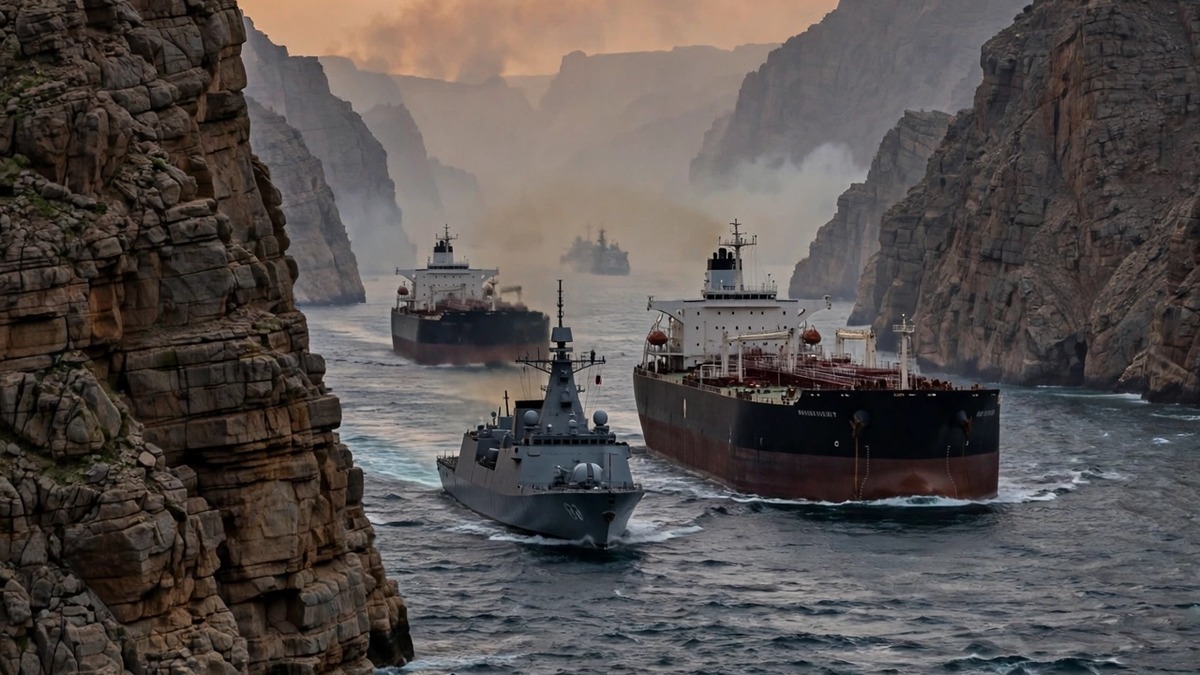
The update, JMIC 111, counts four attacks in the strait over four days, up from three in the period before. All four happened between 1 and 3 November, off the coast of Oman’s Musandam Peninsula, the rocky headland that watches over the strait’s narrowest passage.
What happened in the Strait of Hormuz
The assessment says Iran’s Revolutionary Guard is keeping up steady pressure on merchant shipping: drone overflights above the waterway, targeted surveillance of passing vessels, and radio warnings telling ships they are being watched.
None of the four attacks has been tied publicly to a named attacker. What the update describes is a pattern rather than a single event: repeated, low-level pressure on the shipping lane, day after day, instead of one large strike.
The strait matters because of what passes through it. Roughly a fifth of the world’s seaborne oil moves through the narrow channel between Iran and Oman, along with a large share of liquefied natural gas. When attacks rise, insurers raise their prices, some owners reroute, and the ships that do pass through move more slowly and more cautiously.
A second strike north of Qatar
Separately, a tanker was struck by two unidentified projectiles north of Qatar on Wednesday night, according to Britain’s maritime agency UKMTO in warning 196-26. No group has claimed the attack, and the crew’s condition is still unknown.
The Qatar strike is the second tanker hit reported by UKMTO in four days. On 3 November, a tanker was struck by two unknown projectiles about 14 nautical miles north-east of Lima in Oman, near the strait — both projectiles hit the engine room, and there were no casualties and no spill. The two incidents are separate, and no link between them has been established.
The pattern is familiar to anyone following the waterway. In the past, attacks on tankers near Hormuz have often gone unclaimed, leaving owners, insurers and navies to read the intent from the timing and the target rather than from any statement.
Why Hormuz shipping is thinning out
Traffic through the strait remains far below normal, and US-assisted transits — ships moving through with American naval help — have slipped to about 31 a day.
The fall in traffic is a choice made ship by ship. Some owners are holding their vessels outside the Gulf until the picture clears. Others are accepting longer routes around Africa rather than risking the strait. Each decision on its own is small; together, they thin out one of the world’s most important trade routes.
The United States announced a naval mission, Project Freedom, to guide stranded ships through the strait, starting this week. Iran has warned that foreign armed forces, above all the US military, would be attacked if they approached or entered the strait. The warning and the mission now face each other across the same narrow water.
What happens next
The question now is whether the pressure stays at this level or climbs. Four attacks in 96 hours is already a faster pace than the three in the period before it, and the Qatar strike shows the danger is not confined to the strait itself.
Shipowners will watch two things: whether any group claims the Qatar strike, and whether the next JMIC update shows the count rising again. If attacks keep coming at this pace, more owners are likely to hold their ships back, and the thinning of traffic through Hormuz will deepen.
For now, the waterway stays open — but it is open under pressure, with fewer ships, slower transits and warships never far away.
Source: Gulf News; UKMTO | 6 November 2026