KEY POINTS:
- Kuwait’s army said early Wednesday its air defences were countering hostile drone attacks; explosions heard were interceptions.
- Kuwait named no origin for the drones and reported no casualties or damage; it did not blame Iran.
- Hours earlier, US fighter jets hit an IRGC missile launch site on Qeshm Island after Iranian drones targeted a US radar in Bahrain.
- Bahrain issued a fresh danger alert and condemned the attacks; US Central Command says the drones were intercepted with no damage.
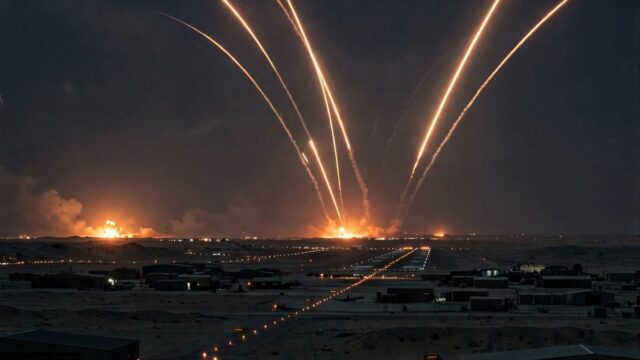
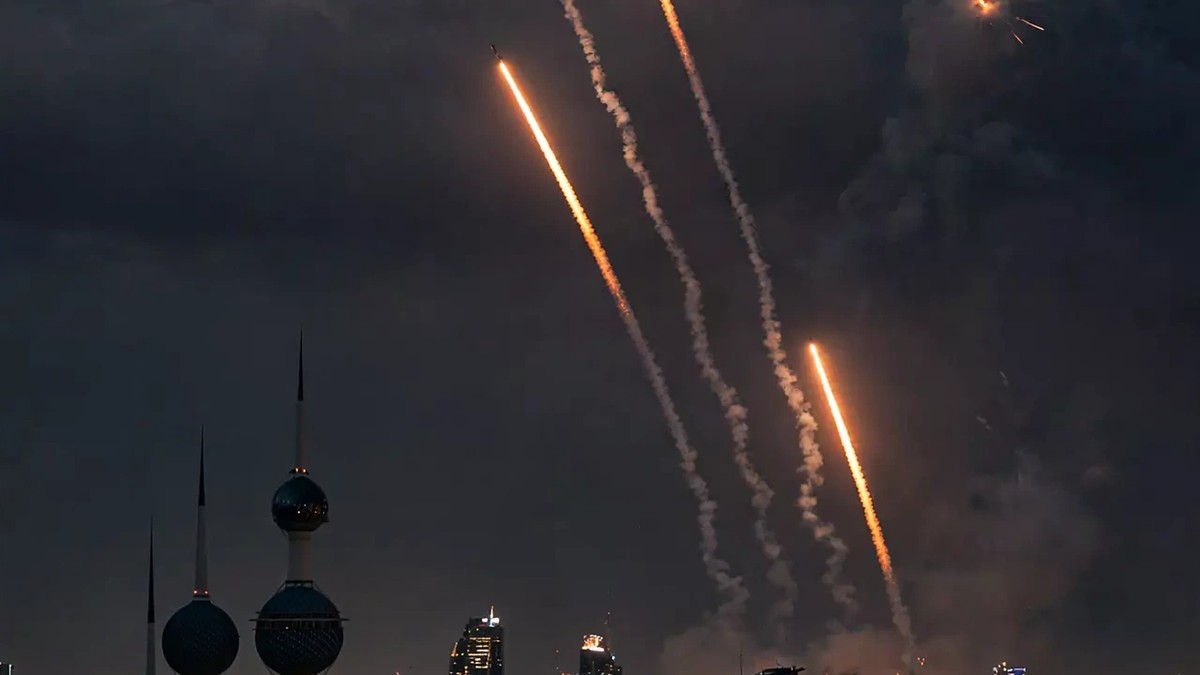
Kuwait’s air defences engaged hostile drones over the country early on Wednesday, the army said, hours after American jets bombed an Iranian missile site on Qeshm Island.
Kuwait woke to the sound of its own air defences on Wednesday. In a statement posted on X at about 1.39am Gulf time, the General Staff of the Kuwaiti Armed Forces said its systems were countering hostile drone attacks and that any explosions people heard were the result of interceptions. Residents were told to stay calm and follow the safety instructions issued by the authorities.
The statement gave no detail about where the drones came from, what they were aimed at, or whether anyone was hurt. It did not say the drones were Iranian. That silence matters, because Kuwait hosts American forces and has been hit by Iranian missiles and drones before during this war — yet officials stopped short of pointing a finger this time.
Bahrain, a few hundred kilometres down the Gulf coast, issued its own warning late on Tuesday. The Interior Ministry spoke of a potential threat, urged people to avoid main roads unless necessary, and told residents to stay calm and move to the nearest safe place. No all-clear had been reported by the early hours of Wednesday.
What happened overnight
The night’s exchanges began in Bahrain. Iran’s Revolutionary Guards said they had launched drones at a US-operated radar system at Sheikh Isa Air Base, describing the strike as a precision operation and a reply to what Tehran calls repeated violations of Iranian airspace by American drones. It was the third Iranian drone attack on Bahrain in five days, and the first reported attack on a Gulf country since early September.
Bahrain said its air defences intercepted the attack and reported no casualties or damage. Blasts were heard over the capital, Manama. US Central Command said a number of Iranian one-way attack drones aimed at the radar were intercepted, with no damage to American equipment and no injuries to US personnel. Central Command also rejected the Guards’ claim that the radar had been hit, calling it false.
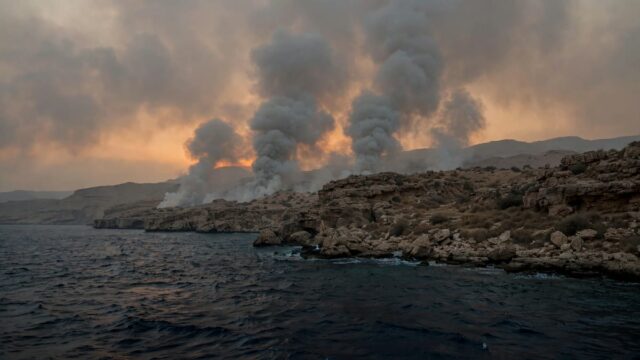
Washington answered within hours. A US military official told Reuters and Al Jazeera that American fighter jets used precision munitions to strike a Revolutionary Guards missile launch site on Qeshm Island, in the Strait of Hormuz, describing the operation as self-defence in response to Iranian aggression against US personnel and assets. Iranian media reported five to six explosions on the island on Tuesday evening, and an Iranian official told Tasnim the attack caused no damage to vital infrastructure. Iranian outlets also reported that an air-defence missile launcher in the island’s Nariman area was targeted, though the extent of any damage to military facilities was unclear.
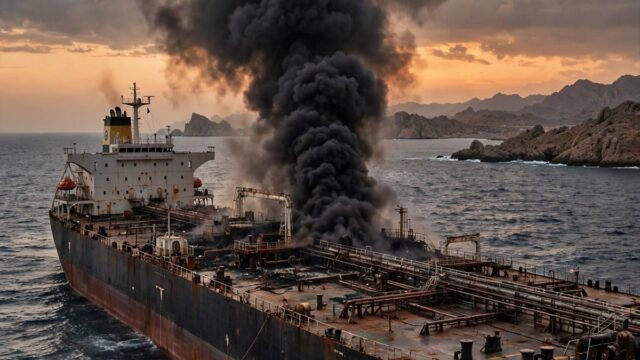
The shipping war in the strait ran on in parallel. Iran’s navy said another tanker caught fire after striking a naval mine east of the waterway, taking the number of vessels it says have been hit in and around the strait in the past day to five. No vessel has been named, and no outside authority has confirmed the mine claims. Oman said it had evacuated 24 crew members from the Panama-flagged LPG tanker Tara Gas after it caught fire near the Musandam Peninsula; one Indian seafarer remains missing.
Why the Kuwait drones matter
Kuwait is now the third Gulf state drawn into the fighting in the space of a night, after Bahrain and Iran itself. The war that began on February 28 with American and Israeli strikes on Iran has been fought in bursts ever since — a naval blockade, limited strikes, drone attacks and counter-strikes — but the front has mostly stayed in the strait and over Bahrain. Explosions over Kuwait, a state that hosts US bases and has already seen its airport, refineries and a power and desalination plant targeted during this conflict, show how quickly one night’s retaliation can widen the map.
The timing also undercuts the diplomacy running alongside the fighting. Qatar and Oman have been working to narrow the gap between Washington and Tehran, and Iran’s foreign minister, Abbas Araghchi, was in Muscat on Tuesday, where he met Oman’s Sultan Haitham bin Tariq and discussed what he called a diplomatic initiative to end the war. Qatari officials met their Iranian counterparts the same day. None of that stopped the drones, the jets, or the mines.
There is a second warning inside the night’s events. Bahrain condemned what it called continued Iranian attacks, said it reserved the right to self-defence under Article 51 of the UN Charter, and called on the Security Council to act. The Gulf Cooperation Council accused Tehran of interfering in Bahrain’s internal affairs after Iran criticised a Bahraini court decision sentencing 64 people, mostly Shia clerics, to life in prison for allegedly colluding with Iran. The political fallout is now travelling as fast as the military one.
The strain is also showing inside the American war effort. The acting US Navy secretary, Hung Cao, told a Senate confirmation hearing on Tuesday that the war on Iran had put a strain on the navy, and disclosed that the service had used expired munitions during the February offensive, dubbed Operation Epic Fury. Meanwhile President Donald Trump has warned Tehran of unprecedented consequences over a CNN report that US intelligence believes Iran may be planning to detonate a so-called dirty bomb or use a chemical weapon in Washington — a report Tehran has dismissed as rubbish and a pretext for further aggression.
What happens next
The first question is whether the Kuwait drones stop at interceptions or leave damage behind. No casualties or damage have been reported, and no all-clear has been issued for Bahrain, so the next hours will tell whether the night is over or still unfolding.
The second is whether the exchange derails the mediation. Qatar said on Tuesday that diplomatic efforts were continuing and that officials planned to meet their Iranian counterparts in the coming hours. But each round of strikes makes a settlement harder to sell in either capital, and Iran has said it will respond at the same level to any attack, while Washington has said it will keep striking in self-defence.
The third is the strait itself. Five tankers reported hit by mines in a day, a missing seafarer, and a war that now touches three Gulf states in one night point to a shipping lane that is becoming harder to use and harder to insure. Traffic through the strait has already fallen far below normal, and every new incident pushes it lower. The United States has been guiding ships through the waterway under its naval mission, but the mission itself is now a target.
For now, the pattern of this war holds: a strike, a counter-strike, and a wider map. Kuwait’s air defences firing in the dark is the latest proof that the war is no longer contained to the strait — and that the next escalation may arrive over a country that was not a battlefield yesterday.
Source: Al Jazeera; Gulf News; Arab News; The National; Times Now; Mathrubhumi; Tasnim (via Gulf News) | 18 November 2026