Donald Trump, Xi Jinping and Vladimir Putin ended their first three-way summit in Shenzhen on Thursday with a four-point joint declaration — but no deal on Ukraine, Iran or nuclear arms, and no trade agreement.
The declaration, published after the talks ended, commits the three countries to reforming the United Nations, increasing the supply of refined oil, limiting the International Criminal Court’s reach and talking about reducing nuclear risks. It is the first joint statement of its kind from the three leaders — and it settles none of the wars or the arms questions that filled the agenda.
Key Points
- The three leaders met for about 1 hour and 45 minutes at Kylin Villa in Shenzhen, on the sidelines of the APEC summit, after starting nearly two hours behind schedule.
- A four-point joint declaration was published after the talks: UN reform, more refined oil supply, limits on the International Criminal Court’s jurisdiction, and a dialogue on reducing nuclear risks and preventing proliferation.
- No deal came out of the talks on Ukraine or Iran, and no new nuclear arms treaty.
- Reports said the United States and China agreed to extend their trade truce, decided in a private meeting between Trump and Xi. The Chinese readout mentioned no extension details.
- Trump left Shenzhen for Washington soon after the talks ended, without speaking to reporters.
What happened
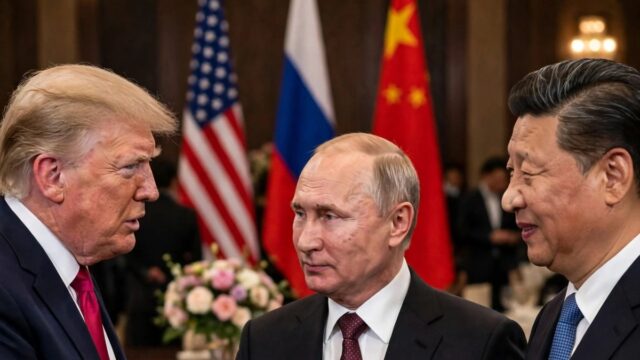
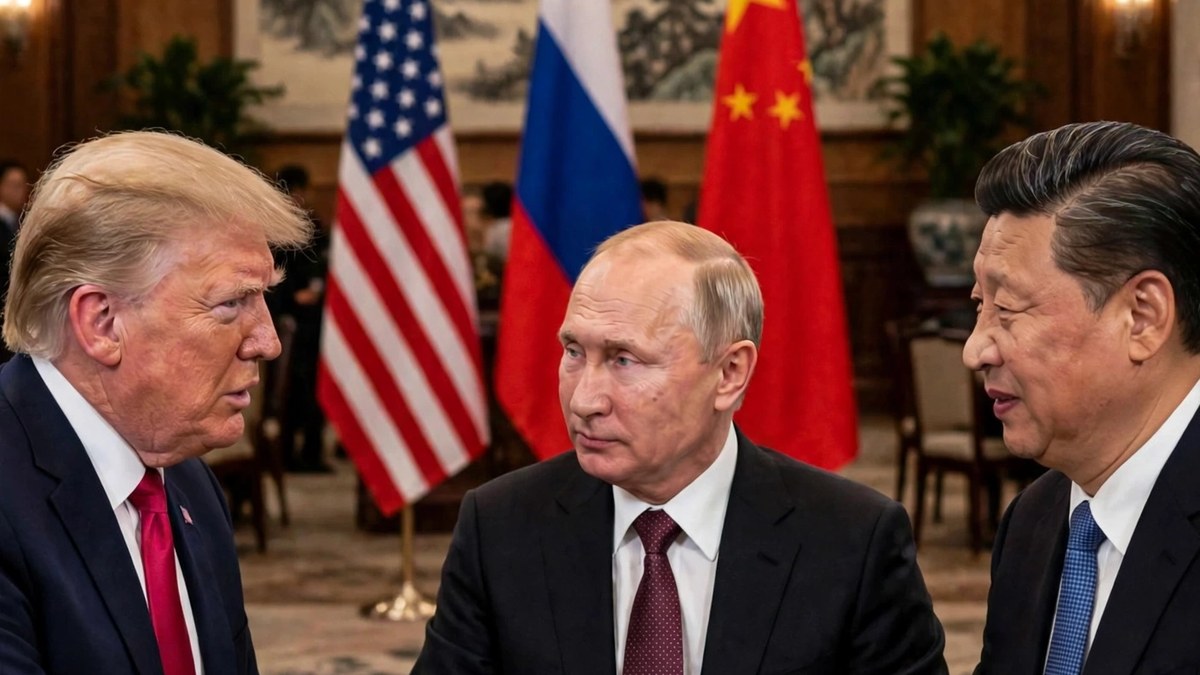
The three men sat around a large round table in a grand hall with high ceilings. The flags of all three countries stood around the table, under huge crystal chandeliers, with a traditional Chinese painting of mountain scenery behind them. The session had been due to start at 2:30 p.m. local time. It began at 4:16 p.m., nearly two hours late, and ended at 6:01 p.m.
Trump had spent the day in one-to-one meetings first. He sat with Putin for about 40 minutes, then with Xi for more than an hour. Russian television showed Trump walking into the room for the Putin meeting and greeting him with the words: “Who is he? He’s my friend!” Russian state news agency TASS reported that the war in Ukraine dominated Trump’s meeting with Putin.
Once the three were together, Xi opened by saying that good relations between major powers were “not a matter of choice, but a mandatory requirement”. Trump said the United States would not let Iran have a nuclear weapon. Putin said all three countries shared an interest in ending the war in Ukraine. Trump later said of the gathering: “We are really making history.”
Xi went further on nuclear weapons than either of the other two. He called for nuclear weapons to be “comprehensively banned and thoroughly destroyed”, describing them as a “sword of Damocles” hanging over humanity, and said “every effort must be made to prevent nuclear war”. Trump, speaking before the session, said the three countries were “uniquely positioned to discuss how to reduce the number of nuclear weapons and to lessen the risk”, while warning it was “not an easy thing to give up nuclear weapons”.
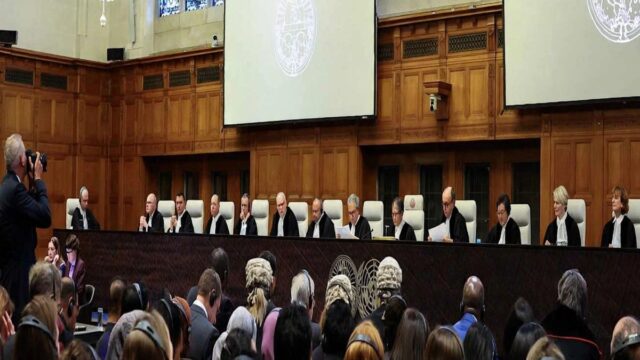
The joint declaration, published at 6:55 p.m. by China’s state news agency Xinhua, listed four points. First, the three countries, as permanent members of the United Nations Security Council, committed to reforming the UN so it can respond more effectively to global challenges. Second, they plan to increase the production and supply of refined petroleum products, and reaffirmed the importance of stable energy flows. Third, they said the consent of states and respect for the immunities of state officials are of paramount importance, and agreed the International Criminal Court and similar bodies “must not abuse their jurisdiction”. Fourth, they reaffirmed that “a nuclear war cannot be won and must never be fought”, and will hold talks on reducing nuclear risks and preventing the proliferation of nuclear weapons.
The one clear result of the day came from the Trump-Xi meeting before the trilateral session. The two leaders agreed to extend the trade truce between their countries, according to the Globe and Mail, CNBC and Bloomberg. Neither side said how long the new extension runs, or on what terms. The truce agreed in Busan in October 2025 had been due to run until 10 January 2027, after tariffs between the two countries peaked at 145 percent on the American side and 125 percent on the Chinese side. Nikkei reported that the Chinese government’s own readout of the Xi-Trump meeting mentioned no extension details.
Why it matters
The declaration is the first thing the three leaders have ever signed together, and its most substantial point is the last one: a promise to talk about reducing nuclear risks. It is a dialogue, not a deal. No caps were agreed, no treaty was signed, and the last pact between Washington and Moscow, New START, remains lapsed since February, leaving the two largest arsenals without a limit for the first time in more than half a century. China, with more than 600 warheads against more than 5,000 in each of the American and Russian stockpiles, has shown little appetite for joining talks that would limit its own build-up.
The oil point matters for a different reason: the three countries are among the world’s largest producers and consumers, and a joint promise of more refined fuel supply is aimed at steady prices and stable flows. The court point is a direct challenge to the International Criminal Court, which has an arrest warrant out for Putin — the three leaders said its jurisdiction must not be abused.
The summit was always more about the photograph than the outcome. Expectations had been set low by every capital involved: the White House, the Kremlin and Beijing all said in advance that no agreement was likely, and analysts described the meeting as a first conversation rather than a place where deals get signed.
The gap between the three leaders explains why. Trump came to Shenzhen wanting a new three-way deal on nuclear arms. Putin came wanting cover for the war in Ukraine and an end to the isolation that followed his full-scale invasion in 2022. For Moscow, sitting at the same table as the American and Chinese leaders was a prize in itself. Xi, as host, wanted room to pursue China’s aims without interference: no return to the tariff war, no challenge to its lead in rare earth minerals and technology, and no American pressure over Taiwan.
The unease beyond the room was real, and it has not gone away. Ukraine’s president, Volodymyr Zelenskyy, warned in October that he did not want the meeting to become a new Yalta, the 1945 conference where Roosevelt, Churchill and Stalin carved up the post-war world. “We really don’t want this to turn into ‘Yalta 2, 3, 4,’ with a redistribution of influence,” he said. Allies in Europe and Asia worried that Trump might present proposals on Ukraine or Taiwan as wins, without Ukraine or Europe in the room.
What happens next
The three sides said nothing about when — or whether — they would meet again, and no date was set for the nuclear-risk dialogue the declaration promises. Trump left Shenzhen for Washington soon after the talks ended, without giving public remarks, leaving the White House, the Kremlin and Beijing to put their own gloss on the day.
The questions that filled the agenda in Shenzhen are still open. The trade truce’s new terms are unknown, and the broader trade talks that were meant to follow it have no date. The nuclear arsenals of the United States and Russia remain uncapped. The wars in Ukraine and in Iran go on, and the declaration the three leaders signed says nothing about either of them.
Sources: USA Today, Fox News, The Globe and Mail, CNBC, Bloomberg, Associated Press, Nikkei Asia, The Times | 19 November 2026 (Updated with the full text of the joint declaration)