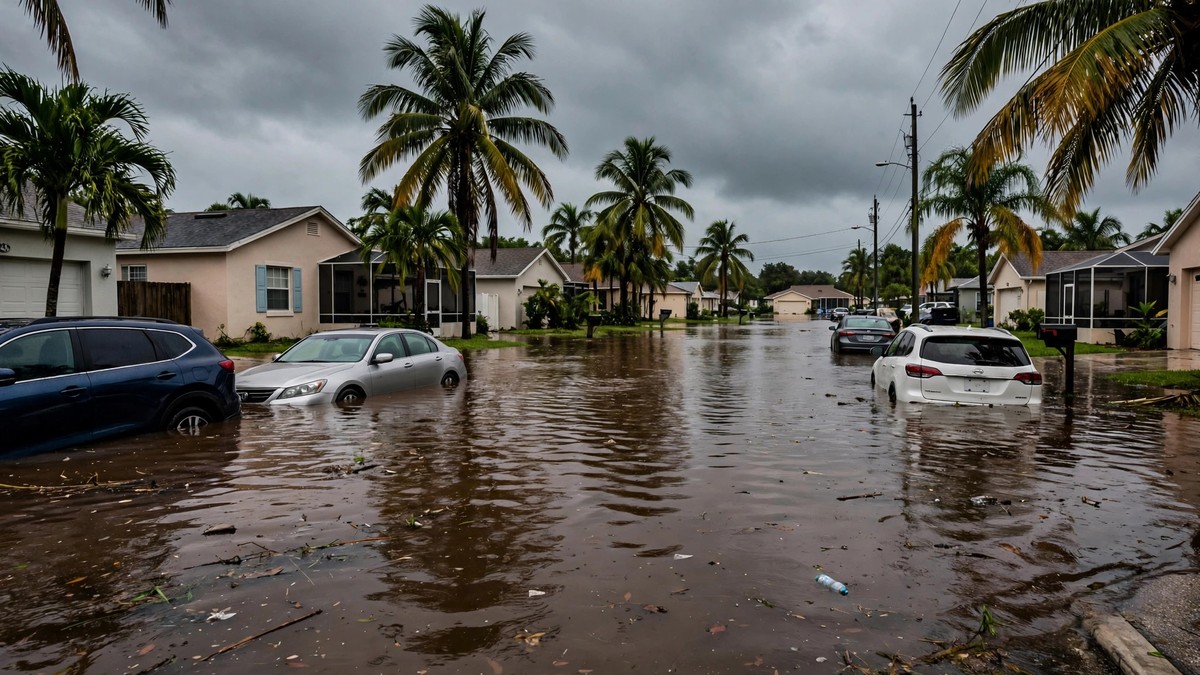
More than 15 inches of rain fell on South Florida overnight, flooding streets in Broward County, forcing schools to close and prompting emergency declarations as forecasters warned of more rain through Friday.
The rain arrived in the middle of Florida’s dry season, when November usually brings cooler, drier air as hurricane season ends. Instead, the Hollywood area received more than a foot of rain in a few hours, according to the National Weather Service.
Key Points
- The National Weather Service recorded 15.3 inches of rain near Plantation in 24 hours, the highest total in Broward County.
- Broward County, Fort Lauderdale, Hollywood and Tamarac all declared states of emergency.
- Broward and Miami-Dade schools are closed on Thursday, and Volusia County schools are closed on Thursday and Friday.
- No deaths had been reported as of Wednesday evening, and no one was hurt when the roof of a Hollywood synagogue collapsed.
- Another 3 to 6 inches of rain is forecast through Friday, with up to 12 inches possible in places, and the flood risk stays at Level 3 of 4.
What happened
The storm moved in on Tuesday evening, 17 November, and the heaviest rain fell overnight into Wednesday morning. Hollywood, in Broward County, took the worst of it. Rain fell at more than five inches an hour in places, and the National Weather Service later put the 24-hour total at 15.3 inches near Plantation and 13.7 inches near North Perry Airport. In Fort Lauderdale, 5.72 inches fell in the downpour, well above the 1.8 inches that set the daily mark in 1959.
Roads filled fast. Hundreds of motorists were stranded on highways and streets, and parts of Interstate 95 and Florida’s Turnpike were closed. Hollywood police received more than 300 calls for help between 11 p.m. and 4 a.m. Residents used kayaks to move along flooded streets, and parts of Sheridan Street sat under more than a foot of water. West of Interstate 95, residents of an apartment complex had to be rescued from their homes as water poured into first-floor units.
The rain also brought down the roof of Temple Sinai, a synagogue in Hollywood. No one was hurt. Rabbi Gideon Golden-Holz told local station WPLG: “We come together as a community, we work through all kinds of challenges and we will walk through this, and we’re gonna come out stronger even, I’m sure of it.”
Schools shut across the region. Broward County Public Schools closed on Wednesday and Thursday, and Miami-Dade schools are closed on Thursday. Brevard County schools are closed on Thursday, and Volusia County schools are closed on Thursday and Friday. The Broward district said forecasts had called for four to six inches of rain, but some parts of the county received more than ten, and several school bus lots were flooded and could not be reached. “The safety of our students and staff comes first,” the district said. Several campuses of Keiser University also closed.
Fort Lauderdale-Hollywood International Airport was briefly placed under a ground stop, and more than 100 flights were delayed. About 2,900 properties were without power as of 11 a.m. on Wednesday, according to Florida Power and Light.
Why it matters
The scale of the rain is unusual for the time of year. Florida’s dry season normally runs from October to May, but the National Weather Service said the strong El Niño has disrupted that pattern. Alejandra Garcia, a meteorologist with the service’s Miami office, said El Niño had broken up the typical dry season.
South Florida has seen this kind of rain before, and recently. Melbourne, on the Space Coast, set a record for its wettest day on 2 November with 11.5 inches of rain. Another seven inches this week would make 2026 its rainiest year on record. Brian McNoldy, a senior research scientist at the University of Miami, noted that the region went through much the same thing in mid-November 2023.
The flooding also adds to a difficult month for Florida transport. The Federal Aviation Administration halted a router rollout after a ground stop, and investigators are still examining the voice recorder recovered from a jet crash in Florida earlier in the month. The storm is the latest in a week of severe weather around the world, including Cyclone Akvan, which headed for India’s Andhra Pradesh coast.
What happens next
The rain is not over. Florida’s east coast faces a Level 3 out of 4 flood risk through Friday, with a widespread 3 to 6 inches expected and 8 to 12 inches or more possible in some areas. The Associated Press reported that as much as 12 additional inches was possible along the Atlantic coast. A flood watch for south-east Florida stays in force until 7 p.m. Eastern time on Thursday, and the National Weather Service said the flooding risk along the immediate east coast remains through Saturday, 21 November.
Forecasters are also watching the St. Johns River in northern Florida, where a warning for minor flooding is in force. The river is expected to reach 17.2 feet by 1 a.m. on Friday, high enough for water to reach homes in several Brevard County neighbourhoods, forecasters said.
After Florida, the storm will head north, and it is likely to disrupt travel during the busy weekend before Thanksgiving. Forecast models favour a track that takes the storm into the north-east by Monday, bringing rain, wind and flooding to the coast. The National Hurricane Center also gives the system a medium chance of turning tropical or hybrid while it remains over water. If it is named, it will be called Kyle. Broward County will decide on Friday’s classes once officials see the weather and the roads.
Sources: CNN, The Associated Press, The Washington Post, People, the Miami Herald, Florida Today and the National Weather Service. | 19 November 2026