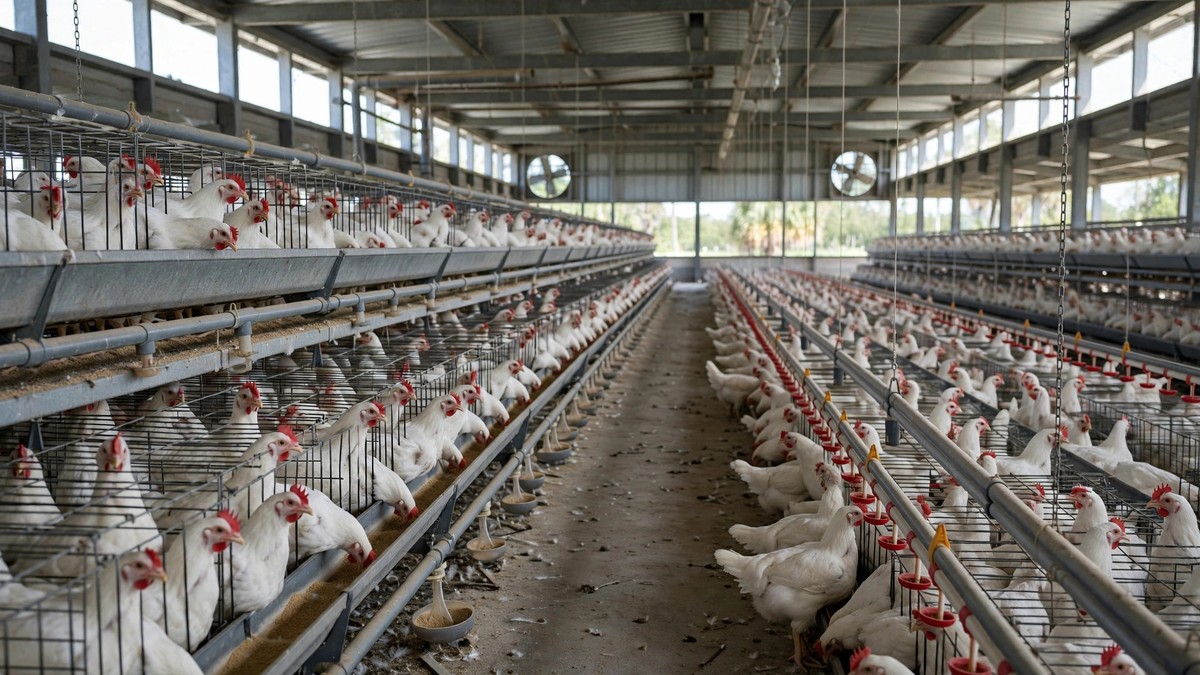
Cal-Maine Foods, the largest egg producer in the United States, will cull about 1.8 million birds after highly pathogenic bird flu was found at one of its facilities in Florida, the company said on Wednesday.
The birds are a small slice of the company’s flock, and health officials say the danger to people is low. But the case is a fresh reminder that the virus which has already wiped out hundreds of millions of birds in the United States is still moving through American farms, and still able to push egg prices up.
Key Points
- Cal-Maine will cull 1.4 million laying hens and 360,000 young hens at a Florida facility.
- The 1.8 million birds are 2.7 percent of the company’s total flock.
- Production at the site has stopped while the company follows US Department of Agriculture rules.
- Health officials say the risk to the general public is low. Seventy-four human cases have been recorded in the US since February 2024, with no sign of spread between people.
- Egg prices hit a record $6.23 a dozen in March 2025. The current average is $2.32.
What happened
Cal-Maine said on Wednesday that tests had found highly pathogenic avian influenza, the bird flu strain behind the recent outbreaks, at one of its Florida sites. The company has halted production there and is working under US Department of Agriculture protocols while the affected birds are destroyed.
The cull covers 1.4 million hens in lay and 360,000 pullets, young hens that have not yet started laying. Together they make up 2.7 percent of the company’s flock. Cal-Maine, based in Mississippi, is the largest egg producer in the country.
The company said it would lean on its other production and distribution sites to limit the disruption for customers. It gave no date for when the Florida site would reopen.
The share price told a calmer story. Cal-Maine shares fell 1.9 percent in premarket trading on Wednesday, then rose 5.3 percent once trading began, a sign the market reads the outbreak as contained to one site.
Why it matters
Bird flu has forced the destruction of hundreds of millions of birds in the United States over the past few years, cutting egg supplies and lifting grocery prices. The worst recent stretch ran from mid-October 2024 to early March 2025, when about 50.7 million laying hens were lost and the average retail price of a dozen eggs reached a record $6.23.
Prices have since eased. The Bureau of Labor Statistics puts the current average at $2.32 a dozen. Industry data cited by Al Jazeera shows about 21.5 million birds have been affected so far this year, after that severe run of outbreaks at the end of 2024 and the start of 2025.
A cull of this size at a single producer is unlikely on its own to move prices much. But each new outbreak keeps the risk alive for shoppers: food costs have stayed in focus for American households. US consumer prices rose 0.4 percent in October, and demand for everyday goods has held up as the economy added 165,000 jobs in the same month.
What happens next
The Florida site stays closed until it is cleared, and Cal-Maine will restock it gradually. The next things to watch are whether the virus turns up at other company sites, and whether wholesale egg prices move in the coming weeks.
Health officials are watching the human side too. The Centers for Disease Control and Prevention says: “The human health risk to the general US public from HPAI viruses is considered low.” It has counted 74 human infections since February 2024 and found no evidence of the virus spreading from person to person.
Sources: Reuters, Al Jazeera, Seeking Alpha. Time: 19 November 2026, 06:50 +08.