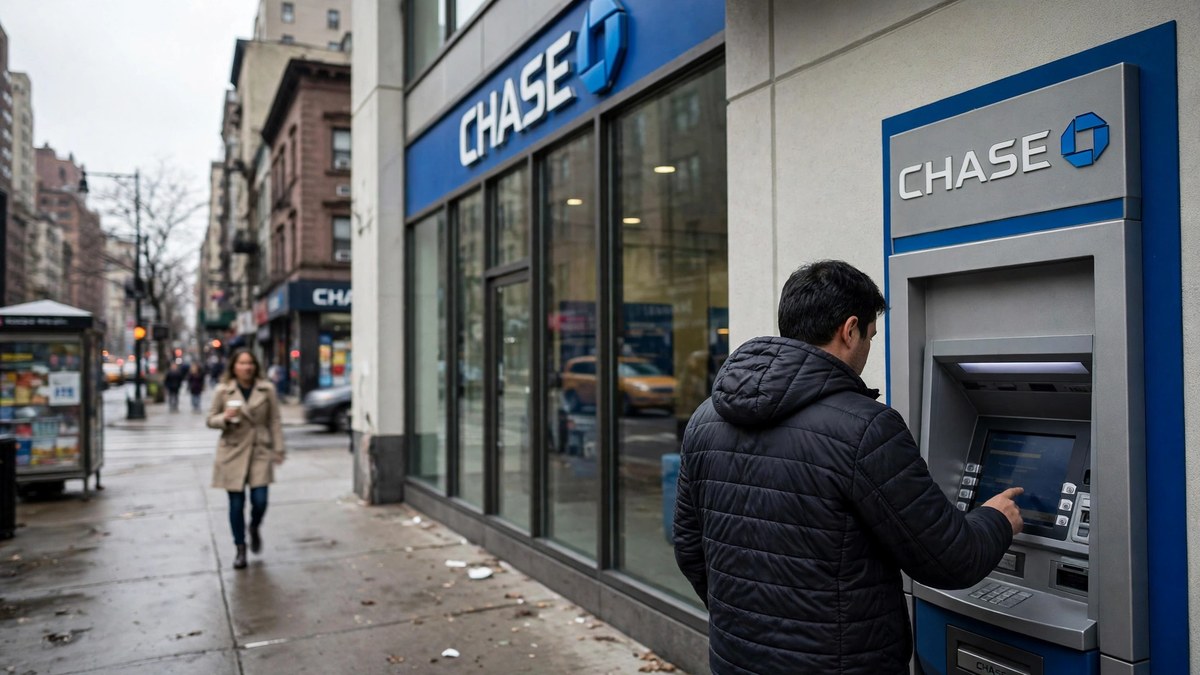
A Chase bank outage slowed payments across the United States on Monday after a software bug hit JPMorgan’s systems, the latest in a run of technology failures in five days.
Key Points
- JPMorgan Chase said a software bug in its on-premise hardware slowed transactions on Monday, 16 November.
- About 4,800 customers reported Chase problems on Downdetector around 2 p.m. ET, the peak of the outage.
- Other banks saw delays only on payments that passed through Chase. Zelle itself kept working.
- The bank said transactions were “being processed normally now” by Monday evening.
- Chase banks 7.4 million small businesses, whose payments slowed too. JPMorgan shares closed down about 2.3%.
What happened
Customers started reporting problems on Monday morning. The first error reports appeared from about 11:30 a.m. ET, according to CNBC, and Zelle reports began surfacing from about 9:30 a.m. ET. By 2 p.m. ET, nearly 4,800 people had flagged Chase problems on Downdetector. Luke Kehoe, lead industry analyst at Downdetector’s parent company Ookla, told USA Today it was the second-highest number of Chase reports in a 15-minute period in at least a year, and the highest since 24 September. Reports had eased from the peak by 4:02 p.m. ET but stayed high into the evening.
JPMorgan Chase said the cause was a software bug in its on-premise hardware systems. “JPMorgan Chase has experienced a temporary issue related to a software bug in on-premise hardware systems,” the bank said in a statement, adding that there was no evidence the problem was “cyber-related”. It added: “This is not a systemic issue — other banks may have been impacted by slowness in transactions only to the extent that they were a party to a transaction with us.” Customers kept access to their accounts and funds throughout, the bank said. A person familiar with the matter told NBC News the outage was limited to the bank’s retail business.
Downdetector also showed reports climbing for the other big banks — Bank of America, Wells Fargo, U.S. Bank, Capital One, Truist, PNC and Citigroup — while Zelle payments slowed too. But Bank of America and U.S. Bank told USA Today their own systems were not directly hit. The delays reached their customers only on transactions that involved Chase. Zelle said its platform was operating “as it should”, noting that it holds no customer funds and that accounts sit with the member banks.
Small businesses felt it as well. Chase banks 7.4 million small businesses, and their payments slowed along with everyone else’s. The bank said on Monday afternoon that it was working to fix the problem by the end of the day. Shortly after 7 p.m. ET, it told USA Today that transactions were “being processed normally now”.
Why the Chase outage matters
The outage showed how much of the country’s money moves through one bank. Chase serves more than 86 million customers across 5,000 branches, and Zelle, the payment network run jointly by the big banks, routes millions of everyday transfers through its members. A bug in one bank’s hardware was enough to slow payments at several others, even though their own systems were fine.
It was also the latest of four large technology breakdowns in four days. On Friday, Microsoft’s Outlook email service went down, drawing more than 130,000 reports on Downdetector, and the FAA ordered a nationwide ground stop after a failure in the air traffic control system. On Monday, United Airlines reported a widespread outage of its own, hours before the Chase problems began. Technical experts told USA Today there was no sign of a cyberattack behind any of the failures. “Nothing is falling apart,” said Patrick Moorhead, founder of Moor Insights & Strategy. But the run of breakdowns showed how concentrated the systems are that people rely on every day. “When one piece fails, it fails at national scale,” Moorhead said.
JPMorgan shares closed at $338.21 on Monday, down about 2.3% from Friday’s close.
What happens next
Chase has not said what exactly went wrong during the hardware update, or when it will explain the failure in full. For customers, the practical step is to check that payments sent on Monday went through, and not to send them a second time. A delayed transfer can still land, and a repeat can mean paying twice. Anyone charged a fee because a payment arrived late should keep a record of the error message and ask the bank to waive it.
Sources: USA Today, CNBC, Associated Press, CBS News, NBC News, Reuters | Published 17 November 2026