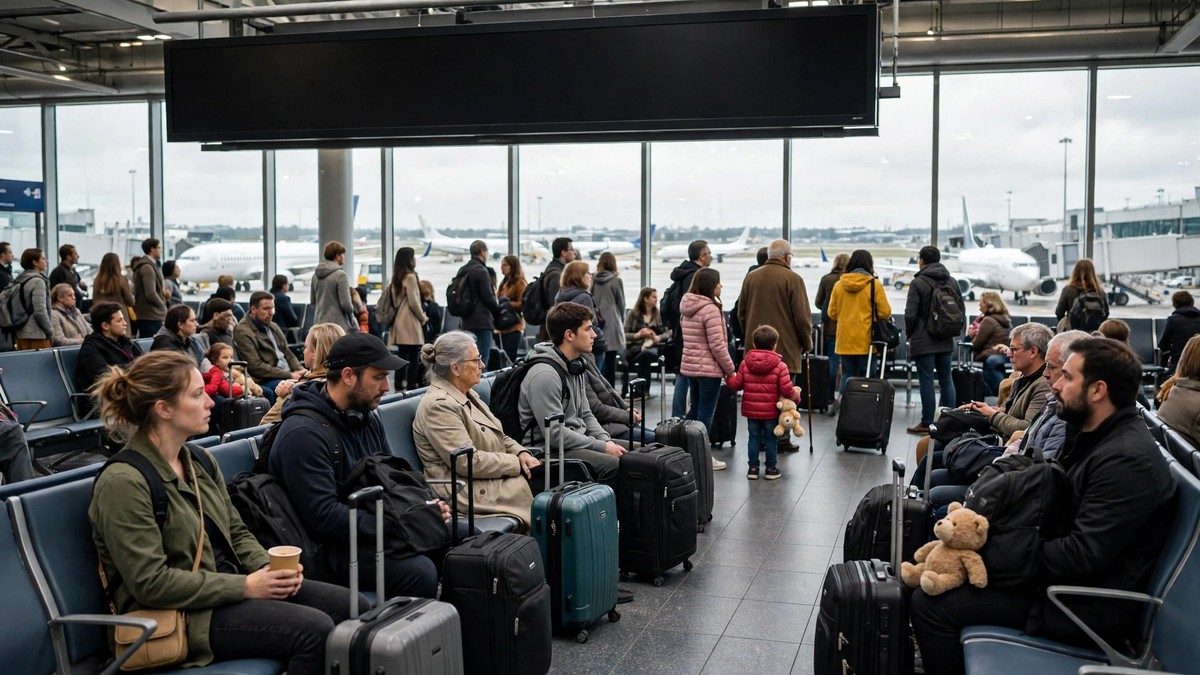
The FAA grounded every departing flight in the United States on Friday after a communications failure hit air traffic control centres nationwide, stranding thousands of passengers.
Key Points
- The FAA ordered a nationwide ground stop on Friday afternoon, halting every departing flight in the United States.
- The halt followed a communications failure affecting all of the FAA’s Air Route Traffic Control Centers, and technicians were investigating.
- More than 440 flights were cancelled and 9,000 delayed by 5 p.m. ET, according to FlightAware.
- Homeland Security Secretary Markwayne Mullin said there was no sign of a nefarious attack and called it a telecommunications outage.
- Planes already in the air were allowed to continue to their destinations, while inbound international flights were handled case by case.
What happened in the FAA ground stop
It came without warning on a Friday afternoon. At about 3:54 p.m. Eastern time, the Federal Aviation Administration ordered every departing flight in the United States to stay on the ground. The order, sent out by the agency’s Air Traffic Control System Command Center, cited “extraordinary circumstances” and “reasons of safety” and told operators that all departing traffic should remain stopped until further notice.
The cause was a failure in the systems that let controllers talk to pilots. Transportation Secretary Sean Duffy said the halt followed a communication issue affecting all of the FAA’s Air Route Traffic Control Centers, the facilities that guide aircraft at cruising altitude. He confirmed the order on X at 4:16 p.m., saying agency technicians were investigating and updates would follow. The FAA later described it as a temporary telecommunications outage and said every flight had been accounted for.
Planes that were already in the air were not ordered down. They were allowed to carry on to their destinations, and flights heading into the United States from overseas were dealt with one by one. The advisory listed an end time of 11:30 p.m. Eastern, but the order itself said “until further notice”, so that time was no promise that flying would restart by then.
The disruption built fast. FlightAware counted more than 440 flights cancelled and 9,000 delayed by 5 p.m. Eastern, only about an hour after the order. At Chicago O’Hare, controllers had already stopped traffic shortly before the nationwide order went out, after radio and radar problems were reported there. Atlanta’s Hartsfield-Jackson, the world’s busiest airport, was among those grounded, and Los Angeles International halted departures at about 1:45 p.m. Pacific time.
By early evening there were signs the halt was easing. At 5:52 p.m. Eastern, the FAA’s own live airspace status page no longer listed a nationwide ground stop, and flights were reported to be gradually resuming — but the agency had not publicly confirmed the stop was over or said when normal flying would return.
Why the FAA ground stop matters
A nationwide halt of all departures is almost unheard of. It has happened only three times in American history: after the September 11 attacks in 2001, when the system that sends safety notices to pilots failed in January 2023, and now. The 2023 halt lasted nearly two hours after contractors accidentally deleted files while updating a database. Friday’s stop was only the second since 9/11.
The scale is what makes it different from an ordinary delay. The FAA handles more than 45,000 flights a day across American airspace, around 28,000 of them commercial. When every departure stops at once, the backlog does not clear when the order lifts — aircraft and crews are in the wrong places, and the knock-on delays run into the next day.
It also lands on a system already under strain. The air traffic network has been hit by equipment failures, communications problems and a shortage of controllers while the FAA tries to replace ageing infrastructure. That background is why Friday’s failure drew instant attention in Washington, where lawmakers have been pressing the agency since the 2023 outage to stop it happening again.
Officials moved quickly to calm the most alarming theories. Homeland Security Secretary Markwayne Mullin told reporters outside the White House that the cause was a telecommunications outage, that there was no sign of a nefarious attack, and that the halt was ordered out of an abundance of caution. “This is not another 9/11,” he said. He did not rule out a cyberattack entirely, saying officials were not ruling anything out yet. He also pushed back on any link to the separate Microsoft Outlook outage this week, calling them separate issues: https://worldpulsewire.com/2026/11/13/outlook-outage-130000-reports/
One detail is still only speculation. A member of the House aviation subcommittee said the working theory was that the failure could be tied to the rollout of a new AI-assisted air traffic system, but no official has confirmed a cause, and the FAA has said only that its technicians are investigating.
What happens next
The first question is when normal flying returns. The FAA has given no restart time, and even after departures resume, Friday night’s schedule is largely lost and Saturday will be messy as airlines rebuild their timetables. Passengers due to fly are being told to check their airline’s app or website before heading to the airport.
The second question is what failed. The FAA and the Transportation Department will have to explain how a communications problem spread to every air traffic control centre in the country, and whether the outage was a single equipment failure, a cascading fault in the radio systems controllers and pilots use, or something else. Chicago’s problems began before the national order, which suggests the trouble started in one region and spread.
Congress is likely to demand answers quickly, as it did after the 2023 failure. Then, the agency said it had built a new safety-notice service from scratch and made it more resilient. Friday’s halt will test whether those promises held — and whether the country’s air traffic system can take another shock.
Travellers were not the only ones stranded by transport chaos on Friday. In New Orleans, a tanker struck a docked river cruise ship earlier in the day: https://worldpulsewire.com/2026/11/14/tanker-capsizes-river-cruise-ship-new-orleans/
Source: Reuters, Wall Street Journal, USA Today, The Times | 14 November 2026