KEY POINTS:
- US District Judge Tanya Chutkan issued a temporary restraining order late on Thursday, blocking all construction work on President Donald Trump’s 250-foot triumphal arch for 14 days.
- The ruling came within an hour of the National Capital Planning Commission’s 8-4 vote approving the project, after a hearing lasting almost nine hours.
- The order bars construction, excavation, demolition and other work at Memorial Circle while the court weighs challenges from Washington DC, Virginia, veterans and preservationists.
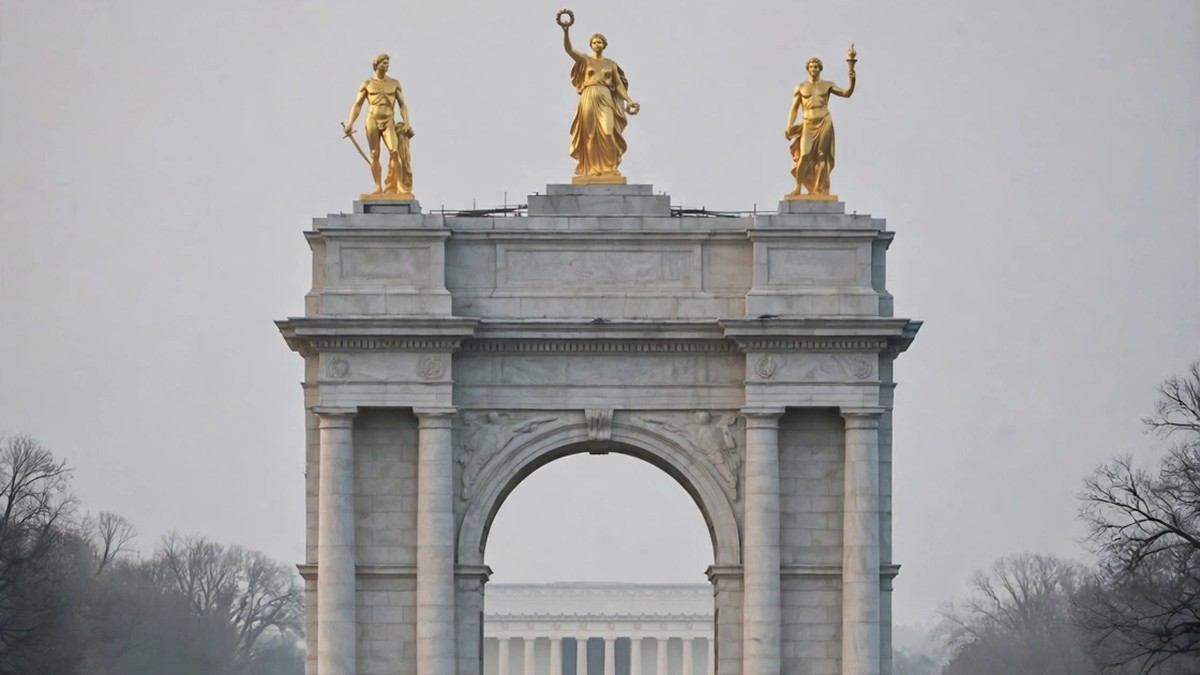
- The arch would stand 250 feet tall between the Lincoln Memorial and Arlington National Cemetery, at an estimated cost of about $100 million.
- The judge said Congress had not authorised the arch and rejected the government’s claim that it serves a national security purpose.
A federal judge has blocked construction of Donald Trump’s 250-foot triumphal arch for 14 days, halting the project within an hour of its final planning approval late on Thursday.
What happened: judge halts the arch within an hour of approval
US District Judge Tanya Chutkan issued a temporary restraining order just before midnight on Thursday, barring the Trump administration from starting any construction work on the proposed 250-foot triumphal arch for 14 days. The order came within an hour of the National Capital Planning Commission voting 8-4 to approve the project’s final plans, after a virtual hearing that ran for almost nine hours and heard more than 100 members of the public, nearly all of them opposed.
The order blocks the government from “initiating, making or otherwise effectuating” any construction-related activity at the site — including construction, excavation, demolition, land-disturbing work, utility installation and road closures — while the court considers the legal challenges against the project. The administration had said it hoped to begin work immediately after the vote, and had told the court that construction could start as early as Thursday. The judge had ordered the government to notify her within an hour of any decision by the planning commission, and she ruled shortly after receiving that notice.
The arch is planned for Memorial Circle, at the west end of Arlington Memorial Bridge, between the Lincoln Memorial and Arlington National Cemetery. It would stand 250 feet (76 metres) tall — a 166-foot stone arch topped by three gilded figures, a winged Lady Liberty at the centre flanked by golden eagles — making it taller than the Arc de Triomphe in Paris that inspired it. The structure would also include an observation deck, offices and space for about 400 visitors, and the administration has said work would run 20 hours a day, year-round, for two to three years.
Why it matters: Congress, the courts and a monument fight
The ruling is a sharp setback for one of President Trump’s most prominent projects to reshape Washington, and it turns the fight over the arch into a question for the courts. In a 33-page opinion, Judge Chutkan said Congress had not enacted any statute authorising the arch, and she rejected the government’s argument that a 1925 law gave it the power to build it. She also dismissed the administration’s claim that the arch would bring national security benefits, calling it a “belated and unsupported assertion” that did not change her analysis.
The challenges come from several directions. Washington DC and Virginia sued on 31 October to stop construction before it began, arguing the project breaks at least five federal laws, including one that generally limits buildings in the district to 130 feet — barely half the arch’s planned height. Three Vietnam War veterans and an architectural historian first sued in February, and preservation groups have joined the fight, arguing the project never received the explicit approval from Congress that the Commemorative Works Act requires for new monuments in Washington.
The timing matters politically. The White House is eager to move before a new Democrat-controlled Congress takes power in January, after Democrats swept both chambers in Tuesday’s midterm elections. Trump has said he wants the arch finished before he leaves office in January 2029, as a monument to the nation’s 250th anniversary. The Justice Department, however, has said construction would take 33 to 39 months, meaning it would not be completed until after he leaves office. The final cost is unknown, but estimates place it at about $100 million.
What happens next: two weeks of legal limbo
The 14-day order gives Judge Chutkan time to decide whether to block construction for the duration of the litigation. If she extends the freeze, the arch will wait for the courts to decide whether a president can raise a monument of this scale without Congress. If she lets the order lapse without a longer block, the administration could move to start work within days, since the planning approval is already in hand and the remaining steps — work authorisation from the Interior Department and notice from the National Park Service — have been described as formalities.
Either way, the project now faces a longer road than the White House planned. The commission’s approval was supposed to clear the last hurdle; instead, the first shovels are on hold, and the arch’s fate rests with a judge who has already signalled deep doubt about whether it can lawfully be built at all.
Sources: NPR / CNN | 6 Nov 2026. The ruling was issued late on Thursday 5 November 2026 (US time), within an hour of the planning panel’s 8-4 approval; the 14-day order remains in force.