President Donald Trump has blamed Democrats for the worst day on Wall Street since April 2025, saying the midterm election results crashed the market and hit Americans’ retirement savings.
Key points
- Trump posted on Truth Social on Thursday evening, 5 November, hours after US markets closed.
- The Dow Jones fell 1,833 points, the S&P 500 dropped 4.35% and the Nasdaq sank 5.52%.
- He wrote that Americans’ 401(k) retirement accounts had dropped, adding: “Remember, it wasn’t Republicans, it was Dumocrats.”
- Analysts said the selloff was driven by fears Democrats would tighten oversight of the AI industry and data-centre construction.
- The Nasdaq 100 fell 6.4%, its worst day since March 2020, wiping out $2.3 trillion in value.
What happened
The trading day had already ended when Trump took to Truth Social on Thursday, 5 November. Wall Street had just suffered one of its worst sessions in years. The Dow Jones Industrial Average closed at 51,522.58, down 1,833.54 points, or 3.44%. The S&P 500 ended at 7,353.80, down 334.82 points, or 4.35%. The Nasdaq Composite fell 1,421.5 points, or 5.52%, to 24,314.997 — its worst single-day percentage drop since April 2025.
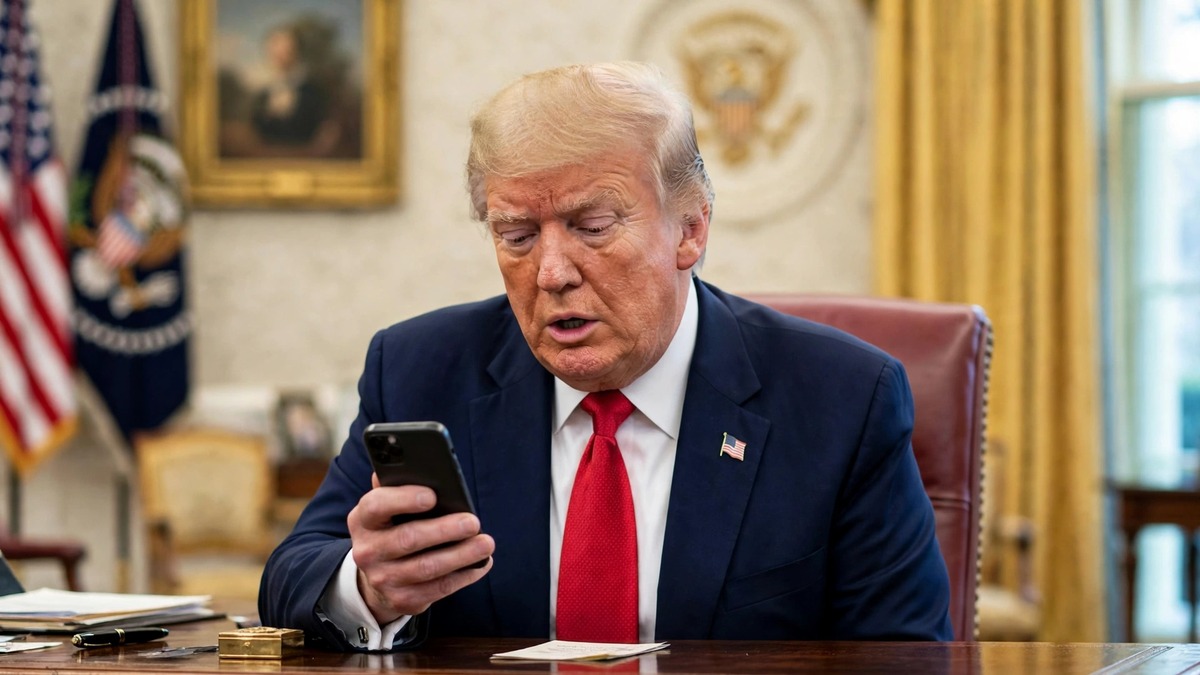
Trump linked the losses directly to the midterm elections two days earlier, when Democrats swept both chambers of Congress. “The Stock Market suffered one of the Worst Days in History based on the results of the Election. Such a sad thing to watch!” he wrote in one post. “It took so much work to get us to a level that no one has ever seen before, and then this. Your 401(k)s have, therefore, dropped. Remember, it wasn’t Republicans, it was Dumocrats.”
In a separate post he went further: “The Stock Market crashed today because the Dumocrats had a big Tuesday — So sad to see, you only have yourselves to blame!” He closed the message with reassurance of his own kind: “Do not fear, however, we will soon, one way or the other, be BIGGER AND STRONGER THAN EVER BEFORE. MAKE AMERICA GREAT AGAIN!”
The “Dumocrats” nickname was no accident. Trump used the derisive label for his opponents repeatedly at campaign rallies during the fall, and he reached for it again the moment the market turned against him.
The damage was real. The Nasdaq 100, the index of the biggest technology companies, sank 6.4% — its worst trading day since the pandemic selloff of March 2020 — erasing $2.3 trillion in value. The seven largest technology stocks, the so-called Magnificent Seven of Apple, Microsoft, Nvidia, Alphabet, Amazon, Meta and Tesla, lost more than $1 trillion in combined market value in a single session. Chip stocks were hit hardest of all: the Philadelphia Semiconductor Index fell as much as 11.2% during the day, its lowest level in more than six months, and the wider chip index ended down 12.25%. For the full market picture, see our report on the Nasdaq crash.
Why the blame game matters
Trump’s posts matter because they show how the president intends to explain the market’s verdict on his party’s defeat. Two days after the midterms, he has a story for the losses: not his policies, not the economy, but the voters and the party that won.
The problem for that story is what the market actually did — and why. Analysts attributed the selloff to fears that Democrats, now in control of the House and the Senate, would tighten oversight of the artificial intelligence industry, including the construction of data centres. That is a political fear, but it is also a financial one: investors were already questioning whether the vast sums being poured into AI infrastructure would ever pay off. Nomura Securities strategist Maki Sawada said the market could remain under pressure, while UBS estimated that about 30% of planned data-centre capacity additions in the United States by 2028 could be affected if construction projects are halted.
In other words, the selloff had a cause Trump could name — Democratic control — and a cause he could not: doubts about the AI boom itself, a boom his administration had championed. His posts named only the first.
There is also a contradiction in Trump’s own account of the week. On Tuesday night, as the results came in, he said he would accept the midterm outcome. On Wednesday, he blamed high fuel prices, stoked by his war in Iran, for the Republican wipeout — while insisting the conflict was justified. By Thursday evening, the explanation had changed again: the market crash was the Democrats’ fault. Three days, three explanations, one constant — the blame pointed anywhere but at him. For the scale of the Democratic victory behind all of this, see our report.
What happens next
The market will deliver its own verdict on Trump’s blame game when trading resumes. The deeper question is whether the AI selloff deepens. If investors keep doubting the data-centre buildout, the losses could spread beyond technology stocks, and the president’s claim that the crash is purely a Democratic creation will be harder to sustain.
Democrats, for their part, now hold both chambers and the power to set the agenda Trump says spooked the market. Any move to tighten AI oversight or slow data-centre construction will be read through the lens of Thursday’s crash — and Trump will be ready with the same message. He has already told his supporters who to blame.
For now, the numbers speak plainly: the Dow down 1,833 points, the Nasdaq down 5.52%, $2.3 trillion gone from the Nasdaq 100 in a day. Trump says the Democrats did it. The market says it was afraid of what comes next.
Source: USA Today (5 November 2026), The Hindu / Reuters (6 November 2026), Bloomberg via BusinessMirror (6 November 2026), BusinessToday (6 November 2026), Seoul Economic Daily (6 November 2026). Time: Friday, 6 November 2026, 21:30 +08.