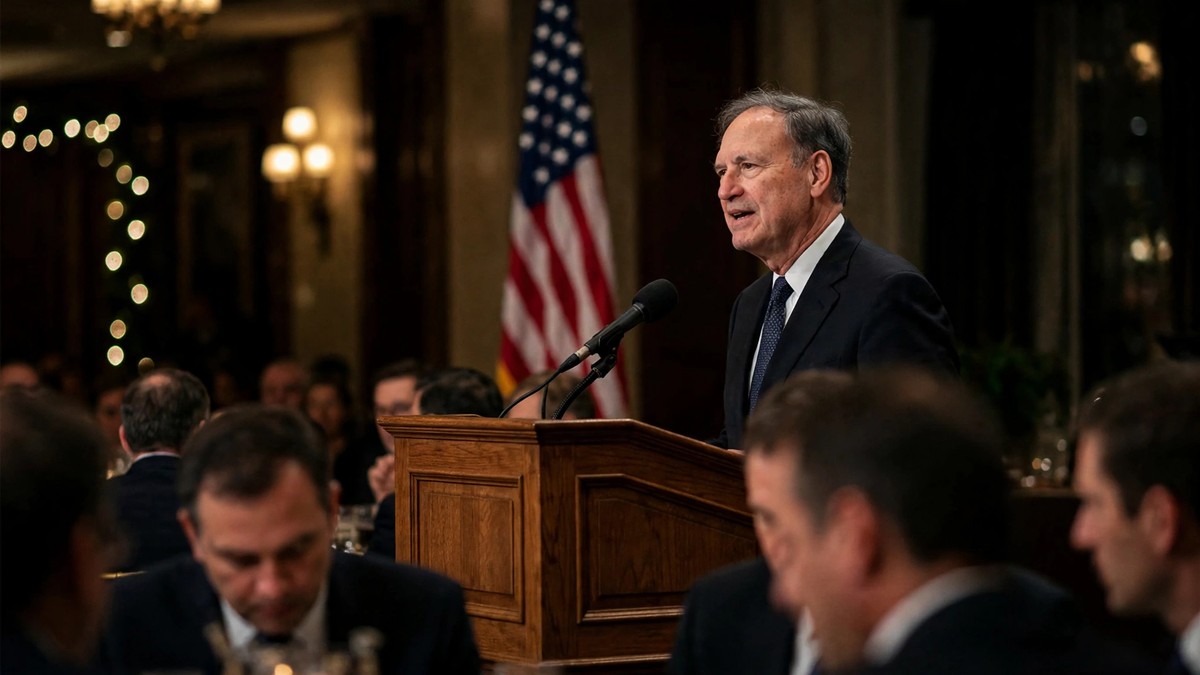
Supreme Court Justice Samuel Alito warned on Thursday that Congress could shut down the nation’s highest court by cutting its funding, in a speech defending judicial independence.
Key Points
- Justice Samuel Alito warned Congress could halt the Supreme Court by cutting its funding.
- Speaking to more than 1,000 lawyers at the Federalist Society’s Scalia Memorial Dinner in Washington on Thursday, he said lawmakers could “turn off the lights” at the court.
- Alito called the judiciary the weakest of the three branches and said its independence must be preserved.
- He also said some lower-court judges had “gone far astray” by blocking presidential actions.
- No defunding plan has been named, and the Constitution protects the justices’ own pay.
What happened at the Federalist Society dinner
Alito spoke on Thursday night to a room of more than 1,000 conservative lawyers at the Federalist Society’s annual Antonin Scalia Memorial Dinner in Washington. The dinner is named for the late justice, and Alito used it to warn that the court depends on Congress for the money it needs to keep running.
“Congress can turn off the lights at the Supreme Court and stop everything from happening if they want to defund their activities,” he said. “And there are many, many, many other things that they can do, or at least try to do.”
He tied the warning to the survival of the constitutional order. “So, it is important to preserve the independence of the judiciary,” he said. “If that is eliminated, then the Constitution as adopted in 1789 will no longer be the same.”
Alito also turned on the lower courts. He said some judges had issued orders that blocked presidential policies without good reason, and that a few had “gone far astray in abuse of their powers.” He called the judges “dedicated” and “skillful”, but added that they were “not perfect” and made mistakes. To size up the danger, he compared a hand grenade with a 500-pound bomb and a nuclear weapon, saying the grenade was the least dangerous of the three but still dangerous.
Why Alito’s warning matters
The warning comes nine days after Democrats won control of both chambers of Congress in the 3 November midterm elections. Alito did not mention the result or the incoming majorities by name, but the timing was clear: the party that has pushed hardest for changes to the court will hold the purse strings from January. Democrats have talked about expanding the court, setting term limits and imposing stricter ethics rules, and some liberal lawmakers have raised using spending power to press the court toward reform.
The Constitution gives Congress that leverage. Lawmakers vote the money that pays for the court’s staff, security, technology and building. The one thing they cannot touch is the justices’ own pay: Article III says a judge’s compensation “shall not be diminished” while they remain in office. Everything else that keeps the court running passes through appropriations.
Alito, 76, has sat on the court since 2006, after nomination by President George W. Bush. He is one of its most senior conservatives on a bench that now splits 6-3 in the conservatives’ favour. The court has faced years of pressure after rulings on abortion, presidential power and federal regulation.
This is not the first time funding has been used as leverage. In 2023 a group of Democratic senators proposed holding back $10 million in court funding until the justices adopted stricter ethics rules. The court later adopted its first formal code of conduct, though critics said it had no real enforcement teeth.
The justices have felt the pressure themselves. Over the summer, Justices Elena Kagan and Amy Coney Barrett made a rare appearance before lawmakers to argue for more money for security, as threats against judges have grown. Courts have also kept checking presidential power in recent weeks: a federal judge blocked construction of the president’s triumphal arch for 14 days.
What happens next
No lawmaker has put forward a plan to defund the court, and Alito named no proposal in his remarks. The test will come in January, when the new Democratic majorities take their seats and the next round of spending bills moves through Congress. The court’s term carries on in the meantime, with its 6-3 conservative majority intact. If funding becomes a weapon in the fight over the court’s future, the clash Alito sketched on Thursday will move from a dinner speech into the appropriations process.
Source: The Hill, NY Post | 14 November 2026