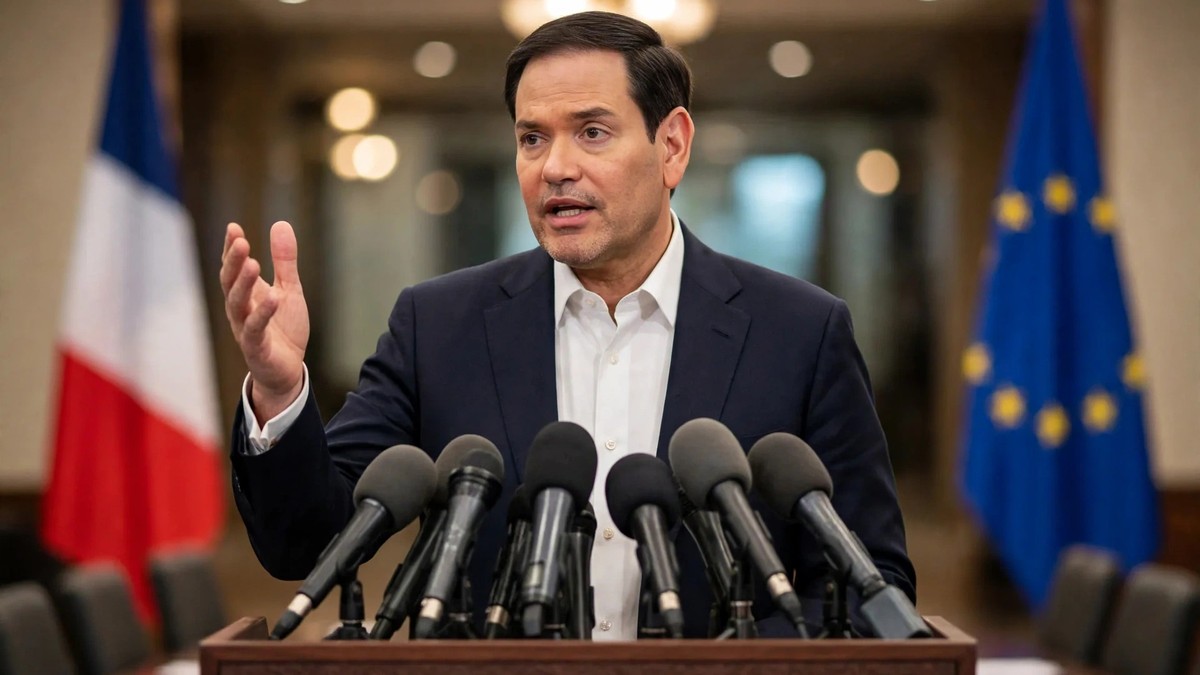
US Secretary of State Marco Rubio said in Paris on Tuesday that Washington sees no need for new major strikes on Iran, because sanctions and a naval blockade are strangling Tehran’s economy instead.
Key Points
- Rubio told G7 allies in Paris on Tuesday that the US economic campaign against Iran is “so devastating” there is no need for major combat operations for now.
- He rejected Iran’s demand for war reparations, saying Tehran should pay compensation instead, and called its conditions “absurd” and “not serious”.
- Iran’s security chief Mohsen Rezaei answered the same day that no negotiations with the US are under way at all, calling talk of talks or a Qatar meeting “complete lies”.
- Rezaei said the Strait of Hormuz will stay closed until the US meets Iran’s seven conditions, including lifting sanctions and ending the blockade of its ports.
- France’s foreign minister warned the risk of renewed strikes “has not been entirely ruled out”.
What happened
Rubio spoke to reporters in Paris on Tuesday 10 November after two days of meetings with foreign ministers from the Group of Seven. He said he had told America’s allies that President Donald Trump does not need to order major combat operations against Iran, because the pressure campaign already under way is doing the work.
“The economic campaign [against Iran] is so devastating that right now there is no need for major combat operations,” Rubio said. “That’s what I told our allies here today.”
He pushed back hard on the idea that holding back from bombing amounts to a stalemate. “The economic pain that is being inflicted on Iran right now is extraordinary and it compounds. It’s growing every day,” he said. “We don’t need to conduct military strikes if we’re achieving the same objective through economic means and economic pressure. That’s not stalemate.”
Rubio added that Iran has never before been so unable to sell its energy on world markets. He said Trump had also heard the same assessment from allies in the Middle East.
The statement came a day after Trump said he would hold off on new strikes for the time being, following appeals from countries in the region, including Qatar’s prime minister during White House talks on Monday. Trump has also said he sees “positive momentum” towards ending the eight-month war, which he described as “effectively over” in military terms.
European members of the G7 had pressed Rubio in Paris to avoid any new escalation. Britain’s Foreign Secretary Ed Miliband called for greater efforts to end the conflict, while warning of the economic damage of a continuing impasse. Qatar’s prime minister, Sheikh Mohammed bin Abdulrahman Al Thani, joined talks on the sidelines of the G7 meeting with four European foreign ministers and the Saudi foreign minister, hours after his meeting with Trump.
Why it matters
Rubio’s remarks mark the clearest public shift yet in Washington’s approach: from bombing to squeezing. The change follows a bruising midterm election for Trump’s Republicans, which the president has acknowledged was partly caused by the war and the surge in fuel prices it brought. Vice President JD Vance was blunter still, saying: “The reason we lost is the war.”
But the restraint Rubio described is conditional, not permanent. If Iran crosses lines set by Washington, he said, the US military “stands ready” to act, and Tehran would pay a “terrible price”. France’s Foreign Minister Jean-Noel Barrot, who chaired the Paris meeting, warned that the risk of a new escalation “has not been entirely ruled out”.
The other obstacle is money. Rubio used the Paris briefing to reject one of Iran’s central demands outright: compensation for war damage. “Iran is demanding reparations. They should be the ones paying reparations because they’re the ones that have destabilised the region for long periods of time,” he said. “They’re demanding pallets of cash, which the president has made clear is not going to happen.”
He described Iran’s conditions as “absurd” and “not serious”, and accused Tehran of being the “common denominator” behind instability across the Middle East, pointing to its support for Hezbollah, the Houthis and militias in Iraq. Iran rejects that characterisation. Rubio said Washington still had “options beyond war” and was not close to a breakthrough.
The mixed signals from Washington have been striking. Only days ago Trump warned that any renewed strike on Iran could be “five times bigger” than the first. Now his top diplomat is telling allies that bombing is unnecessary. For Gulf states caught in the middle, and for energy markets watching the Strait of Hormuz, the question is which version of American policy will hold.
What happens next
Tehran’s answer, delivered within hours of Rubio’s briefing, suggests the gap between the two sides is as wide as ever. Mohsen Rezaei, secretary of Iran’s Supreme National Security Council, said in a television interview that Iran is “not currently conducting any negotiations with the Americans”.
Rezaei called US claims of continuing negotiations, or of a meeting planned in Qatar, “complete lies” and “pure lies”, and said they were invented to ease economic pressure and push down oil prices. He also denied reports that he was due to meet Vice President JD Vance, describing them as “completely baseless and false”. Foreign Minister Abbas Araghchi denied the same reports, saying there were no plans for such a meeting.
Rezaei said Tehran had already sent Washington its seven conditions for ending the war, through Qatari mediators, and was still waiting for a satisfactory answer. The American response so far, he said, had been insufficient and deceptive. Until the conditions are fully implemented, he said, “the Strait of Hormuz will not be reopened”.
Those conditions include ending the war on all fronts, unfreezing Iranian assets, lifting oil sanctions, ending the US blockade of Iranian ports, and compensation for war damage. Araghchi told the IRNA news agency that “the conflict with Iran will not be resolved through military means, nor by intensifying sanctions”. President Masoud Pezeshkian said on Monday that Tehran was prepared to negotiate with dignity, but would not surrender to coercion.
The standoff keeps pressure on oil markets and on shipping through the strait, the narrow waterway through which about a fifth of the world’s petroleum liquids trade passes. Attacks on shipping there have not slowed: 37 ships were attacked in the Strait of Hormuz and surrounding waters in October, the highest monthly total since the war began, according to the Washington Institute for Near East Policy, and 10 attacks have already been recorded in November.
For now, both sides are holding their lines in public: Washington says its economic campaign makes bombing unnecessary, while Tehran says there are no talks at all and Hormuz stays shut. The next test is whether either government moves from those public red lines towards a framework both can accept — or whether the pause Rubio described gives way to the escalation Barrot warned has not been ruled out.
Sources: Reuters, AP, AFP, Gulf News, Press TV, Tasnim, Haaretz, Al Jazeera. Published 11 November 2026, 12:30 +08. All direct quotes are as reported by the outlets named; figures on shipping attacks are attributed to the Washington Institute for Near East Policy. Claims by either side that have not been confirmed by any outside source are presented as claims.