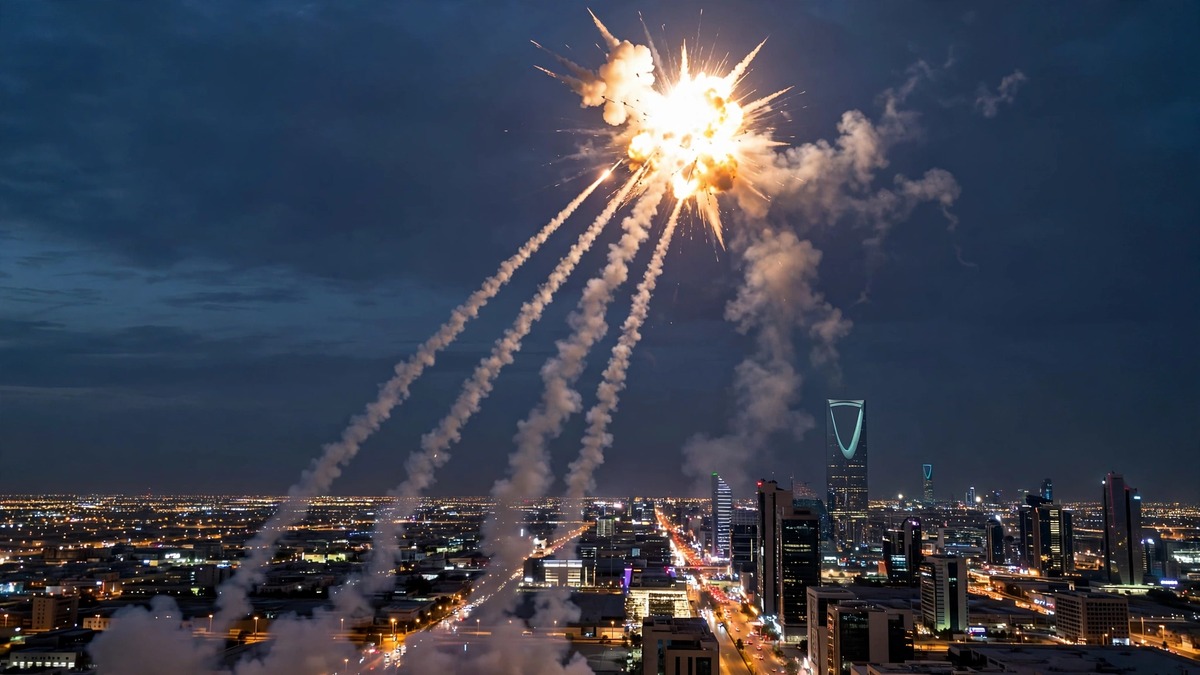
Saudi air defences intercepted two Houthi missiles fired at Riyadh on Tuesday, the Saudi-led coalition said, as schools in the capital moved online and a third missile and a drone were also downed.
Key Points
- The Saudi-led coalition said its air defences destroyed a ballistic missile and a cruise missile fired by the Houthis towards Riyadh on Tuesday.
- A third ballistic missile aimed at the southern region was also intercepted, and a drone was shot down over the Eastern Province.
- Saudi Civil Defence issued early-warning alerts in Riyadh before saying the threat had passed; schools in the capital moved to online classes as a precaution.
- No casualties or damage from Tuesday’s interceptions have been reported. The Houthis later claimed responsibility, saying they targeted Riyadh’s financial district, the airport and oil facilities.
- The attacks continue a run of Houthi strikes on Saudi cities even as Washington and Tehran talk about ending the wider war.
What happened
The Saudi-led coalition in Yemen said on Tuesday that its air defences intercepted and destroyed two missiles launched by Yemen’s Houthis towards Riyadh, amid weeks of escalating hostilities between the kingdom and the Iran-aligned group.
The coalition said its air defences destroyed a ballistic missile and a cruise missile fired at the Saudi capital. Saudi Civil Defence had earlier issued an early-warning alert for Riyadh before the coalition announced the interceptions, later saying the threat in the capital had passed.
In a separate statement, the coalition said it had also intercepted and destroyed a ballistic missile launched by the Houthis towards Saudi Arabia’s southern region. Civil defence had previously issued warning alerts for the southwestern cities of Abha and Khamis Mushait, before later saying the danger had passed.
The coalition also said a drone was intercepted and destroyed in Saudi Arabia’s Eastern Province on Tuesday, according to the Saudi Press Agency. The announcements, carried through the day by the coalition’s spokesman, Maj. Gen. Turki al-Maliki, described a night of heightened missile and drone activity aimed at the kingdom.
Schools in the Saudi capital moved to online classes as a precaution. A message sent to parents in Riyadh said classes would be held online “as part of the ongoing precautionary measures”, without saying how long the arrangement would last. Saudi Civil Defence has also urged residents to follow official instructions and avoid gathering or filming near impact sites.
Separately on Tuesday, a senior Riyadh official visited a Saudi Aramco administrative building in the capital that was damaged in a Houthi attack, the Saudi Press Agency said. The building, used for civilian purposes, sustained minor damage. Prince Mohammed bin Abdulrahman bin Abdulaziz, deputy governor of the Riyadh region, said the attack confirmed what Saudi Arabia has long maintained about the Houthis deliberately targeting civilian sites, and commended the work of civilian, military and security personnel in responding to the incident.
Why it matters
Tuesday’s launches are the latest in a run of attacks on Saudi cities in recent days. On Saturday, Saudi air defences intercepted a Houthi cruise missile fired at the Riyadh region. On Friday, the coalition said it had downed two Houthi ballistic missiles fired towards Najran province and intercepted a drone over the Mecca region. On Thursday, a missile was fired towards the Medina region.
The Houthis have stepped up strikes on Saudi airports, ports and oil facilities amid the wider US-Israeli war with Iran, while Saudi Arabia has carried out airstrikes against Houthi targets in Yemen. Fighting between the Houthis and the coalition backing Yemen’s internationally recognised government has intensified after the Houthis advanced in September towards the Bab el-Mandeb Strait, a strategic shipping chokepoint at the southern entrance to the Red Sea, across the Arabian Peninsula from the Strait of Hormuz.
The attacks also show how the war’s second front keeps moving even as diplomacy moves. President Donald Trump said on Monday, after meeting Qatar’s prime minister at the White House, that further military action against Iran “doesn’t seem to be a very necessary thing” but that the United States was “locked and loaded”. Iran’s foreign minister, Abbas Araghchi, said on Tuesday that the conflict would not be resolved through military means or by intensifying sanctions, and urged Washington to meet Tehran’s demands in a plan to reopen the Strait of Hormuz. Qatar’s prime minister joined talks on the G7 sidelines in Paris on Tuesday, hours after his meeting with Trump, to discuss the Iran crisis.
For Riyadh, the repeated alerts carry a cost beyond the interceptions themselves. Schools shifting online, flights cancelled to Saudi cities and residents told to stay away from impact sites all show a capital living under a standing threat, even when every missile is stopped in the sky.
What happens next
No casualties or damage from Tuesday’s interceptions have been reported. The Houthis later claimed responsibility for the attacks, saying they targeted Riyadh’s financial district, the airport and oil facilities.
Watch whether the pattern holds: attacks on Saudi targets have now come on four days in less than a week, and each round has been followed by coalition airstrikes on Houthi targets in Yemen. The death toll from Saturday’s airstrikes that hit homes near Yemen’s capital, Sanaa, has risen to 44, most of them women and children, according to Houthi health authorities.
The diplomatic track will also be watched. Washington and Tehran are exchanging proposals through Qatari and Pakistani mediators, and Trump’s remarks on Monday suggested no new American bombing campaign is imminent. But the missiles over Riyadh show that the fighting around the war’s edges has not stopped while the talks continue.
Source: Reuters; Gulf News; The Jerusalem Post; SANA; TRT World | 10 November 2026