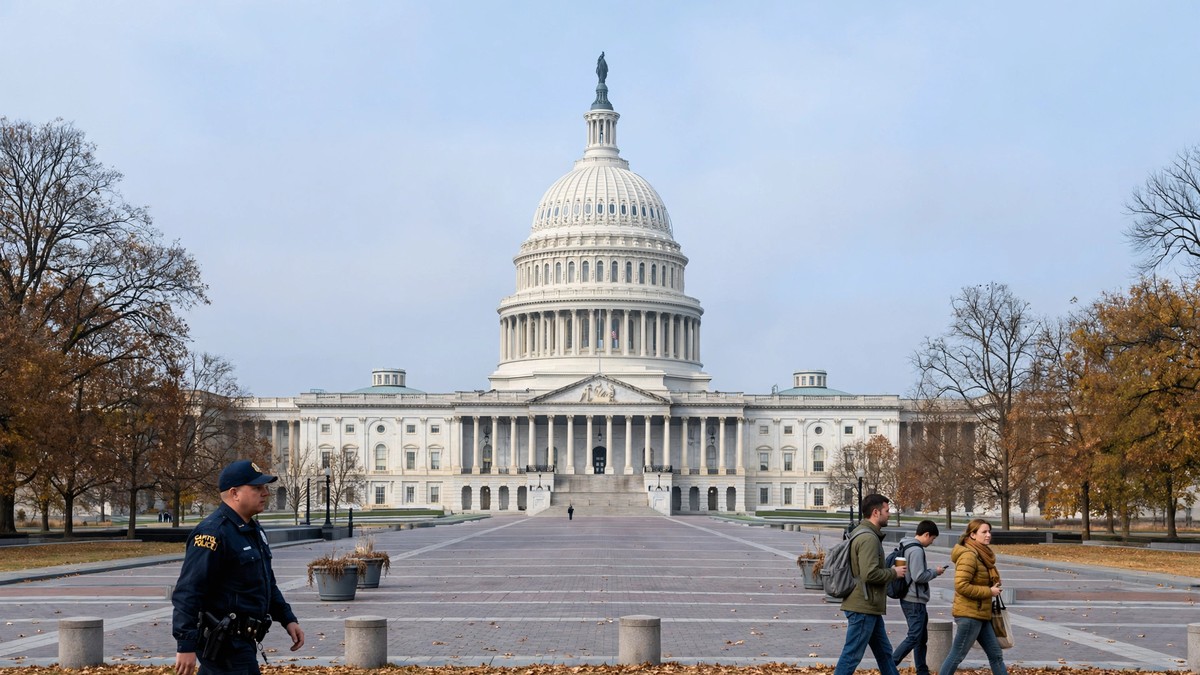
Congress returned to Washington on Monday, 9 November, for a five-week lame-duck session with federal funding due to run out on 11 December and a long list of unfinished bills.
Key Points
- Congress returned to Washington on Monday, 9 November, for the lame-duck session of the 119th Congress, with federal funding due to expire on 11 December.
- Lawmakers have 16 House session days to pass a funding bill or another stopgap, or face a shutdown before the holidays.
- The agenda also includes the annual defence policy bill, the farm bill, the debt limit and a vote on impeaching Defence Secretary Pete Hegseth.
- Democrats won control of both chambers in the 3 November midterms and take over on 3 January, leaving Republicans less than two months to finish their work.
Congress returned to Washington on Monday, 9 November, for a five-week lame-duck session with federal funding due to run out on 11 December and a long list of unfinished bills.
What happened in Washington
The House and Senate came back to the Capitol on Monday after the midterm elections, opening the final weeks of the 119th Congress. The House was due to meet at noon, with the first votes scheduled for 6.30pm, according to the majority leader’s schedule. Republicans still hold both chambers until the new Congress is sworn in on 3 January, but the Democrats who won the 3 November midterms will take over then, and both parties know the clock is running. Our earlier report on the election result is here: Democrats Clear 250 House Seats in Midterm Rout.
The most urgent item is money. The stopgap law keeping the government open, the Continuing Appropriations and Extensions Act, 2027, expires on 11 December. It was signed on 2 September after the House passed it 370 to 48 the day before, and it funds federal agencies at last year’s levels. If Congress does not pass full-year spending bills or another stopgap by then, funding lapses the next day, a Saturday. The House calendar leaves just 16 session days before the deadline: 9 to 12 November, 17 to 20 November, 30 November to 3 December, and 8 to 11 December.
There is a long way to go. The 12 regular spending bills for the 2027 fiscal year are expected to total about $1.9 trillion, but the House has passed only three of them and the Senate none. Any funding bill needs 60 votes in the Senate, so neither party can pass one alone. President Donald Trump has threatened to veto legislation that does not match his agenda, and his budget office said in August that he “strongly opposes another futile Government shutdown”.
Why the Congress funding deadline matters
A lapse in December would be the fourth funding lapse since October 2025. The country has already been through a 43-day shutdown that ended on 12 November 2025 and a 76-day shutdown of the Homeland Security Department, and a new stoppage days before Christmas would hit federal workers and services at the worst time of year. One analyst, Byron Callan of Capital Alpha Partners, put the chance of a shutdown after 11 December at 50%.
The defence budget is tangled up in the same fight. The House passed its version of the annual defence policy bill, the National Defense Authorization Act, in July, authorising more than $1 trillion in spending. The Pentagon has asked for $1.15 trillion in discretionary defence funding, $350 billion in mandatory funding through the party-line reconciliation process, and a further $67 billion to cover costs from the Iran war. None of the three has been approved. House Armed Services Committee Chairman Mike Rogers, a Republican from Alabama, said passing the authorisation bill “continues to be my highest priority, and I’m confident we can get this across the finish line.”
Complicating the defence talks is the impeachment fight over Defence Secretary Pete Hegseth. Representative Thomas Massie plans to force a House vote on articles of impeachment, and Democrats are already deeply sceptical of the Pentagon’s budget requests while the Iran war continues. Our earlier report on the impeachment move is here: Republicans Turn on Pete Hegseth After Midterm Rout.
The debt limit is also on the table. Federal debt passed $40 trillion in September, close to the $41.1 trillion ceiling set in the Republican budget law passed earlier this year. The Bipartisan Policy Center expects the Treasury to reach its maximum borrowing capacity by mid-summer, and a Bank of America estimate published on 6 November warned the United States may be unable to meet all its obligations by November 2027. Republican Senator Kevin Cramer has called for Congress to raise the limit before Republicans lose control, but Democrats may prefer to keep it as a bargaining chip for the next Congress.
The farm bill, years overdue, is another piece of unfinished business. The Senate Agriculture Committee approved its version in September without bipartisan support. Its chairman, John Boozman of Arkansas, said he hoped to reach a deal in the next few weeks, arguing that “family farmers contending with numerous challenges to their viability cannot afford another Farm Bill delay”. House Agriculture Committee Chairman Glenn Thompson of Pennsylvania called a full five-year farm bill a top priority, while the committee’s senior Democrat, Angie Craig of Minnesota, said she remained in bipartisan talks on food aid, farm conservation funding and year-round sales of petrol blended with 15% ethanol.
What happens next
The Senate is due to take its first procedural vote this week on a bipartisan permitting reform bill designed to speed up construction of public projects. House Republican leaders must also decide whether to put the Senate-approved college sports bill, which would regulate name, image and likeness deals for student athletes, to a vote before the session ends.
Senate Republicans are expected to spend much of the remaining time confirming judges and other nominees before Democrats take the Senate majority, though Senator Cramer is still blocking “any and all” of Mr Trump’s nominees in a dispute over a Biden-era wetlands rule. Behind closed doors, House Republicans will also choose their next leader after Speaker Mike Johnson said he would not seek to stay at the head of the party in the minority, setting up a contest between Republican Leader Steve Scalise of Louisiana and Judiciary Committee Chairman Jim Jordan of Ohio.
If the two parties cannot agree on full-year spending bills, the likely outcome is another short-term stopgap that pushes the funding fight into next year, when Democrats will lead the negotiations with Mr Trump. With only 16 House session days left before 11 December, and the new Congress taking over on 3 January, there is little room for delay.
Sources: CNBC, Reuters, States Newsroom, ABC News, Breaking Defense — 9 November 2026, 8:58 pm +08. All figures are the latest reported counts as of 9 November 2026. The 50% shutdown chance is one analyst’s estimate, not a forecast by any official body.