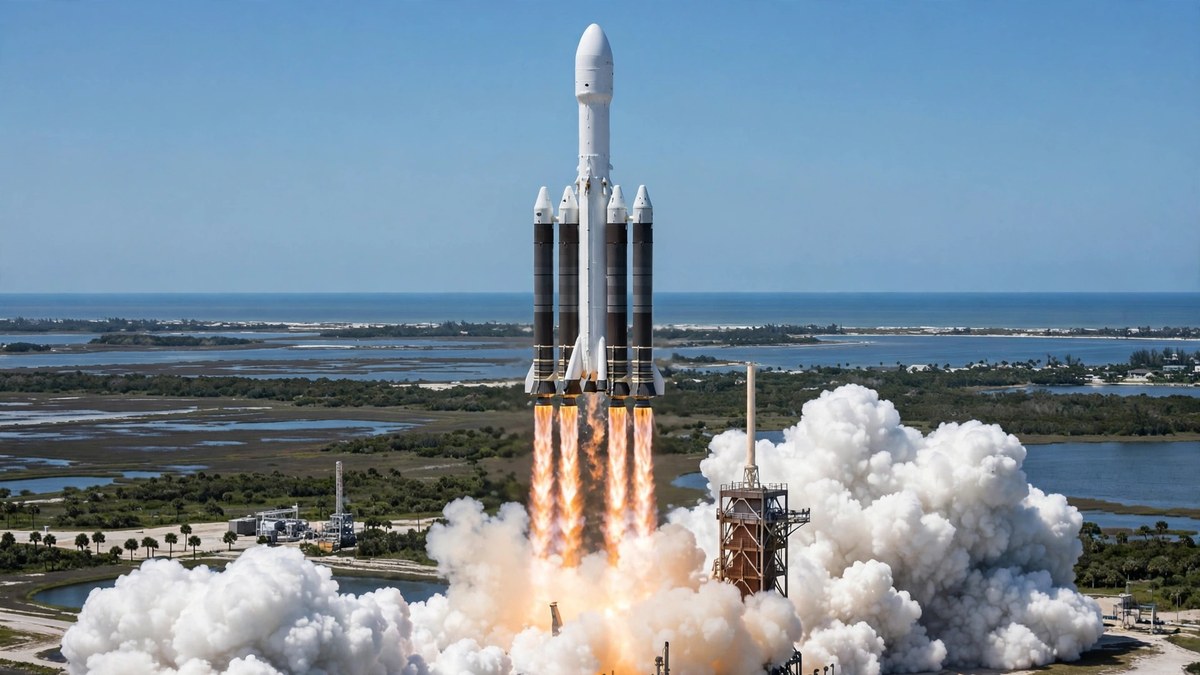
A United Launch Alliance Vulcan rocket failed about ten minutes after liftoff from Cape Canaveral on Sunday, destroying all 40 Amazon Leo satellites on board in the company’s first mission failure in 20 years.
The loss hits Amazon’s effort to build a rival to SpaceX’s Starlink network, and it grounds the only rocket Amazon had booked for most of its launches. Vulcan had already spent nine months on the ground after earlier problems, and the US Space Force had held back its own Vulcan flights until this one proved the rocket was ready. It did not.
Key Points
- A ULA Vulcan rocket failed about 10 minutes after liftoff from Cape Canaveral on Sunday 15 November.
- All 40 Amazon Leo broadband satellites on board were lost.
- It was ULA’s first outright mission failure since the company was formed in 2006.
- The cause is not yet known; ULA said the problem came during the Centaur upper stage’s burn.
- Amazon has booked 38 Vulcan launches for its Leo constellation, which is meant to rival Starlink.
What happened
The 214-foot Vulcan lifted off from Space Launch Complex 41 at Cape Canaveral Space Force Station in Florida at 12:40 p.m. local time on Sunday, at the end of its launch window.
The flight had already slipped twice. A launch attempt on Friday was called off after a fault in a gaseous nitrogen plant that serves several launch providers, and Saturday’s try was delayed by network problems between the rocket and ground systems. On Sunday, the countdown stopped at T-minus 20 seconds before controllers fixed the problem and sent the rocket up.
Six solid rocket boosters and two methane-burning BE-4 engines pushed the rocket off the pad with 3.8 million pounds of thrust. The boosters burned out and fell away about a minute and 35 seconds into the flight, and they appeared to work as planned.
Trouble showed up later. The first stage appeared to burn for longer than the pre-launch plan called for, and it separated from the Centaur upper stage later than expected. Once the Centaur’s engines took over for a burn meant to last 12 minutes and 15 seconds, the stage made unusual orientation adjustments. ULA later said the failure happened during that Centaur burn, but gave no more detail.
About 50 minutes after liftoff, ULA confirmed the mission was lost.
“Based on data received by our Launch Director, we confirm that the Vulcan vehicle launched from Space Launch Complex 41 suffered an anomaly 10 minutes into the flight and failed to deliver the Amazon mission to orbit,” the company said in a statement.
“Since the anomaly just occurred, we don’t have any specific data yet to understand what occurred today,” ULA added. “We will work closely with our customer and other appropriate organizations to find the cause, determine the appropriate corrective action and return to flight as quickly as possible.”
The 40 satellites were the largest single batch Amazon has tried to launch, and at more than 50,000 pounds they were the heaviest payload Vulcan has ever carried — the heaviest ULA has ever flown.
Why it matters
The loss ends a perfect record that had stood since Boeing and Lockheed Martin combined their launch businesses to create ULA in 2006. That record covered its Atlas and Delta rockets as well as Vulcan, which is replacing the Atlas 5.
Vulcan itself has had a troubled start. This was only its fifth flight since it debuted in January 2024, and its first in nine months. Nozzle problems on its strap-on solid boosters marred its second flight in October 2024 and its fourth flight, a Space Force mission in February this year. ULA spent months working on fixes, and its chief executive, Mark Peller, told Aviation Week before the flight that the company had found three credible causes of the nozzle problem and taken steps against all of them. The boosters appeared to work normally on Sunday. The Space Force had kept its own Vulcan launches on hold pending more analysis, and was waiting to see how this flight went.
For Amazon, the timing is bad. Leo is its low-Earth-orbit broadband network, built to compete with SpaceX’s Starlink. The company has put 398 Leo satellites in orbit across 14 earlier launches, about 12 percent of the more than 3,200 it plans. It needs 578 satellites in place before it can start initial regional service, which it aims to begin before the end of this year in the United States and Britain. Amazon must also have the full 3,232-satellite constellation in orbit by July 2029 under its US licence.
Sunday’s flight was the first of 38 Vulcan launches Amazon has bought from ULA, and the rocket was meant to carry the bulk of the constellation. Amazon has also booked 24 launches on Blue Origin’s New Glenn rocket, 24 on Europe’s Ariane 6 and 13 on SpaceX’s Falcon 9. New Glenn has been grounded since a launchpad explosion in May, which investigators traced to an oxygen valve in one of its seven BE-4 engines. The same BE-4 engine powers Vulcan’s first stage, and Blue Origin had fitted a fix to the engines on Sunday’s rocket. It is not yet clear whether the BE-4 engines had anything to do with the failure.
The gap with Starlink is already wide. SpaceX caught a returning Starship booster on Friday, and the company has announced $74 billion of AI supercomputing campuses as the space race and the AI race run together. Amazon cannot close the gap while its rockets are grounded.
What happens next
ULA has started an investigation, and Reuters reported the failure is expected to keep Vulcan grounded for months while engineers work through the data. That leaves Amazon waiting on both of its main rockets at once.
NASA Administrator Jared Isaacman offered the agency’s help on X. “The team at @NASA is available to assist in all matters related to the investigation and remediation effort,” he wrote. “Artemis, Moon Base, and the nation need ULA. We are in your corner and here to help.”
Amazon can still fly Leo satellites on the Falcon 9 rockets it has booked. But Vulcan was supposed to do most of the heavy lifting, and every month it stays grounded pushes the constellation’s schedule further back. The investigation’s findings — and how fast ULA can fix what went wrong — will decide when Amazon’s next batch of satellites gets off the ground.
Sources: Reuters, Spaceflight Now, Aviation Week, NASASpaceFlight, Business Today. Published Monday 16 November 2026.