SpaceX caught its Starship spacecraft with mechanical arms at its Texas launch site on Saturday, after 22 hours in orbit — the first time the upper stage has come back from space in one piece.
The catch closes a loop SpaceX has chased for years: a spacecraft that leaves Earth, circles the planet, and returns to the exact tower it lifted off from, ready to fly again. NASA is counting on the same vehicle to carry astronauts to the Moon, and Saturday showed the idea can work, even though the mission fell short of its full goal.
Key Points
- Ship 42 was caught by the launch tower’s mechanical arms at Starbase, Texas, on Saturday 14 November, after 14 orbits and about 22 and a half hours in space — the first catch of a Starship upper stage returning from orbit.
- The 124-metre rocket lifted off on Friday 13 November and released 26 Starlink satellites before Ship 42 kept circling Earth at about 161 miles (260 km) up.
- The Super Heavy booster did not make it back. Its own catch attempt was called off minutes after launch, and it was destroyed over the Gulf of Mexico.
- NASA welcomed the result. The agency has committed billions to Starship as the lander for its Artemis Moon missions.
What happened
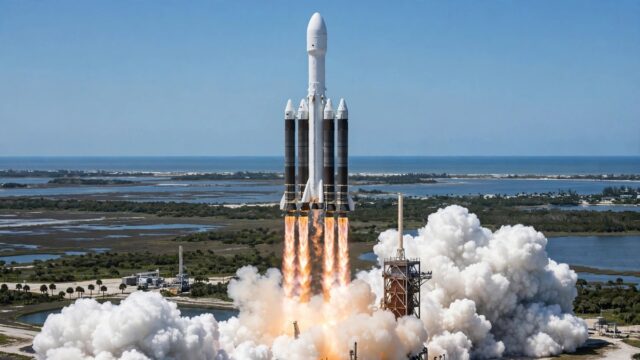
The rocket left the ground at 4:47pm local time on Friday from Pad 2 at Starbase, near Boca Chica in south Texas, with all 33 of its Raptor engines firing. The flight went ahead under a licence issued by the Federal Aviation Administration on the day of launch. Minutes later the two stages parted, and Ship 42 went on alone into orbit.
About 40 minutes into the flight, the spacecraft released 26 Starlink satellites, the newest version of SpaceX’s internet constellation. It then settled into a cruise around 161 miles (260 km) above Earth, sending live views of itself and the planet below back down through Starlink. Over the next day it circled the globe 14 times, far beyond the one or two laps managed on the previous flight in September.
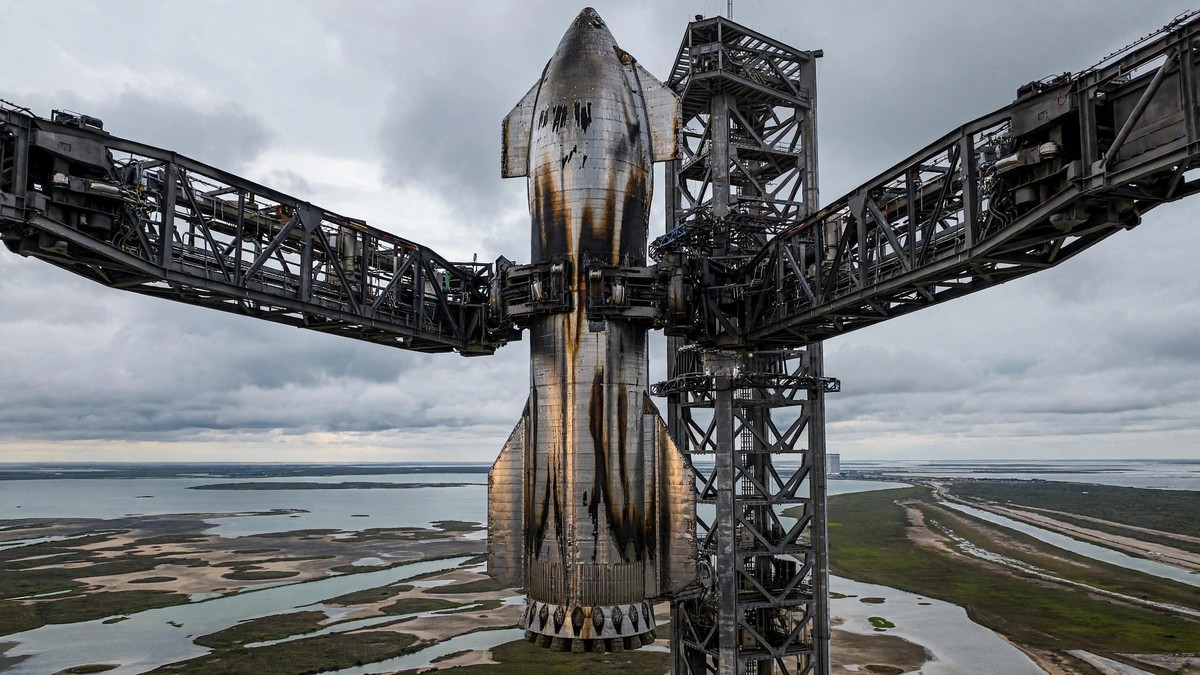
The return began on Saturday afternoon. Ship 42 fired one engine to drop out of orbit and fell back through the atmosphere at about 17,000 miles per hour, its heat shield taking the full force of the descent. Then three engines lit again to swing the craft upright, and it sank slowly through cloud toward the tower. The two mechanical arms, nicknamed chopsticks, closed around it as it hovered, and the engines cut out, leaving the scorched steel spacecraft hanging above the pad where it had launched a day earlier.
“We caught a Starship and now everything changes,” spokesman Dan Huot said on the company’s webcast. It was the fifteenth time a full-scale Starship had flown since 2023, and only the second time one had reached orbit at all.
The booster that did not come back
The plan had been bolder still: catch both halves of the rocket on the same mission, something no one has ever done. The Super Heavy booster, the lower half that carried Starship into space, was meant to fly back to the tower about six and a half minutes after liftoff. It was the first return attempt for the larger Version 3 booster.
Instead, the booster detected a guidance problem on its way back and called off its own catch. Controllers steered it out to sea. It hung over the Gulf for a few moments, then its flight-termination system fired and the booster blew apart just above the waves. Debris was left in the Gulf, ringed by marker buoys.
SpaceX has given more than one account of what went wrong. Huot said the booster aborted itself over the guidance, navigation and control issue it detected. Kate Tice, another SpaceX official, said its engines stopped firing too soon on the way back down. Elon Musk said the booster had run slightly short of fuel because its engines underperformed. No final answer on the cause has come out of SpaceX yet.
The booster has been caught three times before, most recently in March 2025, so the technique itself is proven. What Saturday did not deliver was both catches on one flight, and that remains the goal.
Why it matters
Saturday was the first time a spacecraft launched straight up, reached orbit, and came back down to the same launch site it had left. That is the heart of what SpaceX is trying to build: a rocket that flies to space and back the way a plane flies between airports, with little more than refuelling and a check-over between trips.
The Falcon 9 shows the gap. It has flown more than 700 times since 2010, and its lower stage lands and flies again. Its upper stage does not: after each flight it is dropped into the sea. Starship is designed so that neither half is thrown away.
There are still limits to how reusable the vehicle is. The shield that guards the craft against the heat of re-entry still needs work: its black hexagonal tiles cannot yet be flown again as they are, and SpaceX is testing new designs that would need little or no refurbishment after each mission. Even so, SpaceX officials said Saturday’s catch shows full reusability is within reach.
For NASA, the result carries more than engineering interest. The agency has committed billions to the vehicle as its Artemis lander, the craft meant to put astronauts back on the Moon later this decade and support a lasting base there. NASA Administrator Jared Isaacman welcomed the catch on X. Launches from Kennedy Space Center in Florida are expected to begin in the coming months, SpaceX says, and that site is where the next Artemis mission will begin.
What happens next
SpaceX had not announced a date for Flight 16 as of Saturday afternoon. The first job is the booster investigation: until engineers know why the engines stopped firing too soon, the double catch cannot be tried again.
That work has to keep pace with the Moon programme’s timetable. NASA is targeting 2027 for Artemis III, a crewed mission that will stay in orbit around Earth while its four astronauts practise docking with Starship and with Blue Origin’s Blue Moon lander. Artemis IV, targeted for 2028, would be the first Moon landing since the Apollo era more than half a century ago.
Starbase itself is growing beyond the launch site. SpaceX plans to spend more than $74 billion on two giant supercomputing campuses, including one at Starbase in Texas, in one of the largest bets yet on the machines that train artificial intelligence. The rocket that came home on Saturday and the data centres planned beside it are two halves of the same company’s next decade.
Sources: Reuters, Associated Press, BBC News, Al Jazeera. Published: 15 November 2026.