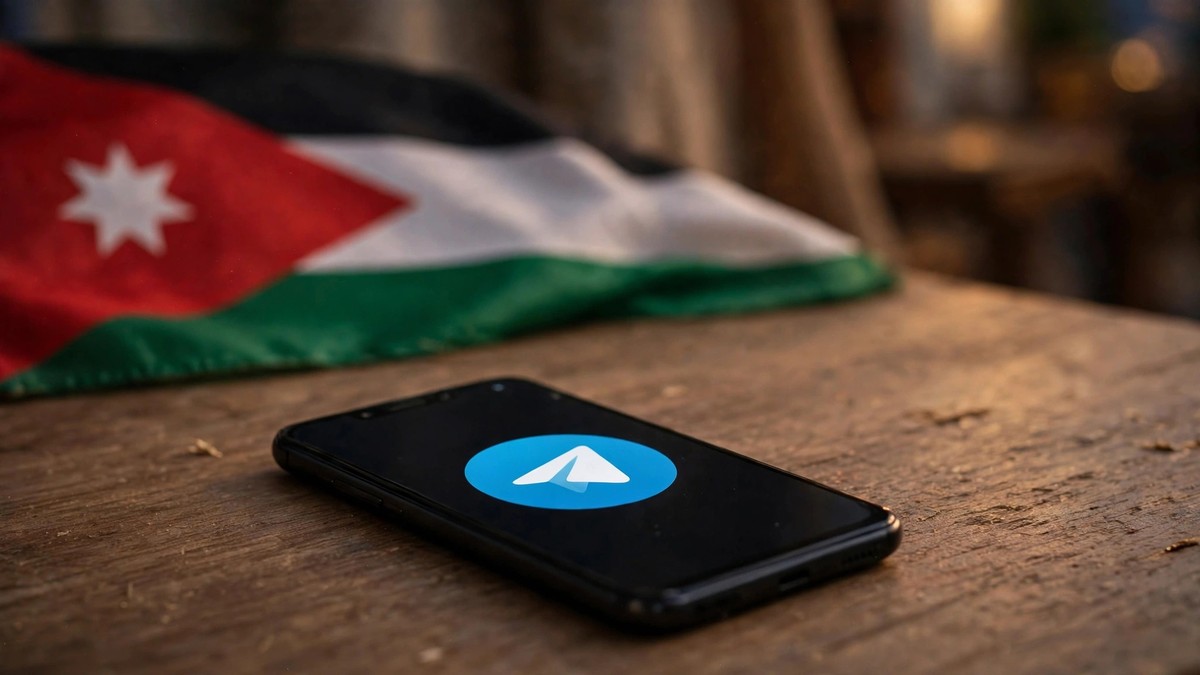
Jordan blocked the Telegram messaging app across the country on Monday, saying the platform could be used to spread extremism and threaten national security, after a deadly church attack last month.
The move came a day after a Jordanian security court sentenced three men to death for the October attack on a church in the south of the country, and it followed a second deadly attack in the capital this month. Officials did not say the app was used in either attack. The ban still puts Jordan alongside India and Russia, which both restricted Telegram this year, and it cuts off a service used by tens of millions of people across the Middle East.
Key Points
- Jordan blocked Telegram across the country on Monday 16 November, the Public Security Directorate said.
- The directorate cited cybercrime, threats, extortion and the spread of extremist content.
- The ban came a day after three men were sentenced to death for an October church attack that killed nine people.
- Telegram is used by nearly one in ten people in the Middle East.
- India and Russia both restricted Telegram earlier this year.
What happened
People in Jordan reported problems reaching Telegram on Monday, according to local outlet Roya News. The Public Security Directorate then announced that the app was blocked across the kingdom.
The directorate said the step was aimed at stopping platforms being used for cybercrime, threats and extortion, and at keeping illegal and extremist material off phones in Jordan. According to the directorate, the ban complies with the law already in force and aims to keep people safe and shield the country.
“Attempts to spread extremism and radicalisation — all of which threaten societal security and national interests — in accordance with existing legislation,” the directorate said, setting out why it had acted.
The directorate also told people to be careful on social media, to stay away from accounts and links they do not recognise, and to report illegal material through official channels. It asked parents to watch how their children use the internet and to switch on parental controls.
Telegram did not answer requests for comment from Reuters or The Jerusalem Post on Monday. An automatic reply from the company said it was committed to protecting user privacy and rights such as freedom of speech and assembly.
Why it matters
The timing ties the ban to a violent month in Jordan. On 23 October, gunmen opened fire during a funeral at St George’s Orthodox Church in Hmoud, about 80 km south of Amman. Nine Christians died in the shooting, and more than two dozen other people were hurt. It was the most serious attack on Jordan’s Christian minority since the 1950s.
On Sunday, a security court sentenced three men to death by hanging after convicting them of carrying out the attack. The three men had been arrested on 26 October after a shootout at an abandoned house in Karak. The ruling is subject to appeal and automatic review by the Court of Cassation. Two weeks after the church shooting, a former convict stabbed a police officer to death outside the Sri Lankan embassy in Amman. Another officer was wounded. Jordan called that attack terrorism.
Jordan answered the church attack with airstrikes across the border in Syria. Amman put the number of Islamic State fighters killed in those strikes at 20. Jordan later acknowledged that the strikes had also killed civilians in Syria, and the two countries agreed to form a joint security committee to review what happened.
The authorities have not said Telegram played a part in any of these attacks. But Islamic State fighters have used the app to put out statements for years, and that history sits behind the decision.
Telegram is a cloud-based messaging app built around speed and security, with chats that can be encrypted end to end and messages that can delete themselves. It was founded by Pavel Durov, who lives in exile from Russia, and is based in Dubai. The app reaches tens of millions of people across the Middle East, close to a tenth of everyone living there.
Durov has faced investigations in several countries. In July, Russia charged him with facilitating terrorist activity, saying Ukrainian spies used the app to organise attacks inside Russia. Durov denies wrongdoing and says Telegram has done more than required to remove criminal content and work with the authorities.
Not everyone agrees a full ban is the right answer. Barak Gonen, a cybersecurity expert and lecturer at the Jerusalem College of Technology, told The Jerusalem Post that blocking the whole app because it may have been used to help plan attacks was “equivalent [to] stopping all the train transportation in the country because some terrorists are known to be on a train”. He called the step legitimate but “very extreme”.
Amman works closely with Washington against extremist groups, and the kingdom is widely regarded as one of the region’s more stable countries.
The ban also fits a wider pattern this year. India temporarily blocked Telegram in June, affecting an estimated 150 million users, after saying cheating networks used it to defraud candidates and spread false claims about leaked exam papers. Russia began slowing the app in February and had blocked it fully by August.
Governments have also moved against other platforms this year. Italy fined Meta 805 million euros over photo privacy, in a case about how the company handled people’s pictures. The action against Telegram is different in kind — a full block of a service, rather than a fine — but it shows the same pressure building on the companies that run the apps people use every day.
That pressure is rising while tensions across the Middle East stay high, with Jordan caught between the war in Gaza, the conflict in Syria and the standoff between the United States and Iran.
What happens next
No end date for the block has been announced. Jordanians who relied on Telegram for news, work or family contact will need other apps while it stays down, and it is not clear whether the ban will be challenged in court.
Telegram could still respond or offer to work with Amman, as Durov has said the company cooperates with the authorities. For now the company has said nothing beyond its automatic reply.
The test will be whether the ban stays in place once the shock of the attacks fades, and whether other governments in the region follow Jordan’s lead.
Sources: Reuters, The National, The Jerusalem Post, Arab News. Published Monday 16 November 2026.