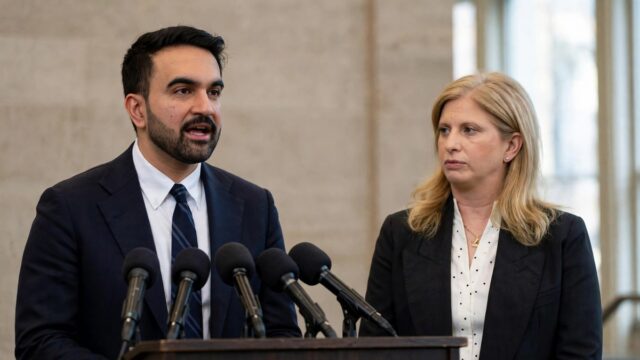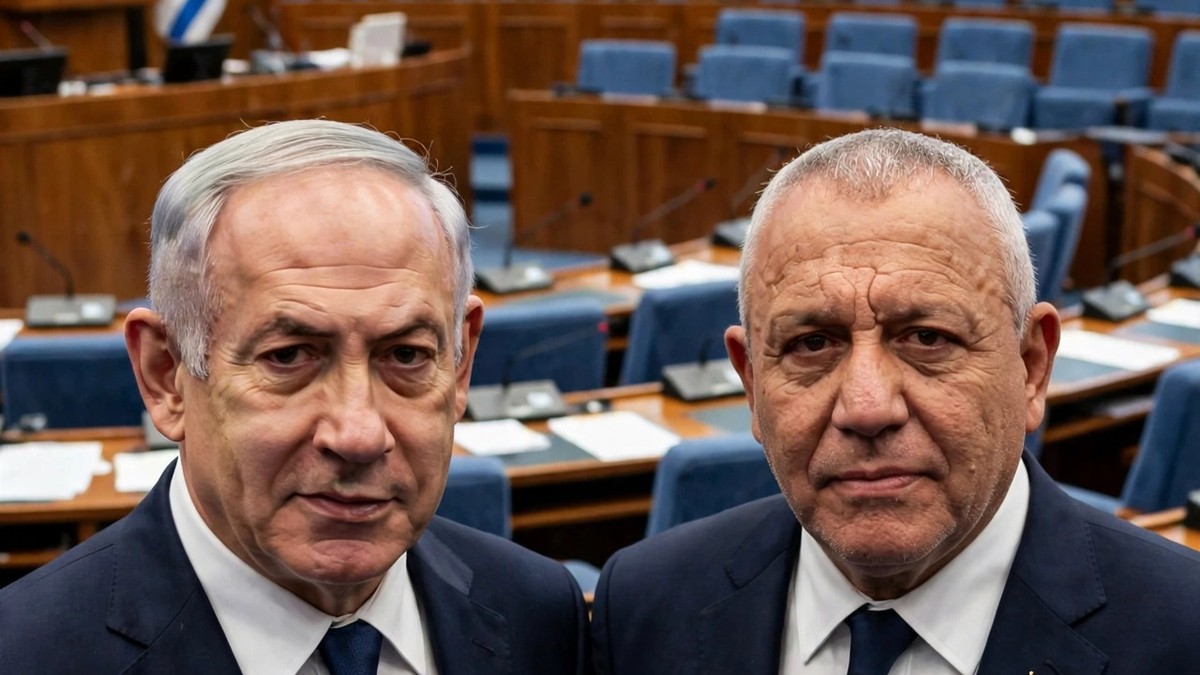
Israel’s caretaker prime minister has asked his rival to join unity government talks, warning Iran is reviving its nuclear programme. Gadi Eisenkot dismissed the appeal within minutes.
Benjamin Netanyahu wants Gadi Eisenkot in the same room, without conditions, to build a government of national unity. Eisenkot’s answer, delivered within minutes of the appeal going public on Saturday evening, was that the offer was a trick.
The exchange is the sharpest public clash yet between the two men since the election on 27 October left Israel without a clear winner. Netanyahu, who lost his parliamentary majority, is arguing that only a broad government can face the threat from Iran. Eisenkot, who holds the mandate to form the next government, says Netanyahu himself is the obstacle and must go.
Key Points
- Netanyahu asked Eisenkot on Saturday to open unity-government talks “without preconditions”.
- He said Iran is working to revive its nuclear programme and must be stopped “once and for all”.
- Eisenkot dismissed the appeal as “another spin” within minutes, saying “these tricks don’t work on me”.
- Neither bloc won a majority on 27 October: Netanyahu 53 seats, Eisenkot 48, Arab-led parties a record 19.
- Eisenkot holds the mandate to form a government, with 28 days from 8 November and a possible 14-day extension.
- The first test comes on Tuesday, when the Knesset votes on appointing Yashar lawmaker Matan Kahana as speaker.
What happened
Netanyahu released a video statement on Saturday evening, also shared on X, calling on Eisenkot to sit down and negotiate a national unity government. “Let us go into the room, without preconditions,” he said. “Put aside all disputes and all boycotts, and reach agreements for Israel’s security and future.”
The appeal came two days after the two men held a security and diplomatic briefing on Thursday that lasted more than two hours, with Netanyahu’s military secretary present. Netanyahu said that meeting had only strengthened his view that a broad government was essential. For the first time, he did not say he must lead it.
He framed the proposal as an answer to the walkout by Joint List lawmakers during the singing of the national anthem, “Hatikvah”, at the swearing-in of the new Knesset on Tuesday. Ra’am chairman Mansour Abbas and his fellow faction members stayed standing for the anthem. Netanyahu called a unity government “the government of hope” and “the necessary response to those who deliberately walked out”.
Netanyahu tied the appeal directly to Iran. He said Tehran “is once again working to renew its nuclear program” and warned it “will not hesitate to use nuclear weapons against us” if it resumed enriching uranium and speeding up weapons work. “We must remove this existential threat hanging over our heads once and for all,” he said. He pointed to Operations Rising Lion and Roaring Lion as proof that Israel had pushed the danger back before, and argued that only a broad government could finish the job. “A narrow government, or a government that relies on supporters of terrorism, will not be able to meet this enormous challenge,” he said. “But a national unity government will be able to achieve this in time, and thereby ensure Israel’s security for many years.”
He also said a unity government could settle the dispute over drafting ultra-Orthodox men into the army, working with representatives of the Haredi public. That question, the conscription of Haredi men, is one of the sharpest dividing lines in the coalition talks.
Why Netanyahu’s offer matters
The numbers explain why both men are fighting over the same ground. In the 27 October election, Netanyahu’s right-wing and religious bloc won 53 of the Knesset’s 120 seats, Eisenkot’s four-party bloc won 48, and the two Arab-led parties won a record 19. Neither side reaches the 61 needed to govern.
President Isaac Herzog gave Eisenkot the mandate to form a government last Sunday, after 67 lawmakers endorsed him against 46 for Netanyahu. For the full story on the mandate, see
Eisenkot’s preferred route was a coalition of the four Jewish-led parties in his bloc, but they hold only 48 seats, leaving him dependent on Arab-led parties or new partners. Netanyahu wants the opposite: a government of all Jewish-majority parties, leaving the Arab parties out. Eisenkot has said he is open to anyone who accepts his four principles, including Likud without Netanyahu. He has said repeatedly that Netanyahu must not remain in power and that anyone who held a central position when Hamas attacked on 7 October 2023 must step away from public life.
An unconfirmed Channel 13 report said Yashar was ready to offer Likud a place in a unity government led only by Eisenkot, with no rotation, and to find Netanyahu some other government role. “We will agree to compromises, but not on the matter of prime minister,” a senior source in Eisenkot’s orbit was quoted as saying. That plan has not been confirmed by Eisenkot’s camp.
Inside his bloc, questions also remain about former prime minister Naftali Bennett’s position on working with ultra-Orthodox parties, as Eisenkot and Yisrael Beytenu leader Avigdor Liberman remain divided over the proposed coalition framework and the compromises required on military conscription.
Netanyahu’s Iran warning also carried a detail he did not share with Eisenkot at Thursday’s meeting. Channel 12 reported that he had sent Mossad chief Roman Gofman to meet senior American officials about stopping Iran’s nuclear weapons programme. The report has not been confirmed by Netanyahu’s office. The far-right ministers in the outgoing coalition, Finance Minister Bezalel Smotrich and National Security Minister Itamar Ben-Gvir, have publicly opposed any government led by Eisenkot.
The Iran thread runs through the wider diplomacy as well. For the latest on the US position on Iran, see
What Eisenkot said back
Eisenkot answered within minutes, and his reply was blunt. He called Netanyahu’s appeal “another spin” and said: “Nice try, but these tricks don’t work on me. And they don’t work on the citizens of Israel, either.”
He accused Netanyahu of trying to obstruct the formation of a new government because he knows “there is an absolute majority” of Israelis and lawmakers opposed to him. “He claims he wants unity, but disgraces a state occasion in the Knesset and divides and incites as if there were no tomorrow,” Eisenkot said.
He pointed out that the negotiating teams of Likud and his Yashar party had already arranged to meet on Sunday, before Netanyahu spoke. He said Likud could join a government he leads only with “recognition of the principles I have laid out and a break with the extremists” — a reference to Ben-Gvir’s Otzma Yehudit party. Yashar sources told Channel 12 that nothing in Thursday’s briefing had changed their view that Netanyahu must be removed and that their bloc’s oversight of Israel’s security was urgent.
What happens next
The negotiating teams of Likud and Yashar are due to meet on Sunday. The first public test comes on Tuesday, when the Knesset votes on appointing Yashar lawmaker Matan Kahana as speaker. Eisenkot has told Likud and Religious Zionism that if they “truly want a genuine political partnership”, they must let the vote go ahead on schedule and back Kahana. The opposition bloc wants the speaker’s chair so it can control the parliamentary agenda.
From Monday, Liberman is set to chair the Knesset’s Foreign Affairs and Defense Committee, giving Eisenkot’s bloc a grip on security oversight while coalition talks continue.
A newly elected Likud lawmaker, meanwhile, pitched a tent outside the Knesset on Saturday night, saying he would stay there in the cold and rain until a unity government led by Netanyahu is formed. The tent, with a sign reading “Unity”, captured the split on the street as well as in the chamber: one side wants Netanyahu at the head of a unity government, the other says unity is possible only without him.
Sources: Times of Israel, Jerusalem Post, Al Jazeera, Haaretz, AFP (via Free Malaysia Today). Time: Sunday 15 November 2026, checked 09:05 +08 (01:05 UTC 15 Nov).