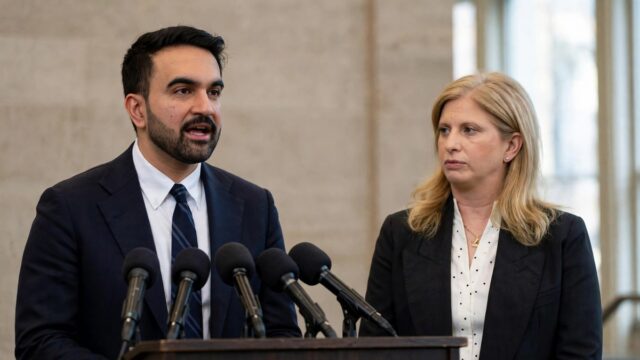
The Poindexter harassment probe opened Friday when House Democrats hired an independent firm to investigate newly elected Ohio congressman Brian Poindexter, days after he beat Rep. Max Miller by about 10 points.
Key Points
- House Democrats hired an independent firm to investigate a sexual harassment allegation against Brian Poindexter, the Democrat elected last week in Ohio’s 7th District.
- The complaint came from a campaign aide who says Poindexter made sexually harassing comments during the race; his campaign calls it an “innocuous compliment.”
- Two Democratic groups knew about the allegation before Election Day, pulled their endorsements and told the DCCC — while voters heard nothing.
- Poindexter, 47, a union ironworker and former Brook Park councilman, beat Rep. Max Miller by about 10 points on November 3.
- The woman has not been identified and the nature of the allegation has not been made public; the investigation is ongoing.
House Democrats moved Friday to investigate one of their own newest members, days after he won a seat they had just flipped.
The Democratic Congressional Campaign Committee, the party’s House campaign arm, hired an independent third-party firm to look into a complaint that Brian Poindexter, the Democrat elected last week to represent Ohio’s 7th congressional district, made sexually harassing comments to a campaign aide during the race.
Julie Merz, the committee’s executive director, confirmed the step in a statement on Friday. “The DCCC has been made aware of the allegations and takes them seriously,” Merz said. “In the interest of fairness to all parties involved, we have hired an independent, third-party firm to investigate any instance of inappropriate behavior, conduct interviews and gather the facts.”
The committee said it would have more to say once the investigation is finished. The New York Post reported that the DCCC described the probe as “swift, thorough and transparent.”
Poindexter, 47, is a union ironworker who served as a city councilman in Brook Park, a Cleveland suburb. He beat Representative Max Miller, a Republican and former Trump adviser, by about 10 percentage points in the November 3 midterm election, flipping a seat Democrats had targeted. The New York Post described Poindexter as backed by Senator Bernie Sanders.
The allegation surfaced late in the campaign but was not made public before Election Day. The woman behind it has not been identified, and neither the committee nor the advocacy group supporting her has described publicly what exactly Poindexter is accused of saying.
What is known is that the two sides describe her role differently. Poindexter’s campaign called her a volunteer. Reckoning Action, an advocacy organisation for victims of sexual misconduct that is supporting her, described her as a low-level campaign staffer. Its executive director, Cheyenne Hunt, told CNN the woman contacted her on November 1, two days before the election, and that the group was protecting her anonymity. Hunt declined to discuss the specifics of the allegation.
Poindexter’s campaign offered its own account of the incident. “Brian gave what he thought was an innocuous compliment to a volunteer,” a campaign spokesperson said in a statement. “He heard later that it made her feel uncomfortable and he felt awful.” The campaign said it immediately began working with an outside human resources firm to get to the bottom of it, adding: “Neither Brian nor the campaign ever wants anyone to feel uncomfortable.”
What happened
The sequence of who knew what, and when, is now as much a part of the story as the allegation itself.
Two political organisations that had endorsed Poindexter said in a joint statement on Friday that they learned of the allegation in the final days of the campaign. The Blue Dog PAC, which supports moderate Democrats, and the Congressional Progressive Caucus PAC said they informed the DCCC, connected the woman with legal advocacy and support services, and pulled their endorsements while the investigation runs.
“We became aware of a report of alleged sexual harassment in the final days of the campaign,” the two groups said. “We informed the D.C.C.C. and connected the individual with legal advocacy and support services so she could determine how she wanted to proceed.”
The groups said the woman had asked that no details be disclosed publicly because she did not want her identity known and wanted time to decide how to proceed while protecting herself. They said they respected that request but also felt they needed to pull their endorsements at once, pending the outcome of the investigation. “The investigation is ongoing and we await the results,” they said.
The endorsements had already vanished quietly. The Blue Dog PAC still had Poindexter’s name on its website as recently as October 28, and the Congressional Progressive Caucus PAC listed him as recently as November 1, according to internet archives cited by the New York Times. Both names were then removed without any public explanation.
Asked about the removal earlier in the week, Poindexter told Politico there was “nothing to read into” it. “Just, I’m waiting to learn the political landscape,” he said.
The DCCC said it learned of the allegation in the last several days leading up to the election. House Minority Leader Hakeem Jeffries has been made aware of the allegation, according to a person familiar with the discussions cited by CNN; his office referred questions to the campaign arm while the investigation continues.
There were other early signs of distance. A source familiar with the matter told CNN that Poindexter was not invited to the new member orientation for the Progressive Caucus, as members arrived at the Capitol for orientation this week.
Why the Poindexter harassment probe matters
The timing is what turns a personnel matter into a political problem for Democrats.
Poindexter won his race partly on the contrast with his opponent. Miller’s ex-wife, Emily Moreno — the daughter of Senator Bernie Moreno — accused Miller of physically abusing her and their young daughter during a bitter custody battle, an accusation Miller denied and which became a focal point of the campaign. Poindexter, who ran on an economic populist message and leaned into his role as a father, appearing with his daughters in an early campaign ad, presented himself as the steadier choice.
Now the party that campaigned on that contrast is investigating its own winner for the same kind of conduct, and it did so only after voters had already cast their ballots. The groups that knew about the allegation before the election chose privacy for the complainant over disclosure to voters — a defensible instinct that nonetheless leaves Democrats open to the charge that they sat on damaging information until it no longer mattered at the ballot box.
The case also lands as lawmakers debate how Capitol Hill handles sexual harassment claims. A group of Democrats is pushing for stricter conduct rules as part of a rules package for the full House next year, following a series of complaints involving other politicians earlier this year.
Poindexter’s past also drew attention during the campaign. Miller’s attacks highlighted two old arrests: a 2013 fight with another man at a baseball game, and a 1998 incident in which police arrested him when they suspected him of possessing crack cocaine. Poindexter was never charged in either incident. He told CNN in an interview in October that he never used hard drugs in his life, and that he is routinely drug tested for his job and has never failed a test.
None of that history is part of the current allegation. But it means Poindexter arrives in Washington already carrying baggage, and the harassment investigation gives his critics a fresh reason to question his judgement before he has cast a single vote.
What happens next
The independent firm’s investigation is ongoing, and no timeline has been given for its findings. The DCCC said it would comment further once the probe is complete. The two PACs said their endorsements stay withdrawn until the investigation finishes.
What the firm concludes will decide whether Poindexter takes his seat under a cloud or with the matter closed. If it finds the complaint substantiated, Democrats will face pressure to act against a member they only just helped elect — a punishment that would be politically painful and personally damaging. If it clears him, the party will still have to explain why voters learned about the allegation only after the election.
Either way, the episode has already cost Poindexter something. He flipped a Republican seat by a wide margin and should be arriving in Washington as one of his party’s success stories. Instead he arrives as the subject of an investigation, uninvited to his own caucus’s orientation, with two of his endorsers waiting on the outcome.
For Democrats, the broader question is whether the party’s handling of the case — quiet endorsements pulled, an investigation opened only after the votes were counted — becomes the template for how it deals with misconduct claims against its own winners, or a warning about what happens when it does.
Sources: New York Times; CNN; New York Post; Politico (via New York Times and CNN reporting). Published November 14, 2026.