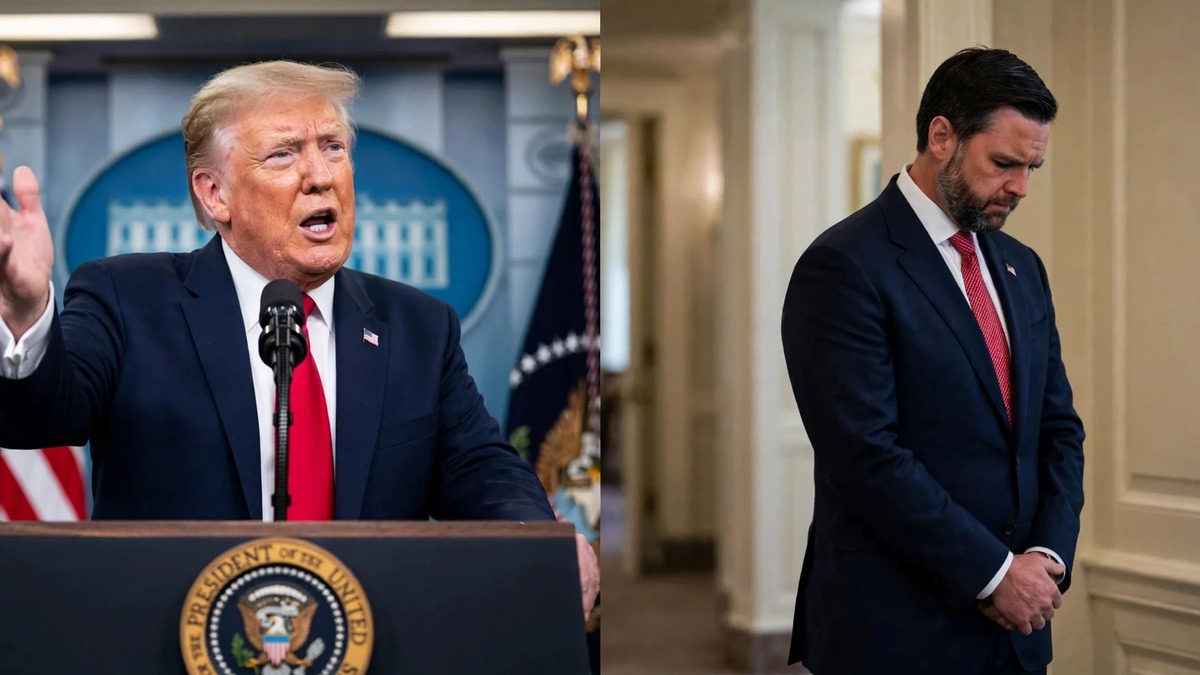
President Donald Trump has ordered Vice President JD Vance off the Iran negotiations and told him to focus instead on alleged corruption in Democrat-run cities, after Vance blamed the war for the Republicans’ midterm losses.
President Donald Trump has publicly removed Vice President JD Vance from the Iran negotiations. In a social media post on Thursday, Trump told Vance to give his “complete and total attention” to what the president described as corruption and crime in cities and states run by Democrats.
“We don’t need a deal with Iran,” Trump wrote. “Those days have long since passed. We’ve got their money, Hundreds of Billions of Dollars, and we’ve got their Strait!”
The message was a sharp public rebuke of the vice president, who had been the administration’s lead negotiator on Iran. Vance had steered talks with Iranian officials in Pakistan in April, and those contacts produced a June memorandum of understanding that paused the fighting for a short period before it fell apart within weeks.
What happened between Trump and Vance
The break came into the open the day after Vance distanced himself from the war. On Wednesday, the vice president blamed the conflict for the Republicans’ heavy defeat in last week’s midterm elections, in which Democrats took control of Congress. Writing on X, Vance challenged anyone who disagreed with him to say plainly that losing the Senate for six years had been a price worth paying.
“If you’d like to argue it was worth it, that losing the Senate for the next 6 years was worth it, then do so,” Vance wrote. “Argue it was a worthwhile cost to pay. Agree or disagree, that’s at least honest.”
Vance, long seen as sceptical of American military action overseas, had given only lukewarm support to the war after Trump launched it in February alongside Israel. He then took charge of the push to stop the fighting, running the talks through the summer. The Wall Street Journal reported on Wednesday evening that he was weighing a new round of direct talks with a senior Iranian security official, a step that would have put him at the centre of the peace process.
Trump’s post shut that down. Instead of diplomacy, the president ordered Vance to take charge of his campaign against alleged fraud in Democratic-led areas, naming Minnesota, California and Illinois among the states he called poorly run and corrupt. “Our Budget could be quickly BALANCED with the correction of this large scale criminal activity. CORRUPTION is in the Democrat Leadership’s blood!” Trump wrote.
The White House press office, asked about the post, replied by email and pointed to Trump’s own words: the president sees no need to negotiate with Iran. The vice president’s office did not respond to a request for comment.
Trump had already said earlier in the week that he believed the war “militarily is effectively over“, and that mediation led by Qatar was making progress. He also said it was unlikely he would need to carry out his earlier threats to restart full-scale bombing of Iran once the midterms were behind him.
Why the Vance sidelining matters
The public sidelining lands at a sensitive moment for both men. Vance is widely seen as a leading contender for the Republican presidential nomination in 2028, and voter anger over the war could weigh on those ambitions. Trump has not yet endorsed a successor. Asked in a “60 Minutes” interview broadcast on Sunday whether he would get involved in choosing one, the president said he “may or may not get involved” in offering an endorsement.
Democrats, who take control of Congress in January, have promised close scrutiny of Trump’s business dealings and other targets, after voters named corruption as one of their top concerns. Trump’s post was in part a response to reports about those plans, and it reframes the argument: the president is telling his own party that the fight worth having is at home, not in Tehran.
The war itself has been costly. The conflict began in February with American airstrikes, and 23 US service members have been killed. Oil shipments through the Strait of Hormuz have recovered to near prewar levels after Iran choked the waterway for months, but tankers now move only under US Navy escort, and attacks on shipping have continued. Britain’s maritime safety agency reported this week that at least two tankers were struck by projectiles in recent days near Iran, one of them in the Strait of Hormuz on Wednesday, with its crew evacuated safely and no casualties reported.
Secretary of State Marco Rubio said this week that he had pressed his counterparts at the Group of Seven talks in Paris to do more to protect shipping from Iranian attacks, but acknowledged he had made no headway.
What happens next
For now, the administration’s message is that no deal with Tehran is needed. Until this week, Trump had kept saying a deal was still on the table and the fighting would stop once the midterms were over. The November 3 vote dealt his party a bruising defeat, and the president has spent the days since blaming others for the result and threatening new tariffs on Mexico over a migrant caravan heading north.
Whether Vance accepts the new assignment quietly remains to be seen. He has said an earlier recommendation to end the war was “sound advice”, and he has not hidden his view that the conflict cost his party dearly. But the president has now made the hierarchy plain in public: the vice president’s job is the domestic anti-corruption campaign, and the Iran file is closed.
Iran, meanwhile, is still talking. Its chief negotiator and parliament speaker, Mohammad Bagher Qalibaf, told Al Jazeera that the United States had asked Russian President Vladimir Putin to help arrange direct talks with Tehran, a claim the White House did not directly answer. Qalibaf said a senior Iranian security official had travelled to Moscow to brief Putin on the negotiations, and that it was now up to Washington to respond. “If they are truly telling the truth and are sincere about negotiations, then they should respond and begin the process,” he said. “But if they want to pursue the path of war, then naturally, we are fully prepared for that as well.”
KEY POINTS:
- President Donald Trump has ordered Vice President JD Vance off the Iran negotiations and told him to focus on alleged corruption and crime in Democrat-run cities and states.
- Vance had led the talks with Iran since the summer and had just blamed the war for the Republicans’ midterm losses, including losing the Senate for six years.
- Trump wrote on social media: “We don’t need a deal with Iran. Those days have long since passed. We’ve got their money, Hundreds of Billions of Dollars, and we’ve got their Strait!”
- The Wall Street Journal reported on Wednesday that Vance was weighing face-to-face talks with a senior Iranian security official.
- Vance is seen as a leading 2028 Republican contender, and Trump has not yet endorsed a successor.
SOURCES: Associated Press, Reuters, USA TODAY, The National, The Korea Times | Thursday, 12 November 2026 (US time)