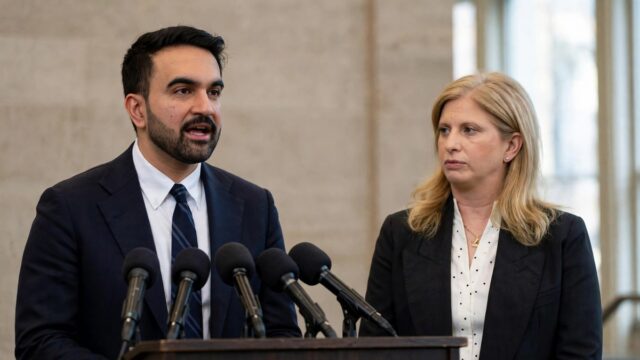
Democrat Jonathan Kreiss-Tomkins has won the Alaska governor race, beating three Republicans with more than half the first-choice votes to become the youngest governor in state history, the Associated Press said.
Key Points
- Democrat Jonathan Kreiss-Tomkins has won the Alaska governor race, the Associated Press said on Friday, taking 50.8% of first-choice votes.
- At 37, he becomes the youngest governor in Alaska’s history and the first Democrat elected to the office since 1998.
- He beat three Republicans, including Bernadette Wilson, the candidate backed by President Donald Trump. Wilson and Dave Bronson have conceded.
- Democrats will hold 30 governors’ offices across the country, up from 24, after a midterm wave that also flipped seats in Iowa, Georgia, Ohio and Texas.
- Kreiss-Tomkins will be sworn in at noon on 7 December. His lieutenant governor will be Zac Johnson, an independent.
What happened
The Associated Press called the race on Friday, more than ten days after Election Day, once counting from mail ballots and remote communities pushed Kreiss-Tomkins past half of the first-choice votes. CNN had projected him the winner the night before. With 50.8% of first-choice votes, he cleared the majority that Alaska’s ranked-choice system requires to avoid a runoff.
His nearest rival, Republican Bernadette Wilson — the candidate President Donald Trump backed — took 28.7%. Former Anchorage mayor Dave Bronson finished third with 13.7%, and Treg Taylor fourth with 7.3%. Both Wilson and Bronson conceded. “JKT was on top on election night, on top in the first round. He’s gonna be your governor,” Wilson said by phone on Friday morning.
Kreiss-Tomkins, a former state representative from Sitka, declared victory after the CNN projection. “It was a team effort every step of the way, and we always believed we could (win),” he said. He finished first in August’s open primary, ahead of fellow Democrat Tom Begich, who then withdrew to consolidate support behind him. Seventeen candidates had registered for the primary, including two Democrats, three independents and twelve Republicans.
Why the Alaska governor win matters
At 37, Kreiss-Tomkins becomes the youngest governor in Alaska’s history and the first Democrat to win the office since 1998. The last Democrat to hold it, Tony Knowles, left in 2002. He replaces Mike Dunleavy, a Republican who has governed since 2018 and could not seek a third straight term.
The result also lifts Democrats to 30 governors’ offices across the country, up from 24. It is part of a midterm wave in which the party also flipped governor’s seats in Iowa, Georgia, Ohio and Texas, according to the Associated Press — a wave that has already reshaped the balance of power in Washington, where Democrats took full control of Congress.
The race also exposed a split on the Republican side. Three Republicans shared the ballot, and party leaders urged voters to “rank the red” — to rank Wilson, Bronson and Taylor in any order. Wilson said afterwards that the approach failed: with three options to choose from, donors held back and the vote stayed divided. “Even if JKT takes it on the first round, there’s no doubt in my mind that this is a very direct result of not being able to consolidate,” she said.
Kreiss-Tomkins will govern alongside Democratic-led coalitions in both chambers of the state legislature: at least 24 members in the House, and a Senate coalition of at least 11, including eight Democrats, two Republicans and one independent. Alaska’s other marquee race, for the US Senate, was still uncalled, with Democrat Mary Peltola’s lead growing as new ballots were counted.
What happens next
Kreiss-Tomkins said he expects to name his transition team early next week, with a steady run of announcements to follow. “There’s a lot to do, and we’re excited to get to work with an obsessive, problem-solving energy,” he said on Friday. The budget, building an administration and setting a governing agenda are the three big jobs ahead, he said.
Alaska’s constitution requires the new governor to take the oath at noon on 7 December. Kreiss-Tomkins has not decided whether the ceremony will be in Anchorage, Juneau or Sitka, his hometown. His lieutenant governor will be Zac Johnson, an independent. The result stays unofficial until the state certifies it on 25 November, with preliminary final results expected on 18 November.
Sources: Associated Press, Alaska Beacon, NPR, CNN | 14 November 2026