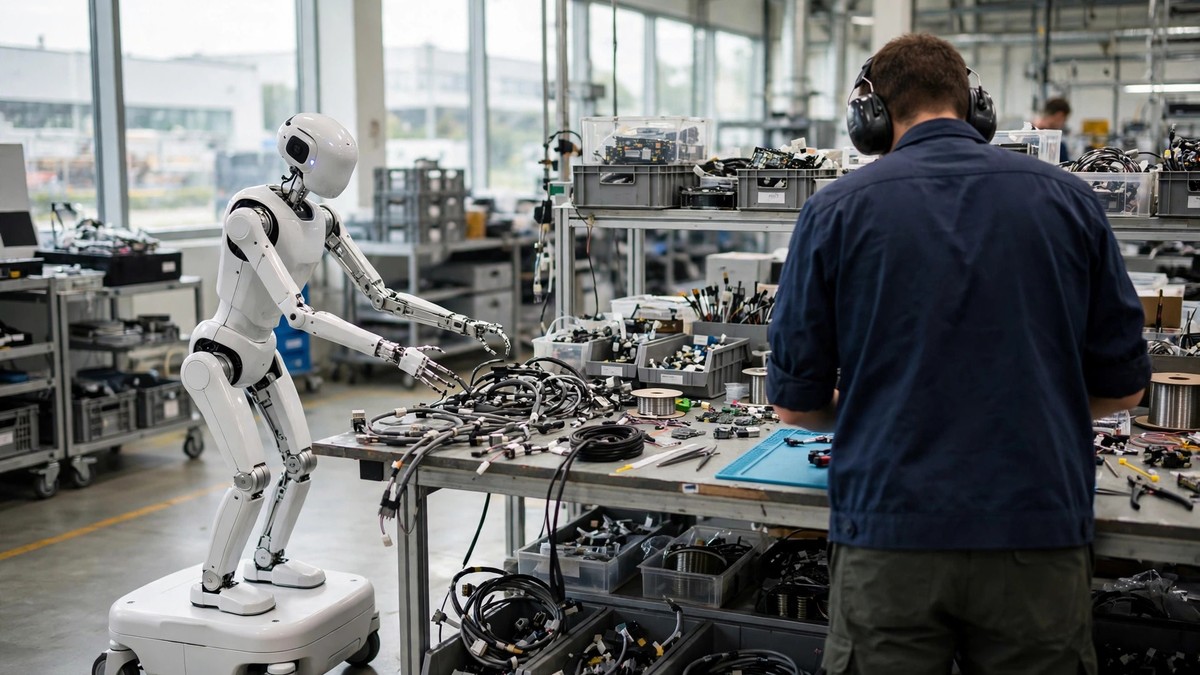
A Swiss startup says its new factory robot does not need to be programmed for every job — it watches a worker do it once, then takes over.
KEY POINTS:
- Swiss robotics company Embodied AI unveiled AIR on 6 November 2026 at Humanoid Europe 2026 in Munich, a wheeled humanoid robot built to work on factory floors beside people.
- AIR starts each job under a human operator’s control, records every run, and its AI learns the task until it can do the job itself, typically within about a month, according to the company.
- The robot uses lightweight tendon-driven arms, with motors and gearboxes in its torso, so the arms carry almost no mass and give way on contact. It is designed to the ISO/TS 15066:2016 collaborative-robot safety standard, with CE marking planned for 2027.
- Embodied AI says it built AIR in nine months, has signed contracts with major manufacturers worldwide, and is now testing the robot with them while preparing scaled production.
- In a cable-handling test for a major consumer electronics maker, the company’s AI reached 98% reliability against a 90% target, after five other funded startups failed to meet the same targets, according to Embodied AI.
Swiss robotics startup Embodied AI unveiled a wheeled humanoid robot on 6 November that learns factory jobs by watching human workers, aiming to fill manual roles that change too often for conventional machines.
What happened
AIR was shown for the first time at Humanoid Europe 2026 in Munich on Thursday, 6 November, at 16:00 Central European Time. Embodied AI, a spin-out of EPFL, the Swiss Federal Institute of Technology in Lausanne, says it went from research to a working industrial humanoid in nine months. The company, headquartered in Lausanne with an office in Rome, says it has signed contracts with major manufacturers around the world and is already testing AIR with them, while drawing up plans for larger-scale production.
The robot is built around a simple idea: make the machine safe by construction, not by software holding it back. Its arms are driven by tendons, with the motors, gearboxes and electronics housed in the torso, so the arms themselves are light and yield when they touch something. It moves on wheels rather than legs, because factory floors are flat and wheels are more stable. The design follows ISO/TS 15066:2016, the technical specification for collaborative industrial robots, and the company plans to seek CE marking in 2027.
AIR learns the way an apprentice does. It begins every new job under the control of a human operator, so it is useful from its first shift. Each run is recorded, and the company’s own AI system studies those demonstrations until the robot can carry out the task on its own — typically within about a month, the company says. The operator stays nearby to handle anything the robot has not seen before, and what one robot learns can be passed on to the next.
The company says the underlying AI is already proven in paid factory work. Its earlier two-arm industrial cell is in use in real production settings, and in a cable-handling test run by a leading consumer electronics manufacturer, Embodied AI says it reached 98% reliability against a 90% target, after five other funded startups had failed to meet the same targets. Those figures come from the company itself and have not been independently verified.
The team behind it is young. Co-founder and chief executive Francesco Stella, 28, developed the arm design during his doctorate at EPFL and previously researched at MIT CSAIL. He founded the company with chief technology officer Kai Junge and chief operating officer Max Polzin, both robotics doctorates with backgrounds at Cambridge, ETH Zurich and EPFL. The company’s first funding round was led by Faber, with TechShop, Look AI Ventures, Plug and Play and Vento joining as investors.
“Safety and reliability are non-negotiable requirements of physical AI to enter the real world at scale,” Stella said in the announcement.
Why it matters
Factories are short of people, and the shortage is forecast to grow. By 2033, the United States could be short of as many as 1.9 million manufacturing workers, according to an estimate from Deloitte and The Manufacturing Institute. At the same time, the Manufacturing Leadership Council reports that 22% of manufacturers plan to use physical AI, such as humanoid robots, within two years — more than double today’s 9%. Deloitte also found that more than 80% of factory task hours are expected to stay human-driven, which is why Embodied AI pitches AIR as a helper for workers, not a replacement for them.
The gap AIR is aimed at is specific: repetitive manual work that changes too often for a conventional robot to be worth programming. Most humanoid robots today are still demonstrations, and most industrial robots are built for heavy work and kept behind safety cages, away from the people who know the job best. A machine that can stand beside a worker, learn by watching, and take over the repetitive part is a different proposition — if the learning claim holds up in real factories.
The launch caps a busy week for AI. It follows OpenAI’s GPT-6 Cyber security model and the open-weights release of Kimi K3.1 Pro, two very different answers to the same question of what AI should be allowed to do on its own.
There are clear limits to what is known so far. No independent test of AIR itself has been published, the company has not named any customer, and there is no price or delivery date. The 98% reliability figure comes from the company’s own account of a customer test. Until named manufacturers put AIR to work and report results, the robot is a promising design with a strong backstory, not a proven product.
What happens next
Three things to watch. First, the factory trials: whether the global manufacturers now testing AIR put it into regular production use, and whether the company names them. Second, the learning claim: whether the roughly one-month path from human control to independent work holds across different tasks, or only on the cable-handling jobs the company has described. Third, the certification timetable: CE marking planned for 2027 is the gateway to selling across Europe, and any slip there would push scaled production back with it.
Sources: Business Wire, “Embodied AI Unveils AIR, a Physically Safe Humanoid Robot That Learns on the Job”, 6 November 2026; The AI Insider, “Switzerland’s Embodied AI Unveils Humanoid Robot Designed to Learn Factory Tasks From Workers”, 6 November 2026; Robotics Tomorrow, 6 November 2026. Deloitte and The Manufacturing Institute, and Manufacturing Leadership Council, figures as cited in the company’s announcement. The Stella quote is from the company’s announcement. Published: 7 November 2026, Kuala Lumpur time.