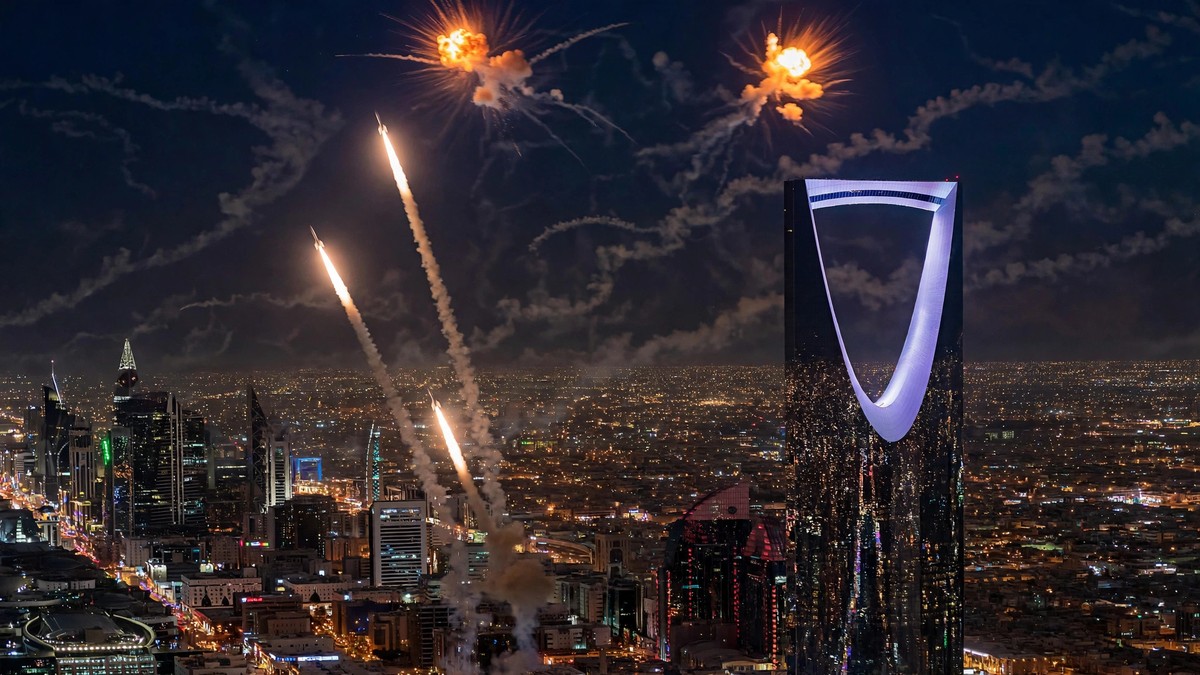
Saudi air defences intercepted nine Houthi missiles and drones aimed at Riyadh, Mecca and other regions between Wednesday night and Thursday morning, the Saudi-led coalition said.
Key Points
- Saudi air defences intercepted nine missiles and drones — two ballistic missiles, three cruise missiles and four drones — between Wednesday evening and Thursday morning.
- Debris from two of the intercepted ballistic missiles fell on Sabuhah village in the Makkah Region. No casualties or damage were reported.
- The Houthis denied aiming at Mecca and claimed strikes on Saudi oil and military sites. Saudi Arabia has not confirmed those claims.
- It was the second day in a row that missiles aimed at Riyadh were shot down, as fighting between the two sides has intensified since September.
What happened
The barrage began on Wednesday evening, when the coalition said its air defences shot down three cruise missiles heading for the Riyadh region. Later that evening, two drones aimed at Mecca and the southern regions were intercepted. Late on Wednesday night, two ballistic missiles fired towards the western part of the country were brought down.
Early on Thursday, Saudi civil defence said debris from the two intercepted ballistic missiles had fallen on Sabuhah village in the Makkah Region. Teams were sent to the area after the wreckage came down. Around the same time, another drone was intercepted over the Eastern Province, and on Thursday morning the coalition said a further drone had been shot down over the Riyadh region. In total, nine missiles and drones were destroyed across the two days.
Saudi civil defence issued alerts on Wednesday warning of possible danger in the cities of Taif, Yanbu and Khamis Mushait, before announcing later that the danger had passed, according to state television. The coalition’s statements gave no details of any casualties or damage from the interceptions.
The Houthis gave a different account of the night. Their military spokesman, Yahya Saree, denied that the group had targeted Mecca with a drone, saying its operations were aimed at oil facilities and military bases. He said the group had fired three cruise missiles at King Khalid International Airport in Riyadh and attacked a pumping station in Yanbu, a key oil hub on the Red Sea coast. The Houthis also claimed strikes on an Aramco facility in Riyadh, the Khamis Mushait airbase, the East-West pipeline and Sharurah Airport. Saudi Arabia has not confirmed any of those claims, and Saree dismissed the Saudi account of missiles over Mecca as a grave falsehood.
Wednesday’s interceptions were the second in as many days. On Tuesday, the coalition said its air defences had downed a ballistic missile and a cruise missile aimed at Riyadh. The Houthis, who control most of the populous parts of Yemen, say they are responding to Saudi attacks in Yemen.
Why it matters
The geography of the attacks is what makes them stand out. Mecca is the holiest city in Islam and the focus of the annual hajj pilgrimage, which millions of Muslims undertake each year. Any weapon aimed at the city carries a weight far beyond its military effect, and the Houthis have been careful to deny that they target it. The coalition, for its part, has made the Mecca claim central to its account of the night — a sign of how much the holy city matters in the contest over who is seen as the aggressor.
Riyadh, the capital, has now been targeted on consecutive days, and the Houthis have widened their sights to oil infrastructure as well. A Houthi attack on Sunday damaged an Aramco tower in Riyadh’s financial district, and the group says it is striking pumping stations and pipelines. Last month, a Houthi attack on King Khalid International Airport killed 13 people and wounded more than 300 — a reminder that not every missile is stopped.
The fighting has been building since September, when the Houthis advanced towards the Bab el-Mandeb Strait, the narrow shipping chokepoint at the southern entrance to the Red Sea. Since then, the group has stepped up strikes on Saudi airports, ports and oil facilities, while Saudi Arabia has ramped up airstrikes on Houthi targets in Yemen. A Saudi pipeline was also hit near Medina earlier this month, in an attack the Houthis claimed as part of the same campaign.
What happens next
Nothing in the statements from either side suggests the exchanges are about to stop. The Houthis have kept up their attacks for two months despite Saudi airstrikes on their positions in Yemen, and the coalition has shown it will keep announcing each interception as it happens. The pattern of the last two days — missiles at the capital one night, a wider barrage the next — points to more of the same in the coming days.
Attention will now turn to whether any of the Houthis’ latest claims can be confirmed. Saudi Arabia has not commented on the claimed strikes on Aramco facilities, the East-West pipeline or the Khamis Mushait airbase, and the gap between the two sides’ accounts of the night is wide. Any confirmed damage to oil infrastructure would raise the stakes well beyond a night of interceptions, and it would put fresh pressure on a region already watching the wider war between the United States, Israel and Iran.
For people living in the cities named in the alerts, the immediate question is simpler: whether the sirens and warnings become a nightly event. Taif, Yanbu and Khamis Mushait were all put on alert on Wednesday and stood down the same night. If the barrages continue at this pace, civil defence warnings in those cities are likely to become a regular part of life.
Source: Saudi Gazette, Reuters, Al Jazeera, Associated Press | 13 Nov 2026, 06:33 +08