Iranian President Masoud Pezeshkian has accused the United States of pursuing ‘diplomacy through threats’ by invoking the ‘mother of all bombs’, as Tehran’s military chief warned of deadlier retaliation.
Key Points
- Pezeshkian, writing on X from the COP31 climate summit in Antalya on Wednesday, accused Washington of waging war in the name of stopping Iran’s nuclear programme, then using a new missile at Lamerd and now invoking the MOAB to press Tehran.
- He pointed to the February 28 strike on a sports hall in Lamerd, where the conflict monitor Airwars found at least 21 civilians were killed; the US military denies striking the city.
- US media reported in mid-October that Pentagon planners had drawn up options involving the GBU-43/B MOAB, the largest non-nuclear bomb in the US arsenal, against Iranian energy and nuclear sites; the reports have not been confirmed.
- Hours earlier, armed forces chief Ali Abdollahi warned the US and Israel would face “far more deadly blows” if they attacked Iran again, and said missile and drone production would continue underground.
- Iran has also written to the United Nations and the IAEA over a US offer of up to $20 million for information on its nuclear programme, saying it invites attacks on its scientists.
What happened
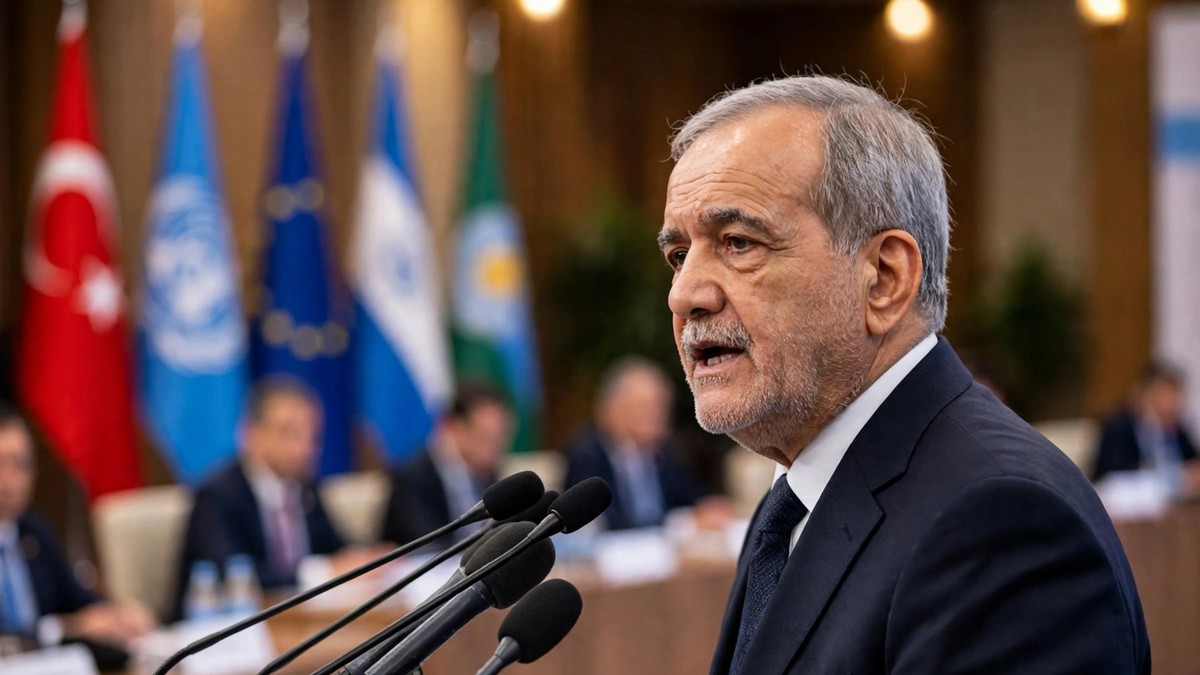
Pezeshkian arrived in Turkiye on Wednesday to attend the COP31 climate summit in the resort city of Antalya. Before addressing world leaders, he posted on X: “They waged war, claiming to stop Iran acquiring nuclear weapons. Then they used the PrSM missile in Lamerd for the first time. Now they invoke the ‘Mother of All Bombs’ to pursue diplomacy through threats. No contradiction, but a disgrace. Who threatens global peace and security?”
The president was referring to two separate episodes. The first was the opening day of the war, February 28, when missiles struck the southern Iranian city of Lamerd. An investigation by the conflict monitor Airwars, corroborated by the Associated Press, found that three missiles detonated above the Shahid Naimi Sports Hall and two residential neighbourhoods, killing civilians as far as 50 metres from the blast points and damaging buildings much further away. Iranian officials said at least 21 civilians, including seven children, were killed. Six weapons experts consulted by the Associated Press concluded the fragmentation pattern matched Lockheed Martin’s Precision Strike Missile, or PrSM. The US military has confirmed firing PrSMs into Iran, but its Central Command denies striking Lamerd and says the video cited in media accounts looks consistent with an Iranian cruise missile.
The second episode is a series of US media reports from mid-October that American military planners had prepared strike options involving the GBU-43/B Massive Ordnance Air Blast, known as the MOAB or the “mother of all bombs”, against Iranian energy infrastructure and nuclear sites, including the underground facility at Pickaxe Mountain. The 21,600-pound weapon is the largest conventional bomb in the US arsenal, but military experts quoted in the reporting doubted it could destroy deeply buried sites, because it is an air-burst weapon rather than a bunker-buster like the 30,000-pound GBU-57 penetrator. President Donald Trump, asked about the weapon in a Newsmax interview, said it was “not nuclear” and “just an extremely large bomb”, and ruled out using nuclear weapons against Iran. He did not confirm any order to deploy the MOAB, and the reporting on the strike options has not been confirmed by any other source.
Pezeshkian said he would use the COP31 summit to highlight what he described as US and Israeli crimes against Iran’s environment.
Hours before Pezeshkian posted, the chief of staff of Iran’s armed forces, Ali Abdollahi, issued his own warning. He said the US and Israel would face “far more deadly blows” if they attacked Iran again, and threatened that any location judged to pose a threat to Iran’s survival would become “the direct target of asymmetric operations”. He said the war had shown “the failure of the sophisticated Western defence equipment against Iranian will and technology”, and claimed Iran’s missile and drone industries could keep producing “even under heavy enemy fire and bombardment”, with production lines deep underground and in tunnels.
Tehran also moved on a separate front on Wednesday. Foreign Minister Abbas Araghchi wrote to the United Nations and the International Atomic Energy Agency seeking condemnation of a US offer of up to $20 million for information on Iran’s nuclear programme, saying the move “risks encouraging espionage and the targeting of nuclear scientists and technical personnel”. Araghchi said demands for inspection of Iran’s nuclear programme could not be met while its sites and personnel were “exposed to acts of assassination, sabotage and aggression”.
The exchange came a day after Secretary of State Marco Rubio said in Paris that he saw no need for major combat operations against Iran because the economic campaign against Tehran was “so devastating”. Araghchi answered on Wednesday by calling Rubio’s remark that Iranians would eventually have to eat “drivel”. Iran’s army also said on Wednesday that an oil tanker had caught fire in the eastern part of the Strait of Hormuz after hitting a naval mine in a restricted area.
Why it matters
The war of words is escalating even as both sides talk about diplomacy. Pezeshkian’s post turns the MOAB reports into a symbol of what Tehran calls American hypocrisy: a war launched to stop a bomb, fought with a new missile, and now pressed with talk of the biggest conventional bomb of all. Abdollahi’s warning, delivered the same morning, signals that Iran’s military is preparing for a longer fight rather than a settlement, with underground production presented as proof that bombing cannot end the programme. The dispute over the $20 million reward shows the nuclear file remains the hardest obstacle: Tehran says it cannot open its sites to inspectors while its scientists are being targeted, and Washington shows no sign of dropping its demands. With the Strait of Hormuz still closed and Iran’s seven conditions for reopening it unmet, the standoff is drifting toward a longer, costlier phase rather than a quick deal.
What happens next
Pezeshkian is due to address COP31 leaders in Antalya, where he is expected to press his case against the US and Israel in front of a global audience. Mediation led by Qatar and Pakistan continues, with Tehran saying it is reviewing the latest American text relayed through Pakistan while demanding a more realistic approach from Trump. The US president has said new strikes are unnecessary “at this point” but that American forces remain “locked and loaded” and the naval blockade of Iranian ports stays in place. Whether the threats harden into a deal or into another round of strikes will depend on whether either side moves first on the conditions Tehran has set for reopening the strait.
Sources: Al Jazeera, IRNA, Dawn, Gulf News, Associated Press, CNN, CBS News.
Time: 11 Nov 2026.