Spanish workers walked out on Wednesday 11 November in the country’s first general strike in 14 years, protesting a housing crisis that has pushed rents to nearly a young worker’s whole monthly pay.
Key Points
- Spain held its first general strike in 14 years on Wednesday 11 November, called by the country’s two biggest unions, UGT and CCOO, over the housing crisis.
- The unions reported early stoppages of 90% at ports and in car plants, 85% in meat processing, 82% in waste collection and 75% in energy.
- Spain is short about 750,000 homes, a gap the central bank expects to pass one million by 2028, while average rent of €1,176 eats almost all of a young worker’s monthly pay.
- The walkout comes 18 days before a snap general election on 29 November, with housing now the central issue of the campaign.
What happened in Spain’s general strike
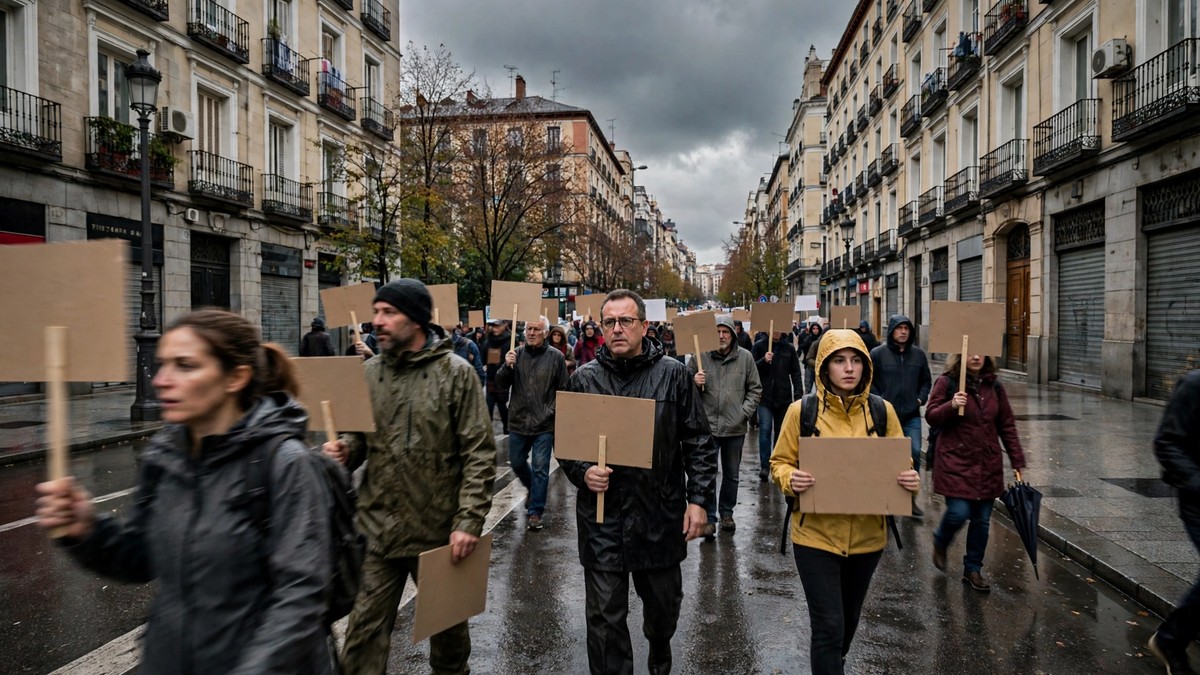
The 24-hour walkout began at midnight, with picket lines forming in stormy weather as two storms, Charles and Bruna, swept the country. The weather agency AEMET issued alerts for 14 regions over strong winds, heavy rain and rough seas.
In Madrid, demonstrators dragged large recycling bins into the streets to block traffic. About 1,000 protesters gathered at the Mercamadrid wholesale market, where the CCOO union said police fired pepper spray and arrested one picket, leaving 13 people needing medical attention. Police confirmed the arrest but not the pepper spray, saying it was used to disperse a separate picket in the Carabanchel district.
In Barcelona, many shops closed and boarded up ahead of expected unrest. The city’s metro ran no trains outside peak commuting hours, while Madrid’s metro cut service by half for most of the day, rising to 80% of normal service at peak times.
The unions said production stopped completely at Volkswagen’s plant in Navarre and SEAT’s in Barcelona, and pointed to a 10% fall in electricity demand as a sign of disruption across energy-hungry industries. The employers’ lobby CEOE said the power drop was smaller than the 14% seen in the last general strike. Its vice-president, Ángela de Miguel, called the walkout counterproductive, arguing the answer was to build more homes and cut taxes on building and buying. She said taxes had pushed up the final price of a new home by 40% in a decade.
The strike follows weeks of demonstrations and encampments set off by the eviction and later death of Maricarmen Abascal, an 87-year-old woman in Madrid. Parliament rejected government decrees aimed at curbing evictions and easing rent pressure last month, and Prime Minister Pedro Sánchez then called the snap election.
The strikers’ slogan is “Salaries. Housing. Prices.” Housing activists want tourist apartments ended, a crackdown on property speculation and automatic lease renewals for tenants. The CCOO is calling for at least 1.5 million price-controlled homes to be built in the coming years.
Jesús González, a 36-year-old hospital IT worker in Madrid who supports the strike, told Reuters: “I’m 36 years old and I still can’t move out on my own… Rents just keep going up, house prices just keep going up, and it’s simply impossible.”
Why it matters
Housing has become the defining issue of the election campaign. Sánchez hopes anger over rents will shift the debate away from corruption cases around his inner circle and a deadly train crash last month, but his Socialist Party still trails in the polls.
The average rent in Spain has almost doubled in 10 years, according to AP. At €1,176 a month, it equals about 98.7% of a young person’s average monthly salary, the Youth Council of Spain says — leaving almost nothing for anything else.
The government blames right-wing parties running many regions and town halls for rising rents and too little building. Union leaders and protesters say the central government shares the blame — and point to Spain’s second fatal train crash this year as well.
The conservative Popular Party, which leads in the polls, and the far-right Vox party have dismissed the strike as a political stunt. Popular Party spokesperson Miguel Tellado called it “an electoral strike”. Analyst Oriol Bartomeus told AP the strike is a chance for Sánchez’s Socialists and the other left parties he needs to stay in power — but any unrest could hand the right a law-and-order argument.
The walkout hit the eurozone’s fourth-largest economy: transport delays, shuttered shops and slowed factories across the country.
What happens next
Large protest marches were planned for the afternoon in Madrid and Barcelona, though the storms threatened turnout. Unions will publish final participation figures; employers have already described the turnout as weak, and Madrid’s metro said 93% of trains ran at 8am even as passenger numbers fell by half.
The election on 29 November will decide whether Sánchez stays in office. He needs the support of other left parties to keep governing, and the strike’s success — or failure — will shape the final weeks of the campaign. Spain is not the only country where voters face a tight race — New Zealand’s general election is also too close to call.
Whatever the result, the housing numbers behind the protest are not going away: a 750,000-home shortfall, rents near a young worker’s full salary, and a central bank warning the gap will pass one million by 2028.
Source: Reuters, AP, Le Temps | 11 Nov 2026