Key Points
- National and Labour both finished on 29.3% of the party vote, separated by fewer than 900 votes, with nearly all regular votes counted.
- The governing right bloc holds 67 seats in a 130-seat parliament — a majority of one — but about 300,000 special votes are still to count.
- The centrist Opportunity Party enters parliament for the first time with seven seats and could decide the next government.
- Prime Minister Christopher Luxon says National has a pathway to govern but admits the result is too close to call; official results come on 27 November.
- National’s vote fell from 38% in 2023 to 29.3%, and four senior ministers lost their seats.
The New Zealand election ended in a dead heat on Saturday, with Prime Minister Christopher Luxon’s National Party and Labour tied on 29.3% and no side able to claim victory.
What happened in the New Zealand election
New Zealanders voted on Saturday in a general election dominated by the cost of living — a contest some called the “supermarket election” because grocery prices and supermarket competition became the central battleground. Polls closed at 7pm local time, and counting ran through the night.
With nearly all regular votes counted, the two big parties were almost exactly level. National took 29.3% of the party vote and Labour took 29.3% — National ahead by fewer than 900 votes. Under New Zealand’s mixed-member proportional system, seats follow the party vote, with extra seats for parties that win more electorates than their share earns.
On the preliminary count, the 130-seat parliament breaks down as National 42, Labour 35, the Greens 16, ACT 13, New Zealand First 12, Opportunity 7 and Te Pati Maori 5. Sixty-six seats are needed for a majority.
That gives the current governing bloc — National, ACT and New Zealand First — 67 seats, a majority of one. The left bloc of Labour, the Greens and Te Pati Maori holds 56 seats. Opportunity, a centrist party led by Qiulae Wong, won seven seats after clearing the 5% threshold — the first new party to do so since the proportional system began in 1996.
The result is a sharp fall for National, down from 38% of the vote in 2023 to 29.3%. Four senior ministers — Nicola Willis, Paul Goldsmith, Chris Bishop and Gerry Brownlee — will not return to parliament.
Why the New Zealand election result matters
No government has been decided, and the one-seat margin means the final answer now rests with the special votes — ballots cast overseas and outside a voter’s home electorate, which have not been counted yet and which have tended to favour the left in past elections.
The outcome is also a verdict on three years of National rule. Voters punished both big parties: neither came close to 30% of the vote, and the two together took barely more than half of it. Smaller parties gained ground instead, with the Greens on 13.3% and Opportunity breaking into parliament for the first time.
That fragmentation leaves New Zealand facing weeks of uncertainty. Luxon will run a caretaker government until the final results are known, and neither side can start serious coalition talks until it knows whether the right bloc keeps its single-seat edge. Voters in the United States delivered their own verdict days earlier, when Democrats swept Congress in the midterm elections, and leaders elsewhere have faced abrupt ends this week too.
What happens next
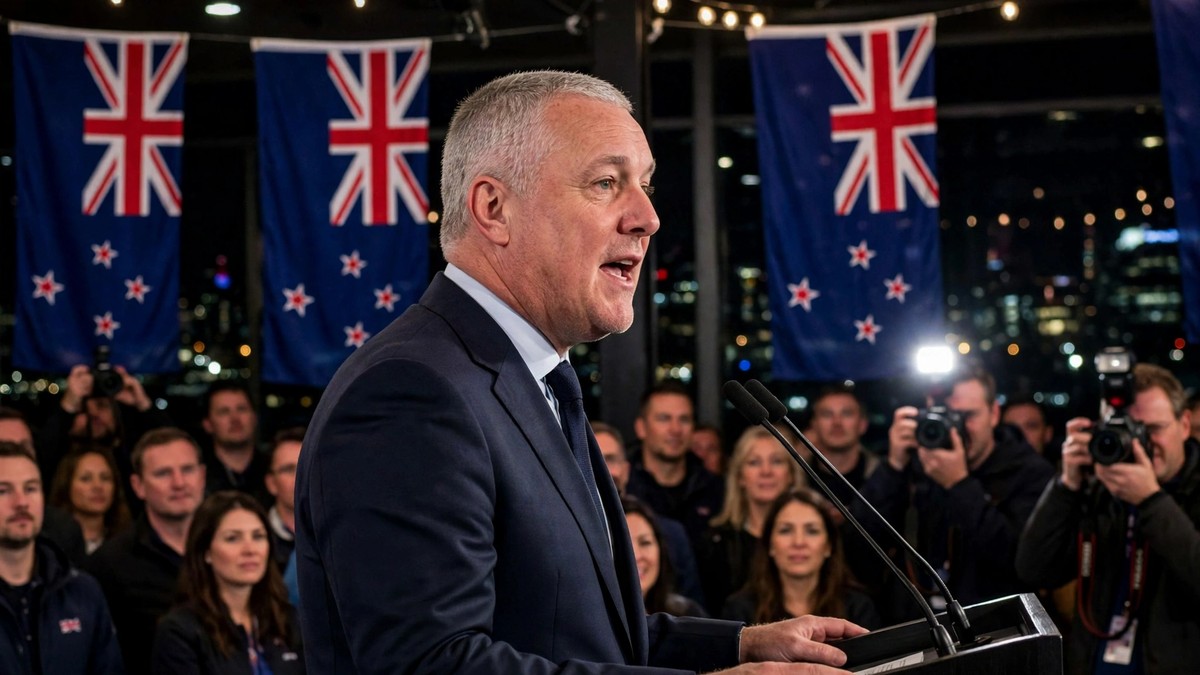
Luxon told supporters in Auckland that National had a pathway to forming the next government, but added that it was too close to call. “It is heartening to see that on the numbers so far, National is once again the largest party in parliament,” he said, before cautioning that the race remained undecided.
Labour leader Chris Hipkins has not conceded. “Tonight, New Zealand has spoken. It may take us a little bit longer to figure out exactly what it is that you’ve said,” he told supporters, adding that politicians would need to find common ground.
Opportunity’s leader, Qiulae Wong, said it was entirely probable that negotiations would have to wait for the special votes. Luxon said about 300,000 votes were still to be counted. The Electoral Commission will declare the official results on 27 November, and coalition talks could then run for weeks before a government is formed.
Sources: Nikkei Asia, Al Jazeera, CNN, The Guardian, RNZ | 7 November 2026, 22:55 +08 (Asia/Kuala_Lumpur). Preliminary results; official results due 27 November 2026.