Nearly 200 nations gather in Antalya for two weeks of climate talks, with money for poorer countries and a push for clean electricity at the top of the agenda.
Key Points
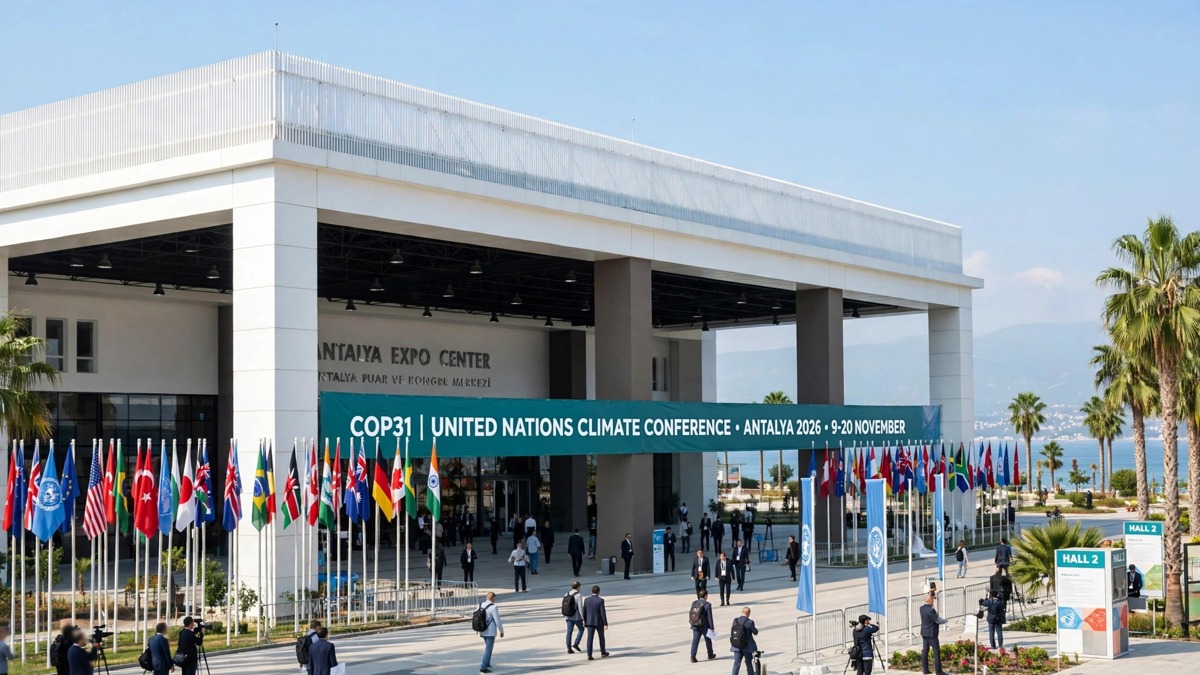
- COP31 opens on Monday, 9 November, at the Antalya Expo Center in Türkiye and runs until Friday, 20 November.
- Türkiye holds the presidency and Australia leads the negotiations, in the first shared presidency in the history of the talks.
- A World Leaders’ Summit follows on 11 and 12 November.
- The hosts want countries to pledge to raise electricity’s share of final energy use from about 20% today to 35% by 2035.
- New national climate plans point to emissions just 6% below 2019 levels by 2035, far short of the roughly 60% cut a 1.5°C path needs, according to a UN synthesis.
- Climate finance is the hardest fight: rich nations agreed at COP29 to mobilise at least $300 billion a year for developing countries by 2035.
The world’s biggest climate summit opens in Antalya on Monday, with nearly 200 nations facing two weeks of talks on money, clean power and a 1.5°C goal that is slipping away.
What happened
Delegates began arriving in Antalya over the weekend, ahead of the formal opening on Monday morning. The first day is given over to food, agriculture and health, with energy and transport following on Tuesday, according to the presidency’s programme.
The summit is being run in a new way. Türkiye hosts the meeting and holds the presidency, led by Environment Minister Murat Kurum, while Australia’s Climate Change and Energy Minister, Chris Bowen, leads the formal negotiations. It is the first time two countries have shared the running of a COP.
The presidency has called the meeting the “COP of Implementation”, built around three words: dialogue, consensus and action. Around 60,000 people are expected over the two weeks at the Antalya Expo Center.
The talks open against a difficult backdrop. Disasters linked to a warming planet have multiplied this year, from deadly floods in Nepal to heatwaves across Europe, and the war in Iran that began in February has shaken global energy markets and disrupted shipping through the Strait of Hormuz. The United States is not expected to take part, after skipping last year’s COP30 in Brazil, and French President Emmanuel Macron will not attend.
Why COP31 matters
The hosts’ flagship idea is electrification: replacing cars, heaters and factory equipment that burn fuel directly with electric versions. They want countries to sign up to a voluntary goal of electricity supplying 35% of final energy demand by 2035, up from about 20% today. The catch is that around a third of the world’s electricity still comes from coal, and the goal does not say how the extra power should be produced.
What the summit will not do is settle the argument over fossil fuels. Efforts to agree a global path away from coal, oil and gas have stalled, and the issue is not a formal item on the agenda. Brazil, which hosted COP30, is instead putting forward a voluntary roadmap for the shift away from fossil fuels, alongside a second roadmap on halting deforestation. About 60 countries that want faster action staged their own meeting outside the UN process this year.
The numbers explain the urgency. A UN synthesis of the 127 new national climate plans submitted by 154 countries, published on 27 October, found they would cut emissions by only 6% on average by 2035 against 2019 levels. A path that holds warming to 1.5°C needs a cut of about 60%. The UN said in September that the 1.5°C limit is now almost certain to be breached, and its findings put the world at about 1.4°C of warming and heading for about 2.6°C.
Money is the sharpest dispute. At COP29 in Baku, wealthy nations agreed to mobilise at least $300 billion a year for developing countries by 2035, but those countries currently receive only about a tenth of what they need to adapt, according to the UN Environment Programme. The African group of 54 nations wants adaptation finance put on the formal agenda, and seven proposals for new agenda items have been submitted. Kurum has said narrowing the finance gap will be a central aim of the talks.
The cost of coal is visible not far from the venue. Villagers living beside lignite mines near the Akbelen forest, a few hundred kilometres west of Antalya, have urged leaders to leave the conference halls and see for themselves what decades of extraction have done to their land and water, Reuters reported. Nejla Isik, an elected official in the area, said the damage should be seen first-hand.
What happens next
Heads of state and government arrive for the World Leaders’ Summit on Wednesday and Thursday. Among the leaders expected are Brazil’s President Luiz Inácio Lula da Silva, Turkish President Recep Tayyip Erdoğan, Australian Prime Minister Anthony Albanese and British Prime Minister Andy Burnham.
Behind the speeches, negotiators will work through technical files: a mechanism to coordinate a fair shift away from fossil fuels, measures of progress on adapting to climate change, and an extension of the work programme on cutting emissions. No landmark decision is expected from what many are calling a transitional COP, so success is more likely to be judged on the signals it sends and the voluntary pledges it gathers.
One question already hanging over the talks is who hosts the next big gathering. The 2028 summit, COP33, will carry out a global stocktake of progress under the Paris Agreement, but it has no host yet after India withdrew its candidacy, and China is reported to be considering a bid. A decision does not have to be taken in Antalya, but the contest is expected to be a talking point.
The final decisions are due when the conference closes on Friday, 20 November.
Sources: Reuters, Le Monde, UNFCCC, Daily Sabah, Dialogue Earth, UN Environment Programme. Published: 9 November 2026, Kuala Lumpur time.