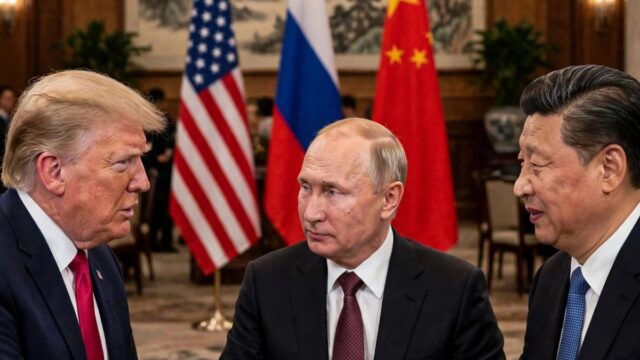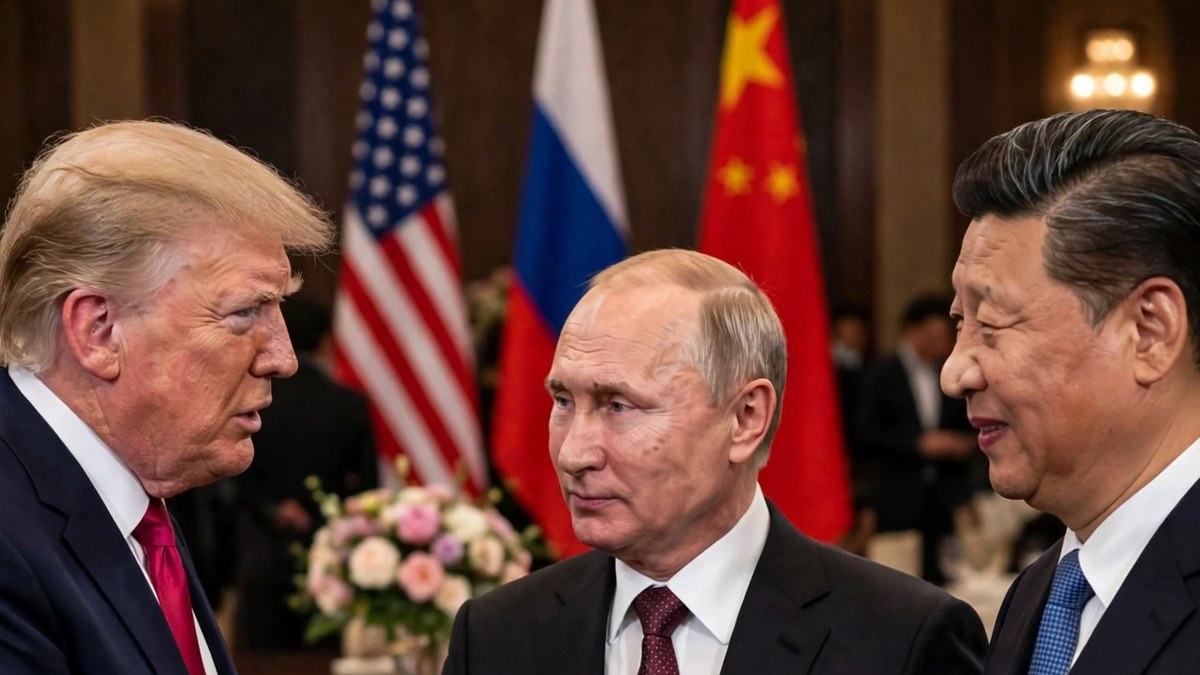
Donald Trump, Xi Jinping and Vladimir Putin meet in Shenzhen on Thursday for the first three-way summit of the sitting leaders of the United States, China and Russia.
No deal is expected from the meeting, and no joint statement has been announced. Even so, the gathering has drawn the world’s attention: it brings together the leaders of the three largest nuclear powers at a moment when the last arms pact between Washington and Moscow has lapsed, and when two wars — in Ukraine and in Iran — are still running.
Key Points
- The three leaders sit down at 2:30 p.m. local time at Kylin Villa in Shenzhen, on the sidelines of the APEC summit, for the first trilateral meeting of sitting American, Chinese and Russian leaders.
- Trump told Fox News the meeting was “already a win” before it began, pointing to the welcome China gave him when he landed on Wednesday.
- Nuclear arms control sits at the top of Trump’s list for the talks. The last United States-Russia arms pact, New START, expired on 5 February 2026.
- The war in Iran and the war in Ukraine are also expected to come up, though American officials say no major agreement is on the cards.
- Allies are uneasy. Politico reported fears in allied capitals that Trump could offer concessions on Ukraine or Taiwan.
What happened
The day opened with the APEC leaders’ plenary session in Shenzhen. Xi used his opening address to present China as the defender of open trade, setting out four areas for regional work — trade and the economy, connectivity, innovation and development — and announcing that China would give $20 million to support practical cooperation among APEC economies, along with a new research centre in Shenzhen.
Trump followed with a speech of his own, telling the room that the United States has been a Pacific power for hundreds of years and praising the strength of its economy. On artificial intelligence he said the technology was “almost completely good, but it’s got some bad elements, and we have to be very careful”, adding that he opposed rules that would “stifle” the industry. Putin, speaking after Xi, described Russia as an integral part of the Asia-Pacific region’s food and energy security.
After the plenary, Trump was due to meet Xi for a bilateral session and a working lunch, their third meeting of the year. The three-way session follows in the afternoon at Kylin Villa, a lakeside state guesthouse in the foothills of Kylin Mountain, about half an hour from Shenzhen airport. The Kremlin said no more than an hour had been set aside for it. Trump was also due to hold a one-on-one meeting with Putin, though Russian officials said no full-scale talks were planned for that conversation. After the trilateral, Trump flies home to Washington.
Wednesday set the tone. Xi met Trump’s plane at Shenzhen airport, the first time he has greeted a visiting leader there since becoming president, and the two men shared a brief hug. At the welcome banquet that evening, Trump and Putin shook hands and exchanged a few words as Xi looked on, with the three men placed on either side of the Chinese leader for the cameras. Russia’s Interfax news agency said Trump and Putin did not have a substantive conversation.
Why the Shenzhen trilateral matters
The meeting is a first. The sitting leaders of the United States, China and Russia have never sat down together before, and the comparison many have reached for is the Yalta conference of 1945, when Roosevelt, Churchill and Stalin shaped the post-war order. Analysts warn against pushing that comparison too far: at Yalta the three powers were wartime allies with a shared plan for the world after the war. No such shared plan exists here, and the three men arrive with very different goals.
Trump wants a result he can present as a win. He comes to Shenzhen weakened at home, after his party’s heavy defeat in the midterm elections saw Democrats take both houses of Congress, and with the war in Iran still deadlocked. His main ask is a three-way deal on nuclear arms. New START, signed in 2010, capped American and Russian strategic arsenals until it lapsed in February. Trump turned down Russia’s offer to extend it, demanding instead a new and wider deal that includes Beijing. China, which had no part in writing the old treaty, has shown little appetite for joining one.
Putin wants something else from the room: cover for the war in Ukraine and an end to the isolation that sanctions have imposed on Russia. He told the APEC audience on Wednesday that he expected “big potential benefit” from the meeting. For Moscow, simply sitting at the same table as the American and Chinese leaders is a prize in itself, after years in which much of the West has refused to deal with him.
Xi, as host, wants room to pursue China’s long-term aims without interference: no return to the tariff war, no challenge to its lead in rare earth minerals and technology, and no American pushback over Taiwan. At their height, American tariffs on Chinese goods reached 145 percent, with China answering at 125 percent, before a truce agreed in Busan in October 2025 paused the fight. That truce has been extended to 10 January 2027. Chinese rare earth exports to the United States are still about 75 percent below normal levels, according to the Center for Strategic and International Studies, and a row over Nvidia chips said to have been diverted to China through South-East Asia has added fresh strain.
The unease beyond the room is real. Politico reported that allies fear Xi and Putin could put forward proposals on Ukraine and Taiwan that Trump might present as diplomatic wins. Ukraine’s president, Volodymyr Zelenskyy, fears a plan for ending the war could be discussed without Ukraine or Europe in the room. China’s foreign ministry, by contrast, called the meeting of “groundbreaking significance” for world peace, and Kremlin aide Yuri Ushakov called it a “showstopper”.
What happens next
The meeting is expected to last no more than an hour, and the three sides have been consulting over a draft joint statement, according to Ushakov. It is not clear whether they will adopt one. With no agreement expected, the test will be what each leader says afterwards, and whether the talks lead to anything concrete in the weeks ahead.
Trump flies home on Thursday night, back to a domestic agenda dominated by the midterm fallout and a string of technology and air travel outages at home. The trade truce with China runs until 10 January 2027, and the next test of it will come in the broader trade talks that are meant to follow. No meeting with North Korean leader Kim Jong Un is planned on this trip, despite Trump floating the idea: his secretary of state, Marco Rubio, said on Wednesday that none had been confirmed.
Sources: Reuters, Al Jazeera, Nikkei Asia, BBC, Politico | 19 November 2026