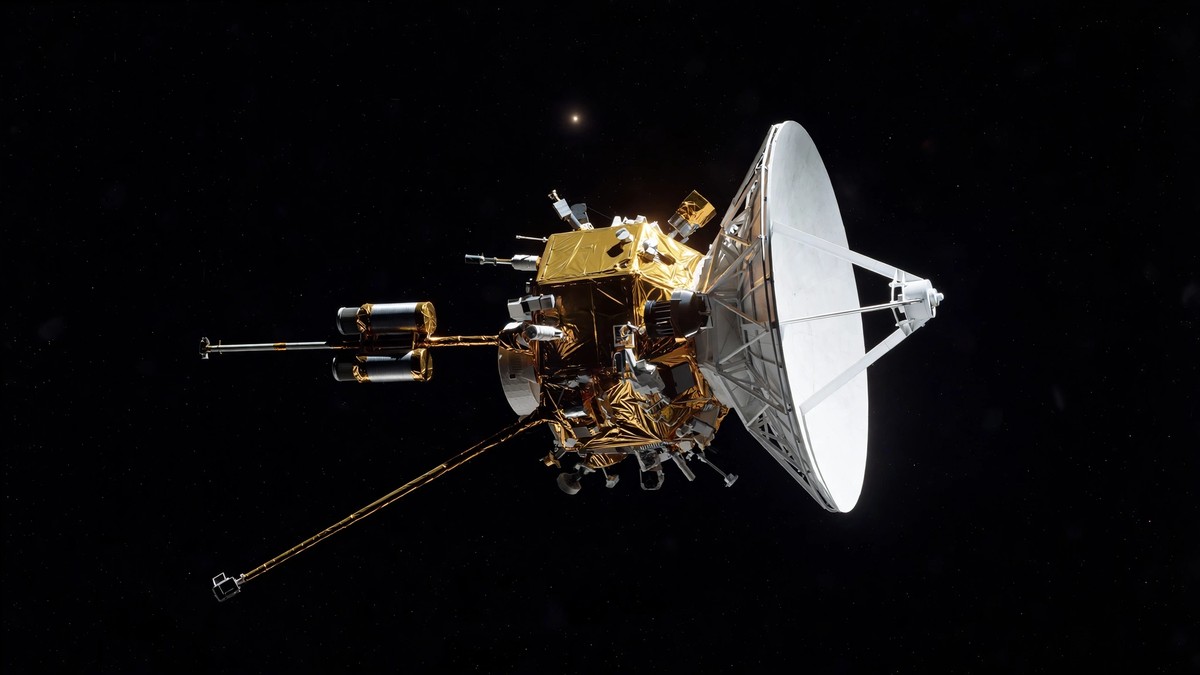
Forty-nine years out, the probe is closing on a distance no craft built by humans has touched before.
Key Points
- NASA puts the crossing at 5:16 a.m. Eastern time on Wednesday 18 November 2026, which is 6:16 p.m. in Kuala Lumpur.
- By Wednesday the gap will be roughly 16.1 billion miles, or 25.9 billion km. A message sent from Earth will take a whole day to get there, and the probe’s answer will take a whole day to come back.
- It left Earth on 5 September 1977, and the stretch that light crosses in one day has taken it 49 years, two months and 11 days.
- Two science instruments are still working on board, while the power supply sheds roughly four watts each year.
- Voyager 2, the twin craft on a different route, is still years from the same distance and is due to get there in November 2035.
On Wednesday, NASA’s Voyager 1 passes a line no spacecraft built by humans has crossed: one light-day out from Earth, 49 years after launch, where a radio message now spends a full day in transit.
On board, the crossing will pass unnoticed. NASA describes it as a mile marker rather than an event. But it gives a measure for the distance the oldest working probe has covered, and for how stretched its link home has grown: a command now spends a day in flight, and the response spends another.
What happened
NASA’s time for the crossing is 5:16 a.m. Eastern on Wednesday, 18 November. That is 10:16 a.m. in London and 6:16 p.m. in Kuala Lumpur. At that instant it will sit 16,094,799,096 miles out, about 25.9 billion kilometres, or 173.14 times Earth’s distance from the Sun.
The yardstick is simple: light needs a full day to cover that span. At roughly 186,000 miles a second, it is a distance, not a duration. Voyager 1 cruises at about 38,000 miles an hour, a pace that has stretched the journey to 49 years, two months and 11 days.
The night before, NASA is asking people everywhere to step outside after sunset and flash V-G-R, for Voyager, in Morse code with a torch, a phone or a glow stick. NASA calls the evening Shine Bright for Voyager’s Light-Day. On Wednesday evening the Planetary Society streams a public programme about the crossing, and on Thursday the Jet Propulsion Laboratory hosts a public discussion, with science chief Nicky Fox and Voyager project manager Suzanne Dodd.
Why it matters
Distance is now the mission’s main problem. A message leaving Earth on Wednesday arrives a day later. The answer needs a second day to return. EarthSky put the one-way travel time in early October at 23 hours, 52 minutes and 30 seconds.
Power is the other limit. Its generators make electricity from the heat of decaying plutonium, and they give up about four watts a year. Close to 50 years on, engineers have shut down system after system to keep it going. What is left working, science-wise, is the plasma wave subsystem and the magnetometer.
The numbers are easier to grasp against closer distances. The Moon sits 1.3 light-seconds off; sunlight takes eight minutes and 20 seconds to arrive. Neptune, the farthest planet, is four hours and 10 minutes out by light. One light-year, or twelve months of light travel, comes to roughly 5.88 trillion miles. The Sun’s closest stellar neighbour, Proxima Centauri, lies 4.24 light-years away.
Voyager 1’s journey began at Cape Canaveral, Florida, on 5 September 1977, with the outer planets as its first destination. Its Jupiter pass in 1979 revealed volcanoes on the moon Io; its Saturn pass in 1980 turned up three moons no one had seen and fine structure in the rings. In 1990 the cameras turned homeward for the Pale Blue Dot portrait of Earth. By 1998 it had overtaken Pioneer 10 as the farthest human-made object from home, and in 2012 it slipped out of the Sun’s bubble of charged particles, the heliosphere, into interstellar space. Voyager 2 made the same crossing in 2018. No other craft has ever left the Sun’s bubble.
What happens next
After Wednesday, Voyager 1 keeps going. Its course points toward Gliese 445, a dim star over 17 light-years off, and it will pass within about 1.7 light-years of it in 40,000 years. The probe will feel nothing as it passes the mark, and it will keep reporting from interstellar space while its power holds out.
Its twin is roughly nine years back along the same path. NASA puts its one-light-day crossing in November 2035.
Closer to home, spaceflight is moving fast: SpaceX caught its Starship booster on its return to Earth, while a Vulcan rocket failed during an Amazon satellite launch.
Sources: NASA, USA Today, EarthSky, Space.com. Published: 17 November 2026, Kuala Lumpur time.