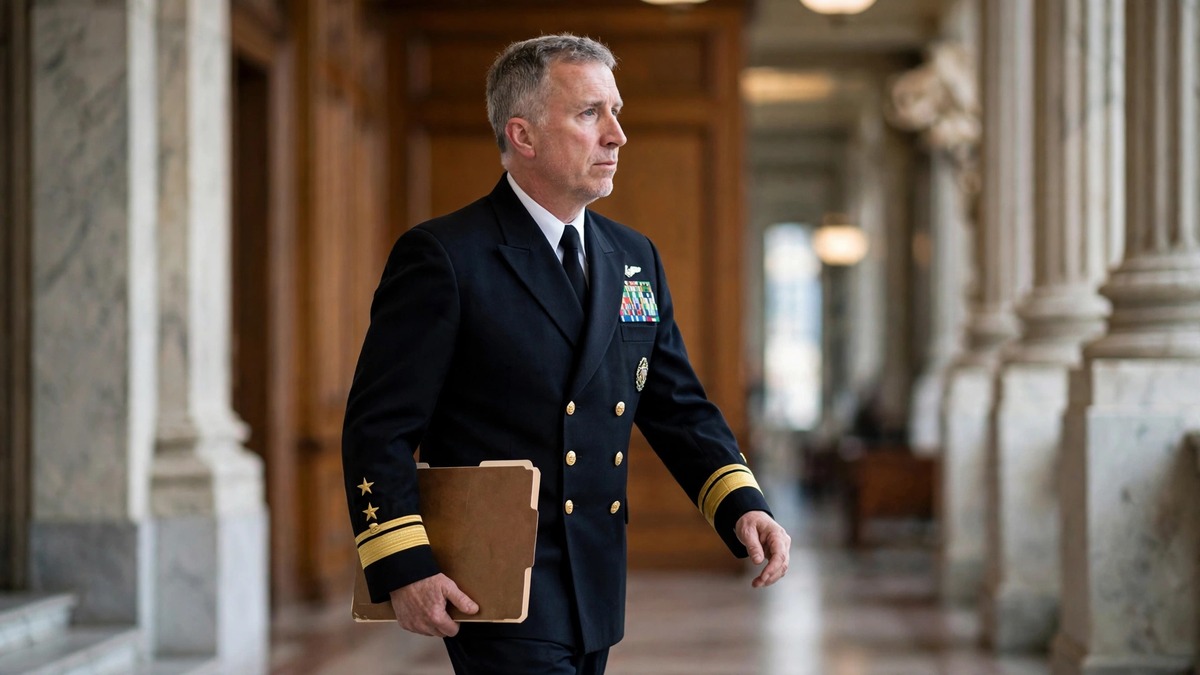
Rear Adm. Brian Monahan has resigned as the attending physician of Congress amid a Pentagon investigation that found his office failed to track prescription drugs, including opioids, for lawmakers and Supreme Court justices.
Key Points
- Rear Adm. Brian Monahan, Congress’s attending physician since 2009, has resigned amid allegations of misconduct.
- Senate Majority Leader John Thune confirmed the departure, saying: “My understanding is he’s resigned.”
- A Pentagon inspector general report released Friday warned of “health and safety risks” in the office’s drug handling.
- A February 2026 count found gaps in the records for five controlled substances, including opioid pain medicine.
- Sailors who worked in the office said they were ordered to cut lawmakers’ toenails and deliver medicine at 3 a.m.
What happened
Monahan, a two-star Navy admiral, had looked after the health of members of Congress, their staff and Supreme Court justices since 2009. His departure was first reported by Punchbowl News, and Thune confirmed it to reporters.
Neither Monahan nor the Navy has announced the resignation in public, and the Navy’s website still names him as the attending physician. His office did not answer repeated requests for comment.
The resignation landed in the same week the Pentagon’s inspector general published its findings on the Office of the Attending Physician, the small Navy-run medical unit tucked into the basement of the Capitol. The report, heavily redacted in its public form, described a “gap in clinical quality management” and said the office had no working system to check the care its staff gave or the drugs it handed out.
“The absence of [DoD] oversight of clinical quality management and pharmacy operations increases the risks to both patients and Navy medical personnel assigned to the OAP,” the report said.
The watchdog’s sharpest findings concerned the pharmacy. Federal rules require regular checks of controlled substances, yet the report found no proof that either the Drug Enforcement Administration or the Defense Department had ever inspected the office’s drug store. A Navy inventory board looked at the stock seven times between January 2023 and February 2026, fewer than the rules demand, and still found five problems, including prescription records missing from the medical bags carried on congressional trips abroad. The inspectors could not confirm whether any of the five had been put right.
The February 2026 count alone turned up gaps in the records for five controlled substances, including opioid pain medicine. The report said staff in the office only “loosely” followed Navy pharmacy rules and did not allow Pentagon pharmacy inspections.
American officials told the Wall Street Journal the claims against Monahan went further: a toxic workplace, medicine given to lawmakers and their staff without prescriptions, and weak control of controlled substances. The Pentagon watchdog and the Navy opened their inquiries about a year ago.
Why the Monahan resignation matters
The office Monahan ran is one of the most discreet in Washington. It gives routine check-ups, vaccinations and minor first aid to lawmakers and their staff, writes everyday prescriptions, arranges referrals to outside specialists, prepares travellers for trips abroad, and stands ready to stabilise a medical emergency or a disaster at the Capitol. It also looks after the nine justices of the Supreme Court, which has just agreed to decide whether the president can bar migrants from seeking asylum. The Navy has staffed it since 1928, after a House lawmaker died while waiting hours for a doctor.
Yet for years, the report found, nobody was clearly in charge of checking its work. Walter Reed National Military Medical Center took on credentialing its medical staff in 1994, but when oversight of the hospital moved to the Defense Health Agency in 2013, no written order said who should watch over the Capitol office. The agency oversees military treatment facilities, and the attending physician’s office is not one. The report found that no part of the Defense Department believes it has the authority to police the unit’s clinical care or its pharmacy.
Attempts to help were turned away. Walter Reed’s offers of pharmacy assistance visits were rebuffed, and the health agency was not allowed to see the office’s internal records.
The investigation itself ran into a wall. Monahan refused to take part, stepped aside from the inquiry and told investigators to speak to congressional lawyers instead. When the watchdog asked him in March 2026 to put it in touch with another contact in the office, the House deputy’s general counsel replied the next day that Navy staff in the office could not speak without Congress’s approval. A final request for records and interviews in August 2026 was refused as well.
As a result, the inspectors never saw the office’s clinical quality rules, its internal pharmacy procedures, its prescription records, its workplace climate surveys or its peer reviews. The office had five doctors, two pharmacists and 11 corpsmen on its books in August 2025.
The people who worked there have described a punishing routine. Sailors told Navy Times their duties included jobs “no one else wants to do,” among them “cutting a congressman’s toenails or bringing their medication to their private residence at 3 a.m.” They said they worked 70- to 80-hour weeks, usually in 12-hour shifts from 6 a.m. to 6 p.m., with duty every other day, and stayed as late as 4 a.m. when Congress sat late, only to report back at 6 a.m. At least four former staff members said poor treatment of sailors had been common for a decade and that they feared losing monthly bonuses if they challenged managers.
Monahan mostly kept out of public view, though he was known as the personal physician to Sen. Mitch McConnell of Kentucky, whose care he oversaw during the senator’s time out of the spotlight.
The episode also fits a wider pattern of quiet Navy departures. In the same week, the Navy removed the commander of a destroyer deployed to the Middle East and several senior officers from a nuclear-powered submarine after an underwater collision damaged the vessel, without the usual public announcements. Congress has spent the same week policing its own ranks, too: House Democrats opened an investigation into newly elected Rep. Brian Poindexter after an aide accused him of sexually harassing comments.
What happens next
The inspector general made five recommendations: name an outside body to oversee the medical staff at the office, write clear policies and procedures for it or work with the House and Senate to make sure care is adequate, review the pharmacy inspection records, and consider asking the Defense Department or the Drug Enforcement Administration to inspect the pharmacy again if the office is found to have broken federal law. The Pentagon has agreed with the recommendations.
A separate Navy inquiry into the office is still running, and its findings have not been released. Whoever takes over the post inherits an office that treats some of the most powerful people in the country with no outside check on how it handles their medicine.
For now, the doctor who looked after Congress for 17 years has gone without a public word, and the watchdog’s verdict stands: the people who prescribe the pills, and the people who take them, were left without anyone watching.
Sources: Wall Street Journal; Military Times; New York Post; The Washington Sun; CBS News. Published 14 November 2026, 21:30 +08.