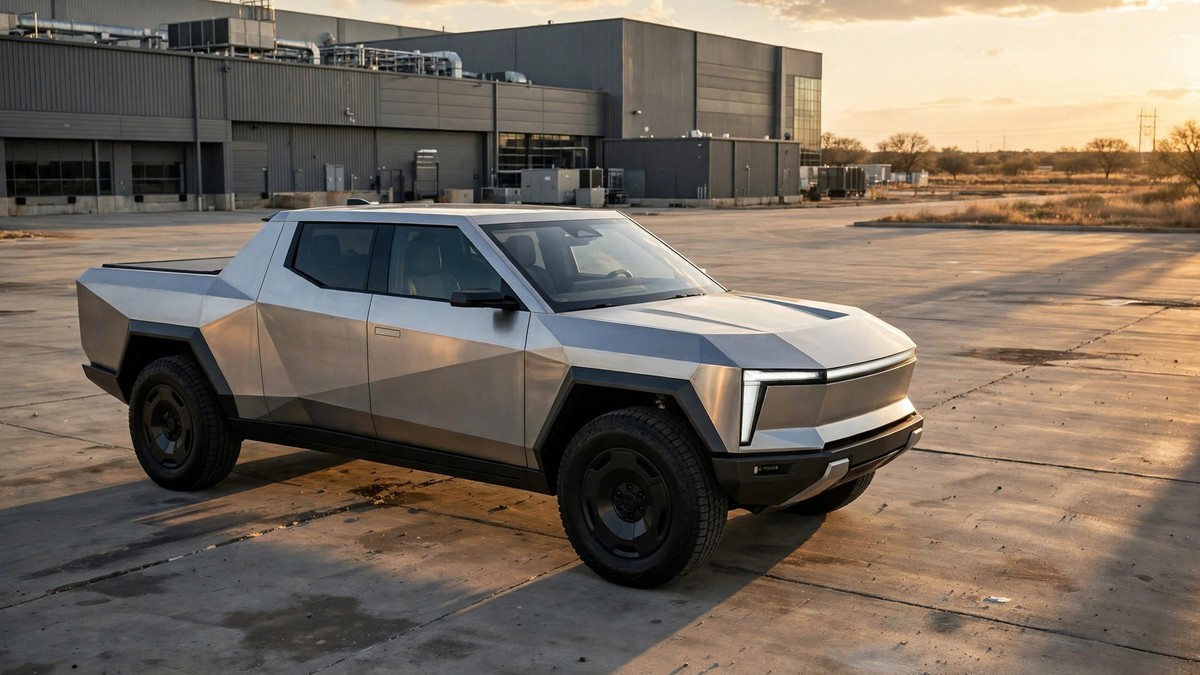
The angular pickup that was meant to reshape the truck market is being pushed aside for a robotaxi.
Key Points
- On Friday 6 November, Musk announced that the Texas factory will phase out the Cybertruck around the middle of 2027.
- The factory space will go to increased production of the Cybercab, Tesla’s two-seat robotaxi with no steering wheel, pedals or mirrors.
- US sales fell to 20,237 in 2025, down 48% from 38,965 in 2024, Kelley Blue Book figures show — far below Musk’s forecast of 250,000 a year.
- Tesla has not said whether Cybertruck production will move to another factory or stop altogether.
- The Cybercab began paid rides in Austin in September 2026; about 570 of the more than 1,200 Tesla robotaxis in Texas are Cybercabs.
Tesla will wind down production of its Cybertruck pickup at its Texas factory around the middle of 2027, chief executive Elon Musk has said, clearing the line for more of its driverless Cybercab robotaxis.
What happened
Musk announced the move on Friday, 6 November, in a short post on X, the social platform he owns. “Tesla will be winding down production of the Cybertruck at Gigafactory Texas around the middle of next year to make room for increased Cybercab production,” he wrote.
The factory outside Austin is the only plant that builds the stainless-steel pickup, so the decision touches the whole supply of the vehicle. Musk did not say whether production would move to another site or stop completely, and Tesla has issued no further statement. The Cybertruck’s lead engineer, Wes Morrill, wrote on X that the truck “was an incredible technology development platform and lives on through Cybercab” — wording that reads as a farewell. When a user on X asked whether that meant the model was finished, Musk answered with a single word, “true”, and added that “the Cybertruck fleet will be around for a long time.”
The announcement closed a bruising week for Musk. Reuters reported his companies were on track to shed more than $180 billion in market value over the week, after his heavy political spending in Tuesday’s US midterm elections delivered little — most of the Republican candidates he backed lost their races. Tesla’s shares rose 4.7% on Friday after the Cybertruck news, the BBC reported.
About 80 minutes before Musk’s post, Tesla had raised US Cybertruck prices by up to 9% and stopped taking orders for the entry-level dual-motor version, EVWire reported.
Why it matters
The Cybertruck was Musk’s most personal project: a wedge-shaped, stainless-steel pickup unveiled in 2019 with a promise to take on America’s best-selling trucks. At the unveiling, a designer threw a metal ball at a window to show it was shatterproof — and cracked it. Twice. Musk still called it “a better sports car than a Porsche 911” and “a better truck than an F-150”, and forecast annual sales of 250,000.
The sales never came close. Kelley Blue Book figures show Tesla sold 20,237 Cybertrucks in the US in 2025, down 48% from 38,965 the year before, and sales through the end of September 2026 were down a further 28%. Auto Express estimates total deliveries since launch at under 70,000. In the third quarter of 2026 alone, just 8,295 were sold. Development costs for the vehicle have been reported at $5.6 billion, and estimates put unsold stock at between $800 million and $1 billion.
The truck also collected 11 recalls since deliveries began in late 2023, according to the US National Highway Traffic Safety Administration, some fixed in workshops and others by software updates. And its sharp-edged steel body kept it out of Europe: safety experts say the design cannot meet pedestrian-impact rules there.
There were other pressures. Musk’s open alignment with right-wing politics, including President Donald Trump, alienated some buyers; AP reported Tesla drivers selling their cars and protesters gathering outside showrooms. Even so, the wider electric-pickup market has struggled too: analyst Felipe Munoz told Reuters that Ford’s electric pickups also flopped, because “electric pick ups aren’t popular in the US”.
What the decision really marks is Tesla’s turn from carmaker to AI and robotics company. The Cybercab — a two-seater with butterfly doors and no steering wheel, pedals or mirrors — is the vehicle Musk now calls Tesla’s main autonomous model for a global robotaxi network. Paid rides in a small fleet began in Austin in September 2026. About 570 of the more than 1,200 Tesla robotaxis operating in Texas are Cybercabs, according to the state’s Department of Motor Vehicles, and Tesla lists installed capacity for the model at more than 125,000 units. The US auto safety agency opened an audit in September into how Tesla self-certified the Cybercab as meeting federal safety standards.
The pivot also lands in a crowded week for AI products, with Google shipping its Gemini Omni 1.2 Flash video model and Meta rolling out Muse Voice, a voice-and-video mode for its AI assistant.
SpaceX, Musk’s rocket company, was one of the Cybertruck’s biggest customers: it bought $131 million worth of the trucks in 2025 at list price, according to its IPO filing, Reuters reported.
What happens next
Three questions are open. First, whether any Cybertruck production survives anywhere: Austin is the only known plant tooled for the truck’s specialised parts, and no move has been announced. Second, whether the Cybercab can carry the factory’s weight — it is still a small programme, and production only began earlier this year. Third, whether regulators clear the way: the safety agency’s audit of the Cybercab’s certification is still running, and its outcome will shape how fast Tesla can scale the robotaxi fleet that the Cybertruck is making room for.
Owners, meanwhile, keep their trucks: Musk has said the existing fleet will be on the road for a long time, and the model’s fans — one owner told AP he would buy another “in a heartbeat” — are left with a vehicle that may soon be a collector’s item.
Sources: Reuters, “Tesla to pull the plug on Cybertruck after years of poor sales”, 6 November 2026; Associated Press, “Tesla’s Cybertruck heads for an exit after years of hype and division”, 7 November 2026; BBC, “Elon Musk appears to signal the end of the road for Cybertruck”, 6 November 2026; Auto Express, “Tesla Cybertruck’s end is nigh”, 6 November 2026; EVWire and InsideEVs, 6 November 2026, for the price rise and entry-level order pause. Sales figures are from Kelley Blue Book, as reported. The $5.6 billion development cost and $800 million–$1 billion unsold-inventory figures are reported estimates, not Tesla figures. Direct quotes are Musk’s and Morrill’s posts on X, as reported. Published: 7 November 2026, Kuala Lumpur time.