Ukraine’s president says Europe will take an equal seat at the next round of peace talks with Russia, after US envoys briefed him in Dublin on Thursday on their meeting with Vladimir Putin in Moscow.
Key Points
- Volodymyr Zelenskyy said the Dublin talks produced three results: work on the war’s biggest prisoner exchange, a larger European role in diplomacy, and more multilateral meetings to come.
- Jared Kushner said Russia and Ukraine had agreed to widen the next round of talks to include European nations, but the Kremlin did not confirm that Putin had agreed to it.
- In Moscow, Putin held firm on his demands, rejecting foreign troops in Ukraine and any demilitarised zone, and pressing for a new European security arrangement.
- Zelenskyy said renewed limits on the Starshield satellite service were weakening Ukraine’s defences against Russian drones.
- The fighting went on through the diplomacy, with at least two people killed in Russian strikes on Ukraine on Thursday.
What happened in Dublin
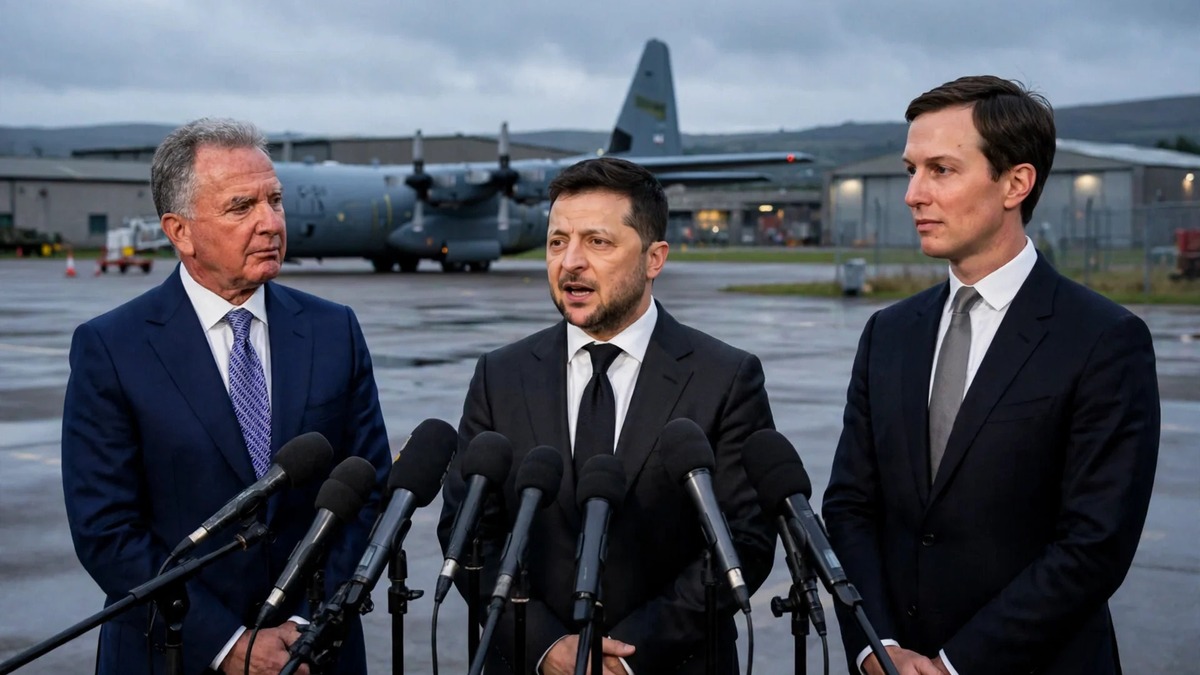
The meeting took place late on Thursday at Baldonnel military airbase on the edge of Dublin, hours after Witkoff and Kushner had spent more than two hours with Putin at the Kremlin. Zelenskyy was in the Irish capital for a summit of European leaders. After the briefing, he set out the results in a post on X.
First, the prisoner exchange. Zelenskyy said work was under way on what could become the largest prisoner exchange since the war began. Kushner, writing on X, said the United States was working toward the war’s largest exchange and that it could reunite thousands of people with their families, though he gave no details of the deal.
Second, Europe’s role. Zelenskyy said European representatives would take a more active part in diplomacy and hold an equal place at the table, rather than sitting separately as they did in Abu Dhabi. Witkoff said Putin had agreed to European representatives joining the next round, describing the Europeans as partners whose involvement mattered. Kushner, speaking beside Zelenskyy on the airbase tarmac, said no deal could be concluded without Europeans at the table and that Putin was willing to try it.
But the Kremlin did not confirm that Putin had agreed to Europe joining the talks, something Kyiv and its allies have long been seeking. His aide Yuri Ushakov confirmed the three-way talks would continue but questioned Europe’s place, saying European governments still had to choose between peace and continued war — and that everything they had done so far pointed to war.
An EU official told AFP that representatives of five European capitals and the European Commission had also met the American envoys, and that a new multilateral meeting would be fixed soon. Zelenskyy thanked Ireland for hosting the talks alongside the European Political Community summit.
The Moscow talks behind it
The Dublin meeting followed two days of talks in Abu Dhabi on 10 and 11 November — the first three-way negotiations in nine months — which ended without a breakthrough but with agreement to work on a large prisoner swap.
The Kremlin session was Witkoff’s tenth meeting with Putin in person. Putin thanked the envoys and asked them to pass his thanks to President Donald Trump for helping arrange contacts with the Ukrainian side. Witkoff told Putin that Trump saw ending the war as quickly as possible as a priority.
Putin gave no ground on the core issues. He repeated that foreign troops in Ukraine after any deal would be unacceptable and a legitimate target, and he rejected talk of demilitarised zones, saying the state border was the only line that counted. That covers the four Ukrainian regions Moscow claims to have annexed in 2022 but has never fully controlled, as well as Crimea, seized in 2014.
Putin also proposed a five-day humanitarian operation in Kostyantynivka, a city in the Donetsk region where he said 400 to 500 civilians still lived, modelled on a short truce last month that let hundreds of people leave the Russian-held town of Oleshky. Kyiv pushed back: an adviser to Zelenskyy warned Russia could use the pause to move troops in, and Ukraine’s presidential office said Russia had used the Oleshky operation to bring in equipment and rotate troops, and that the details needed clarifying. Russia said in the summer that it had taken Kostyantynivka; Ukraine says fighting there continues.
Fighting and Starshield
Zelenskyy said fresh limits on Starshield, the satellite internet service made by SpaceX that Ukraine’s forces rely on for frontline communications, were hampering its ability to shoot down Russian jet-drones and costing civilian lives.
The limits were first imposed in mid-October and later lifted, but they returned on Thursday across the whole front line, according to RFE/RL. Ukraine’s envoy in Washington said they had been brought in over several days and were now fully in force. The 105-member bipartisan Congressional Ukraine Caucus demanded answers from the American administration and SpaceX and called for full access to be restored immediately. Neither the US government nor SpaceX had responded at once.
The war did not pause for the diplomacy. On Thursday a Russian drone struck a high-rise residential building in Kyiv, killing at least one person and setting part of a floor on fire. Another person was reported killed in the southern Kherson region, and strikes on energy and civilian infrastructure in the western Rivne region left more than 160 settlements without power. Russia said it had intercepted drones heading for Moscow and over the Rostov and Tula regions.
Why it matters
The Dublin outcome, if it holds, changes who sits at the table. Europe has been on the outside of the American-led process — its delegation was not even in the room in Abu Dhabi — and Kyiv has long argued that a war fought in Europe cannot be settled without Europeans. Thirty-nine countries, in a French-backed declaration issued in Dublin, insisted that Europeans must have a say in any decision affecting European security. The European Council president, Antonio Costa, said Europe’s security framework did not need to be reinvented and accused Russia of wrecking it by attacking Ukraine. France’s President Emmanuel Macron urged Europe to agree on a single, clear vision of what it wants from the talks.
The gap between the two accounts is the problem. Washington and Kyiv say Europe is in; Moscow has not said so, and its condition — that Europe stop sending military aid to Kyiv — has not changed. Until that gap closes, the next round risks starting with an argument about who is even in the room.
The prisoner exchange is the one concrete gain so far. If it goes ahead, it would be the largest swap of the war, reuniting thousands of families — a humanitarian step both sides can claim, even while they remain far apart on territory and security guarantees.
What happens next in the Ukraine peace talks
European leaders meet in Dublin on Friday for an informal session of the EU Council, with Ukraine high on the agenda and the question of a single European representative to be discussed.
A new multilateral meeting is to be fixed soon, and the next round of talks is expected to include European representatives — if Moscow agrees. No date or size has been announced for the prisoner exchange. Russian officials had earlier spoken of more than 1,000 prisoners on each side within two to three weeks, but that figure has not been confirmed.
Beyond that, the calendar points to the APEC summit in China later this month, where Putin and Trump are expected to take up the Ukraine question directly — the moment the shuttle diplomacy of the last two days meets the two leaders who will have to sign off on any deal.
Source: Reuters, AFP, RFE/RL, ANI | 13 Nov 2026, 12:45 +08