Vladimir Putin told Europe to choose between peace and war on Thursday, after talks in Moscow with US envoys Steve Witkoff and Jared Kushner ended with an agreement to keep Ukraine peace negotiations going.
Key Points
- Putin warned that any European troops sent to Ukraine after a peace deal would be treated as legitimate targets by Russia.
- Witkoff called the Kremlin session productive and said another round is already scheduled, with European representatives expected to join it.
- The Kremlin played down Europe’s role, saying European governments must first decide between peace and continued war.
- After Moscow, the two Americans head for Dublin, where they are to update President Volodymyr Zelenskyy of Ukraine on Friday about the Kremlin talks.
- Fighting went on through the diplomacy: a Russian drone attack killed one person in Kyiv overnight, and Ukraine said it had hit Russia’s five largest oil refineries since 30 October.
What happened in Moscow
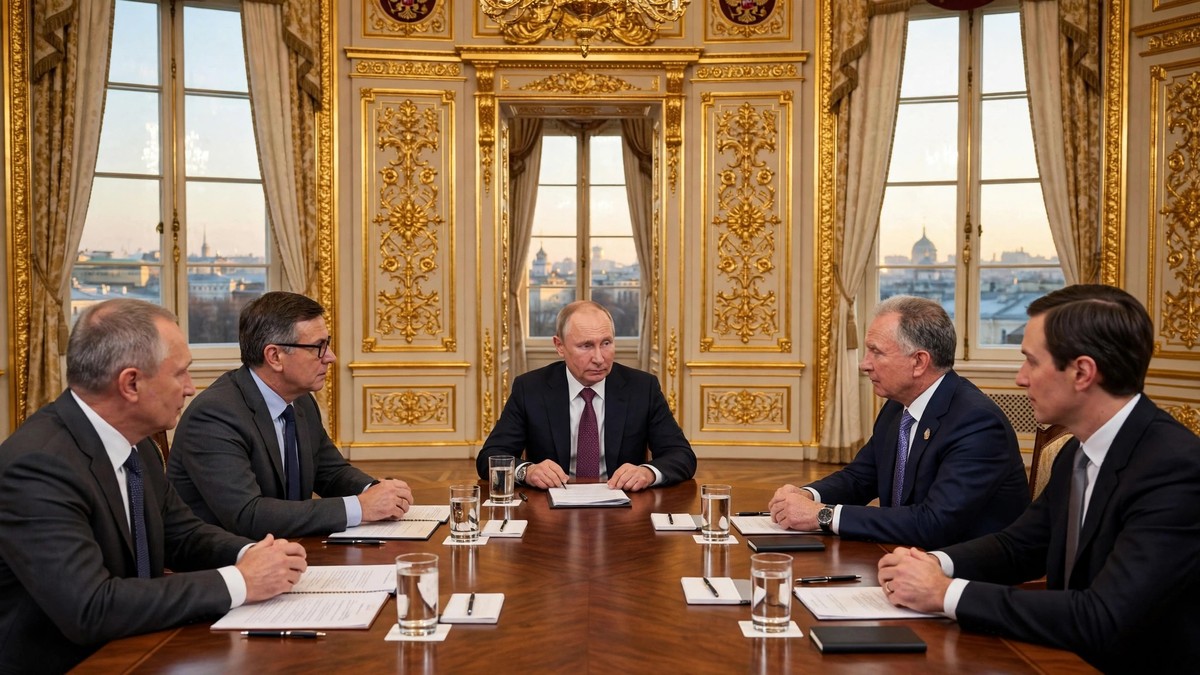
The meeting took place at the Kremlin on Thursday, 12 November, and lasted about two hours. It was the tenth time Witkoff has met Putin in person. The two Americans were met at Moscow’s Vnukovo airport by Kirill Dmitriev, Putin’s special envoy, before being taken to central Moscow. Kushner is President Donald Trump’s son-in-law and, like Witkoff, acts as one of Washington’s top diplomats despite holding no official role in the administration.
Putin used the opening of the talks to deliver his bluntest message yet to Europe. He told the envoys to press Europe into deciding whether it wants peace or continued war. He said Russia regards any foreign troops in Ukraine as “absolutely unacceptable” and a threat to its security, warning that once a peace deal was reached and European troops were deployed, “to us, that constitutes a legitimate military target. The war would resume instantly … it’s a vicious circle.”
Putin also dismissed talk of demilitarised zones, saying the state border is the only line of demarcation. That covers the four Ukrainian regions Moscow claims to have annexed in 2022 but has never fully captured, as well as Crimea, seized by Russia in 2014.
Despite the warnings, the Kremlin called the talks useful, and both sides agreed to keep the direct negotiations going. The American side backed Putin’s proposal for a joint humanitarian mission to a city in eastern Ukraine. Putin is expected to continue the discussion with President Trump at the APEC summit in China later this month. Russia also made clear it does not accept any further expansion of NATO, and said it hopes Europe will support talks on a new European security architecture.
Speaking to CNN at Vnukovo airport as the envoys left Moscow, Witkoff said progress had been made that day, the three-way format had been restarted, and a new meeting had been set. He said European representatives would join the next round of talks, adding: “They’re our partners, and it’s important for them to be involved.” Kushner described the talks as thorough and wide-ranging, saying they should shape the next round of multilateral discussions.
Ushakov confirmed the three-way talks would continue, but he was cooler on Europe joining them, saying European governments had to choose between peace and continuing the war — and that their actions so far pointed to the latter. Russia has also asked Europe to stop sending military aid to Ukraine as a condition for a European seat at the table.
Putin said Russia had never refused dialogue with Europe, and that he backed a peace that would be durable, lasting — and, in his words, eternal. Dmitriev told CNN that support was building for making European security part of the process.
The Moscow meeting followed two days of talks in Abu Dhabi, which ended on Wednesday with agreement on a large prisoner exchange but no breakthrough on a ceasefire or territory. Russian officials said the swap could involve more than 1,000 prisoners on each side and take place within two to three weeks, though the final figure has not been announced. The United States said differences remained on territory, but some progress had been made on post-war security guarantees. Kyiv has firmly rejected Putin’s demand that it give up all of the eastern Donbas region in return for peace. Vladimir Medinsky, who led Russia’s delegation in Abu Dhabi, said the parties had “moved closer to achieving peace”.
Why it matters
The Moscow talks matter because they restarted a process that had been frozen for nine months. The Abu Dhabi meetings were the first direct negotiations between Russia and Ukraine mediated by the United States since February, and the Kremlin session was the next step — the first time the American mediators had sat down with Putin since the process resumed. The fact that the talks happened at all is, for now, the clearest sign the diplomatic track is alive again.
The open question is who gets a seat at the table. Washington and Kyiv want European countries brought into the negotiations, and Kushner has urged Europe to choose a single representative to speak for it. Moscow has resisted, pointing to Europe’s weapons supplies to Kyiv, and its delegation refused to sit down with a European team in Abu Dhabi. Witkoff and Ushakov gave sharply different accounts of what was agreed on Europe’s role, and that gap will shape the next round.
Putin’s warning about European troops also sets a hard line on the one thing Kyiv wants most: security guarantees that would stop a future attack. If any European force deployed after a deal is treated as a target, the guarantees Ukraine is asking for become much harder to build. Putin’s wider demand — a new European security architecture, which European governments see as a way for Moscow to gain a veto over NATO’s future membership — shows the talks are about far more than Ukraine’s borders.
Europe is answering with pressure of its own. More than 40 European leaders gathered in Dublin on Thursday for a European Political Community summit on the continent’s security, with Zelenskyy, Canadian Prime Minister Mark Carney and NATO Secretary-General Mark Rutte among those attending. Rutte said the United States, Europe and Ukraine are “very much aligned” on what security guarantees should look like. France said the European Union will approve new sanctions against Russia on Monday, covering 150 additional entities and 50 banks.
For all the talking, the war itself has not paused. Russia launched ballistic missiles and dozens of drones at Ukraine overnight, killing a woman and injuring five people when a drone hit a residential block in Kyiv. Ukraine’s military said 89 of the 123 Russian combat drones were shot down, and strikes on energy infrastructure caused power cuts in nine regions. Ukraine, meanwhile, said it had struck Russia’s five largest oil refineries since 30 October. Zelenskyy also warned that Starshield, the military version of Elon Musk’s Starlink service that Ukraine’s forces rely on, had faced “significant disruptions” in recent days — “systematic speed restrictions”, he said, that were helping Russia kill more Ukrainians. SpaceX, which owns the service, said there had been no change.
What happens next
The envoys fly to Dublin on Friday to meet Zelenskyy and brief him on the Moscow talks. The Ukrainian president has said political change, including the Democrats’ recent midterm win, could open a “window of opportunity” for a deal this year, but he has insisted Ukraine will not give up Russian-occupied territory in return for peace.
Attention then turns to the next round of talks, which Witkoff said would include European representatives. Ushakov’s cooler response suggests Moscow has not agreed to that, and European leaders meeting in Dublin on Friday are due to discuss appointing a special envoy for the diplomatic process. Brussels is due to approve the new sanctions package on Monday.
The prisoner exchange agreed in Abu Dhabi is the nearest concrete step. If it goes ahead on the timetable now reported, families on both sides could see relatives home within weeks. Beyond that, the calendar points to the APEC summit in China later this month, where Putin and Trump are expected to take up the Ukraine question directly — the moment the shuttle diplomacy of the last two days meets the two leaders who will have to sign off on any deal.
Source: Al Jazeera, CNN, The Times, Euronews, BBC, Associated Press | 13 Nov 2026, 03:33 +08