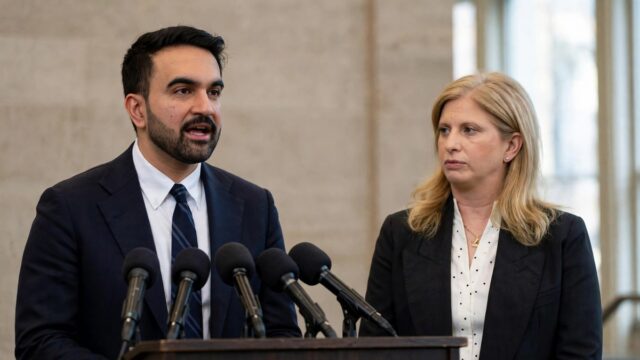
Maryland Senator Chris Van Hollen will challenge Chuck Schumer for the job of Senate majority leader, opening the first contest for the post in a decade after Democrats retook the chamber in the midterms.
Key Points
- Chris Van Hollen, 67, announced on Thursday he will run for Senate majority leader against Chuck Schumer.
- Senate Democrats will pick their leader by secret ballot on 1 December.
- Democrats flipped eight seats in the midterms and will hold at least 55 seats from January.
- Schumer, 75, has led the caucus since 2017 and says he already has the votes to stay.
- El-Sayed and Sanders have signalled support for Van Hollen; Gallego and Gillibrand back Schumer.
What happened in the Van Hollen challenge
Maryland Senator Chris Van Hollen said on Thursday he will run for Senate majority leader, setting up a direct contest with Chuck Schumer for control of the chamber’s Democratic caucus. He made the announcement on MS NOW’s The Briefing with Jen Psaki, telling the host: “Yes, I am planning to run for the Senate majority leader.”
Van Hollen framed his bid as an answer to the message voters sent in last week’s midterms, when Democrats retook both the House and the Senate. “This is not about any one individual, but it is about answering the call of the American people,” he said in the interview, calling the result a “huge outburst of democracy”. He told Reuters the election showed voters wanted “a change from the status quo that isn’t working for working people”, adding: “It’s now on us to meet this moment, and to do that we need new leadership.”
The move came only days after Van Hollen had played down the idea. On Saturday he told CNN that seeking the job was “not my focus”, and noted that he was also interested in running for president. By Thursday afternoon he said he was “still actively listening to members” — and hours later he declared his candidacy.
Schumer, 75, responded the same day. “I welcome any discussion about the future of our caucus and the important work ahead,” he posted on X. “I’m proud of what we’ve accomplished together — 55 seats and counting is an amazing result — and I have the votes to continue serving as Democratic Leader.” He told reporters on Tuesday: “I am confident I will be elected majority leader.”
The winner will lead a Democratic majority of at least 55 senators in the 120th Congress, which begins on 3 January 2027, after the party flipped eight seats in the midterms. That majority would be the main check on President Donald Trump during his final two years in the White House.
Van Hollen, 67, has served in Congress for more than two decades, including 14 years in the House before joining the Senate in 2017. He has held senior roles in both chambers, including House Democratic assistant to the leader and chair of both parties’ Senate and House campaign arms. His national profile has grown sharply over the past two years. He drew the administration’s anger early on when he travelled to El Salvador to meet Kilmar Abrego Garcia, a Maryland resident who had been mistakenly deported there. He has also become one of the Senate’s sharpest critics of the Israeli government, accusing it of “ethnic cleansing” in Gaza and calling Prime Minister Benjamin Netanyahu a “wanted war criminal”.
He has offered at least one direct criticism of Schumer’s leadership, saying he and the Democratic Senatorial Campaign Committee were too involved in Senate primaries this cycle. “We have two members in that room, newly elected senators, who would not be there if Schumer and the DSCC had had their way,” Van Hollen said on Tuesday at a post-election Democratic conference in Washington. He said the committee had “sided with the crypto industry and AIPAC against these candidates”.
Support for Van Hollen is already taking shape. Michigan Senator Abdul El-Sayed, whom Van Hollen was the first Democratic senator to endorse in the Michigan primary, has suggested he would back him. Senator Bernie Sanders, an independent who caucuses with Democrats, said the same at a news conference on Tuesday: “If this campaign was about anything, it was about change and the need for the Democratic Party, in my view, to move in a new and bold direction. But in my view, the time is now for change, and I will not be supporting Chuck to be reelected as the Democratic leader.” Incoming Senators Adam Hamilton of Kansas, Troy Jackson of Maine, Annie Andrews of South Carolina and Peggy Flanagan of Minnesota have also said they want a new leader. “I think whether it’s fair or not, Chuck Schumer is seen as a more divisive figure by many people, and I think we need somebody who’s going to bring us together,” Hamilton told CNN on Sunday.
Schumer also has defenders. Senator Ruben Gallego of Arizona told reporters: “When the manager takes you to the World Series, you give them another contract.” Senator Kirsten Gillibrand of New York, who ran the Senate Democrats’ campaign arm this year, praised Schumer for overseeing what she called a standout cycle. Scott Colom, who will become Mississippi’s first Black senator since Reconstruction, stayed uncommitted when asked if he would back Schumer, replying: “I don’t know my options. What are my options?”
Read our report on the other leadership race in Congress:
Read our report on El-Sayed’s historic Michigan win:
Read our report on Colom’s upset in Mississippi:
Why it matters
This is the first genuine contest for the Senate Democratic leadership in a decade. Schumer took charge of the Senate Democrats in 2017 after Harry Reid stepped down, and no Democrat has ever run against him for the job. The race is a test of whether the midterm mandate — the biggest Democratic win in years — means a change of leadership as well as a change of majority.
It also decides who runs the Senate floor for the next two years. The leader sets the agenda, decides which bills get a vote and speaks for the party in negotiations with the White House. With at least 55 seats, Senate Democrats can block much of Trump’s programme — but only if the caucus holds together.
The contest exposes real divisions inside the party. Liberals have long accused Schumer of not fighting Trump hard enough, and anger deepened over his handling of a government funding fight last year. Some progressive activists also view him as insufficiently critical of Israel as many Democrats have grown more sceptical of the US-Israeli relationship. Schumer also faces the prospect of a primary challenge — potentially from New York Representative Alexandria Ocasio-Cortez — if he runs for reelection in 2028.
What happens next
Senate Democrats will choose their leader by closed ballot on 1 December. Schumer needs only majority support from his caucus to win, and he insists he has it. Van Hollen’s task is to turn the appetite for change among incoming senators and progressives into votes.
Watch for endorsements over the next two weeks: several returning senators and most incoming freshmen have declined to publicly back Schumer, and each defection matters in a secret ballot. Also watch whether more senior Democrats break for Van Hollen, and whether Schumer’s claim to already hold the votes survives the first public count. World Pulse Wire will update this story as the leadership race develops.
Source: Reuters, CNN, Washington Post | 13 November 2026