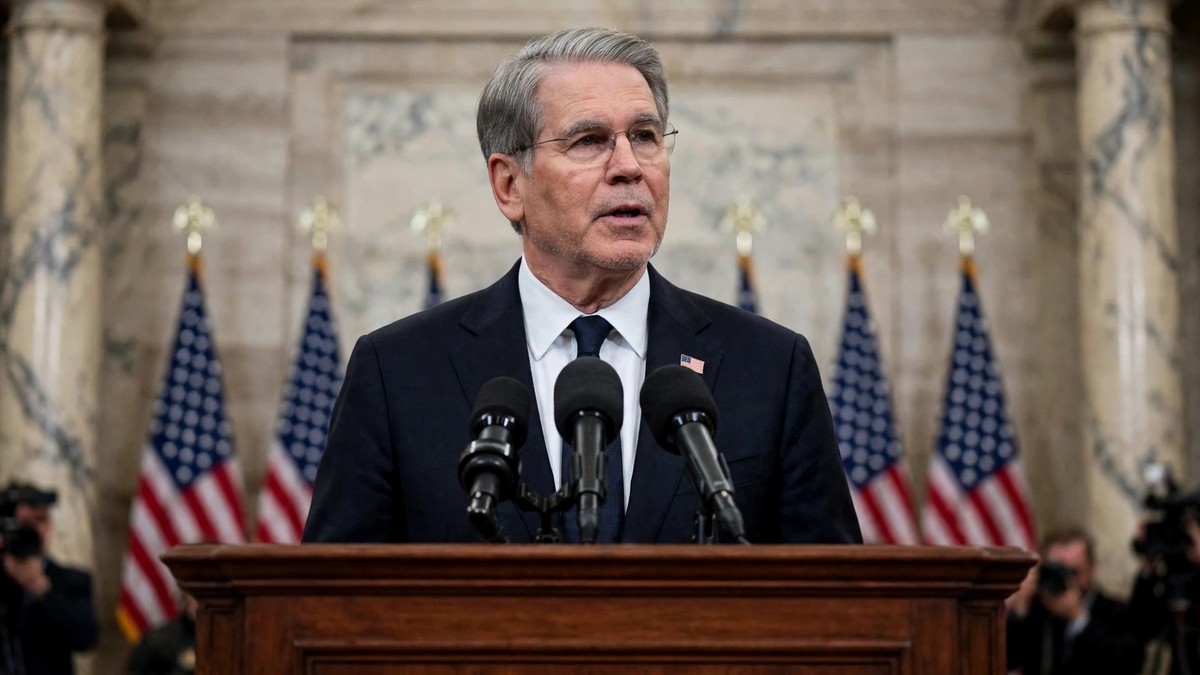
US Treasury Secretary Scott Bessent has moved from his Washington home onto a military base after reported Iranian threats against his life, as officials warn Tehran’s plotting against Americans has reached an advanced stage.
Key Points
- Bessent recently moved from his Washington-area home to a US military base after Iranian threats against his life, first reported by the New York Times and confirmed by Reuters and Treasury officials.
- US officials say Iranian plotting against current and former American officials has reached an advanced stage, according to a senior intelligence memo seen by Reuters.
- Bessent has led the economic pressure campaign against Iran, Operation Economic Outcast, since August. A Treasury spokesperson says he “will not be deterred by the Iranian regime’s threats”.
- On the same day, the Justice Department charged three alleged Iran-backed operatives over nearly 20 plots in the United States and Europe, including a September plot at RAF Fairford in Britain.
- Iran has denied plotting attacks on American soil, and has denied involvement in the Fairford plot.
What happened
The New York Times reported on Tuesday 10 November that Bessent had recently left his home in the Washington area and moved onto a military base, after threats to his life linked to Iran. The paper cited three people with knowledge of the matter. Reuters confirmed the move independently, with two people familiar with it, and Treasury officials also confirmed that Bessent had relocated. Neither the location of the base nor the exact date of the move has been disclosed.
American officials concluded in recent weeks that Iranian plotting against current and former US officials had reached a more advanced stage, based in part on intelligence about the threats to Bessent. A senior intelligence official in the Trump administration warned in a memo seen by Reuters late last month that lethal plots by Tehran against US personnel and American citizens had reached “advanced stages”.
The precise nature and severity of the threats against Bessent remain unclear. US officials have also noted that Iran’s ability to carry out large-scale attacks in the United States and other territories overseas is limited — but they treat specific, targeted threats against individuals seriously.
Security concerns around Bessent grew after the Wall Street Journal published an aerial photograph of the Georgetown mansion he bought for $12.5 million shortly after his confirmation as Treasury secretary. The photograph allowed his home to be geolocated, a source familiar with the matter said, and Bessent was relocated to a military base for his safety. The source added that the news media has “an obligation to act responsibly amid growing threats against public officials”.
A Treasury Department spokesperson said Bessent “will not be deterred by the Iranian regime’s threats” and remains committed to carrying out the campaign to squeeze Iran’s economy.
Why the Bessent move matters
Bessent is not a bystander in the war with Iran. Since August he has run Washington’s economic pressure campaign against Tehran, known as Operation Economic Outcast — tougher sanctions and restrictions on trade routes designed to isolate Iran financially, push it to stop attacking shipping, and force the Strait of Hormuz back open. That role has made him one of the Trump administration officials Iran most wants to target, according to the Times.
The move also shows how far the conflict has travelled from the battlefield. The war began on 28 February with US-Israeli strikes, and this week President Donald Trump said the fighting was “effectively over” in military terms, while Secretary of State Marco Rubio told allies in Paris there was no need for major new strikes. Yet the threats against the man running the economic war, and the plots charged the same day, show the confrontation continuing in a different form — through sanctions, blockades, and alleged plots on American and European soil.
Bessent is the latest senior Trump administration official to leave a Washington-area home for a military base or other protected housing. Secretary of State Marco Rubio and Pentagon chief Pete Hegseth are neighbours on a military base in Washington DC, Rubio has previously said on a podcast.
Iran has targeted American officials since January 2020, when Trump ordered the drone strike that killed General Qassem Soleimani, commander of the Revolutionary Guard’s Quds Force. In 2024, federal prosecutors charged Farhad Shakeri, whom they described as a Guard operative, with plotting to kill Trump in retaliation for Soleimani’s death.
What happens next
The same day the Bessent move was reported, FBI Director Kash Patel announced that the Justice Department had indicted three alleged Iran-backed operatives over nearly 20 attacks and attempted attacks across the United States and Europe. The department named the men as Mohammad Baqer Saad Dawood al-Saadi, a dual Iranian and Iraqi national, Mohsen Mohajeri, an Iranian, and Mohammed Ali al-Hassani, an Iraqi. Read the full story of the charges here: https://worldpulsewire.com/2026/11/11/us-charges-3-raf-fairford-terror-plot/
The eight-count indictment links the men to Kata’ib Hezbollah and Iran’s Revolutionary Guard, and includes charges of conspiring to provide material support to a terrorist organisation, conspiring to bomb a place of public use, and financing terrorism. Some of the charges carry a maximum sentence of life in prison. The alleged plots included a September attack targeting RAF Fairford, a British air base where American forces were stationed, and attempted attacks on Jewish communities in the United States and Britain.
Patel said the indictment “shows the determination of Iran to commit terrorist attacks in Europe and the U.S.”, including a plot recently prevented at Fairford. Attorney General Todd Blanche said: “Anyone who plans a terrorist plot on a military base housing American servicemembers will be prosecuted by the United States government.” Iran has denied involvement in the Fairford plot.
The security picture around American forces in Britain has been deteriorating for weeks. The United States moved bombers out of RAF Fairford in October, and pulled aircraft from RAF Mildenhall on Monday, after Iranian threats. Washington had already warned that Iran was in the advanced stages of planning attacks against Americans, as reported here: https://worldpulsewire.com/2026/11/10/iran-threat-us-aircraft-uk-base/
For now, the administration’s public line is that the shooting war is winding down. Trump said on Monday that the war with Iran could end “fairly soon” and that Tehran was talking with Washington — a claim Iran’s security chief Mohsen Rezaei called a lie the same day. The full account of Trump’s statement is here: https://worldpulsewire.com/2026/11/10/trump-iran-war-effectively-over/
The naval blockade of Iranian ports stays in place, the Strait of Hormuz stays shut until Tehran’s seven conditions are met, and the economic campaign Bessent runs continues. The question now is whether the threats against the people running that campaign will push Washington back towards military action — or harden its resolve to keep squeezing Iran without firing another shot.
Sources: The New York Times, Reuters, USA TODAY, Channel NewsAsia, Kurdistan24, The Hindu, The Times of Israel. Published: 11 November 2026, 15:30 +08 (Asia/Kuala Lumpur).