US prosecutors have charged three men over an alleged Iran-backed terror plot at RAF Fairford in England, saying one of them kept directing the plan from a jail cell in New York.
Key Points
- The US Justice Department unsealed an eight-count indictment on Tuesday 10 November against three men it describes as Iranian-backed operatives.
- Prosecutors say the men were behind nearly 20 attacks and attempted attacks in the United States and Europe, including a planned attack on RAF Fairford, a British base that housed American bombers.
- One defendant, Mohammad Baqer Saad Dawood al-Saadi, 32, is already in jail in New York. Prosecutors say he passed coded instructions to the other two men through phone calls to his family.
- The other two men, Mohsen Mohajeri, 48, and Mohammad Ali al-Hassani, 35, are not in US custody.
- Tehran rejects any connection to the Fairford incident. The charges are allegations, and no defendant has been convicted in this case.
What happened at RAF Fairford
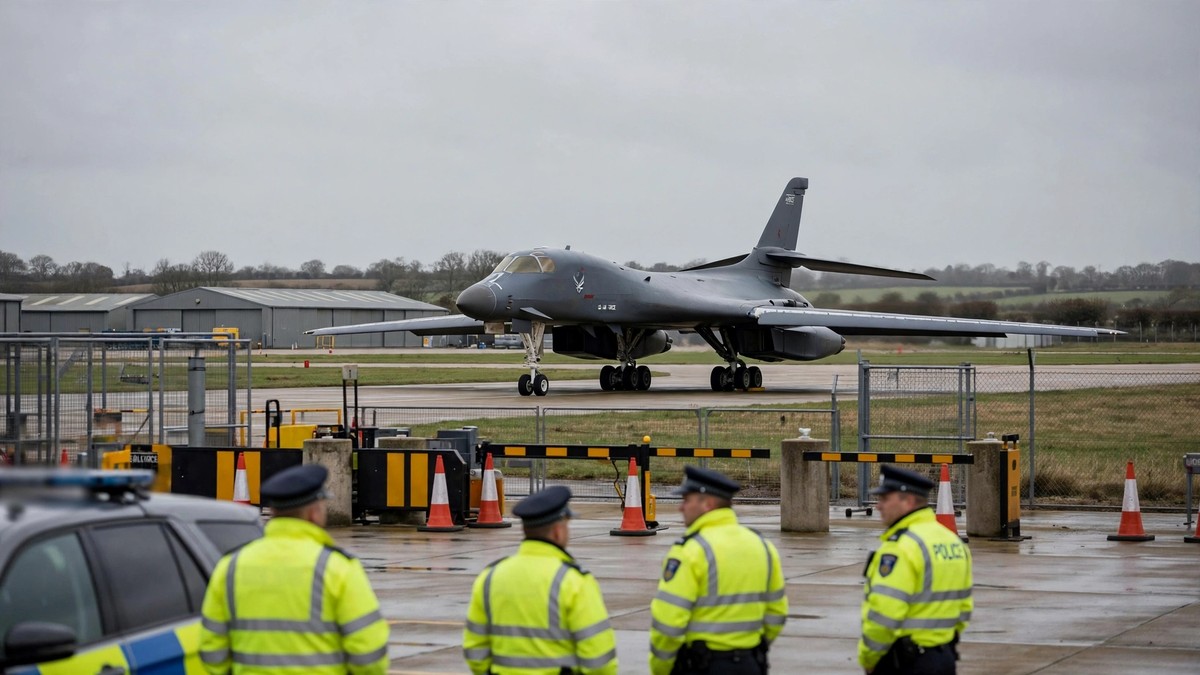
The case turns on a strange night in late September. On 27 September, three white vans were seen heading towards RAF Fairford in Gloucestershire, about 160 kilometres west of London. A local farmer reported the vehicles, and armed police moved in. Several men were arrested near the base. All of them were later released on bail, but two were arrested again and charged in Britain with assisting Iran’s intelligence service.
US prosecutors now say the vans were part of a planned attack. According to the charging document, al-Hassani told others to drive the vans to the base, and some of them carried barrels of fuel. He had also paid the group to buy pieces of metal that could be used as shrapnel, and to make the vans look like fuel delivery vehicles.
The base itself is the reason the case matters so much. RAF Fairford had been used by American B-1 bombers during the war on Iran, and days after the September incident the United States pulled all of its B-1 bombers out of the base. The men are said to have acted for a network tied to Iran’s Islamic Revolutionary Guard Corps and to Kataib Hezbollah, an Iran-backed militia in Iraq. Washington has listed both groups as foreign terrorist organisations.
The most striking claim in the indictment is about al-Saadi. Prosecutors say that even after he was locked up in New York, he kept working on the Fairford plan. They say he used phone calls to his mother and sister in Iraq, speaking in coded language, to pass instructions to al-Hassani and Mohajeri. The Times reported in October that he had also directed money transfers worth more than $1 million from behind bars and overseen the release of propaganda videos.
Al-Saadi was arrested in Turkey in May and brought to the United States. The first charges against him were made public that month, accusing him of directing attacks on American, Israeli and Jewish targets. He pleaded not guilty in June, described himself as a prisoner of war, and has been held without bail at the Metropolitan Detention Center in Brooklyn ever since.
Why the Fairford charges matter
The Fairford plot is only one part of what prosecutors describe as a much wider campaign. The indictment links the three men to nearly 20 attacks and attempted attacks across the United States and Europe, most of them aimed at Jewish communities. They include the non-fatal stabbing of two Jewish men in London in April, and arson attacks on synagogues, Israeli businesses and Jewish schools in Europe. The Times also links the group to firebombings of Jewish ambulances and synagogues, a drone attack on the Israeli embassy in April, and an alleged plan to kill Jews at synagogues in the United States.
American officials used blunt language when they announced the charges. Jamie McDonald, the US Attorney in Manhattan, said the defendants had helped run a campaign of terror that targeted Jewish communities in Europe and the United States, as well as RAF Fairford, where American service members were housed. He added that the threat from Iran and Iran-backed groups was not hypothetical but very real. Attorney General Todd Blanche said anyone who plans an attack on a base housing American troops will face prosecution in the United States. FBI Director Kash Patel said the case showed Iran’s determination to carry out attacks in Europe and America.
The British government had already pointed the finger at Tehran. In October, Prime Minister Andy Burnham said the suspected plot at Fairford was highly likely to have been coordinated in Iran. Tehran has rejected any connection to the incident, and it made no immediate comment on the new charges.
The case is separate from the arrest of a US soldier near Gloucester this week on suspicion of spying for Russia. British police have said that case is not linked to any other counter-terrorism investigation.
What happens next
The three men will face the charges in a federal court in Manhattan. If convicted, they could face life in prison. Only al-Saadi is in American custody. The Times reports that Mohajeri and al-Hassani are in Iran, and prosecutors have not said where they are.
In Britain, the cases against the two men re-arrested after the September incident will continue under the National Security Act. The Fairford case has already changed how the United States guards its forces in Britain. After the bombers left Fairford, the US also moved aircraft out of RAF Mildenhall, another English base, following what officials described as a threat from Iran.
Sources: Reuters, AP, Al Jazeera, The National, The Times, TRT World. Published 11 November 2026. The charges in this article are allegations made by US prosecutors. They have not been proved in court, and the defendants are presumed innocent unless convicted.