The base was hit around midday on Saturday. No group has claimed the attack, and the army has not named who carried it out.
Key Points
- Drones carrying explosives struck the Santa Rosa del Sur military compound in Bolívar department, northern Colombia, around midday on Saturday, 7 November.
- Three soldiers were killed and at least 16 were wounded, the Colombian army said. Eight of the wounded were seriously hurt, according to the army’s First Division.
- No armed group has claimed responsibility, and the army has not named a suspect.
- The attack is the latest in a series of strikes on security forces since President Abelardo de la Espriella took office in August and ended peace talks with rebel groups.
- Higher casualty figures reported by some Colombian media have not been confirmed by the army, and have not been confirmed by any outside source.
Explosive-laden drones struck a Colombian army base in Santa Rosa del Sur on Saturday, killing three soldiers and wounding at least 16 in the latest attack on security forces as rural violence grows.
What happened
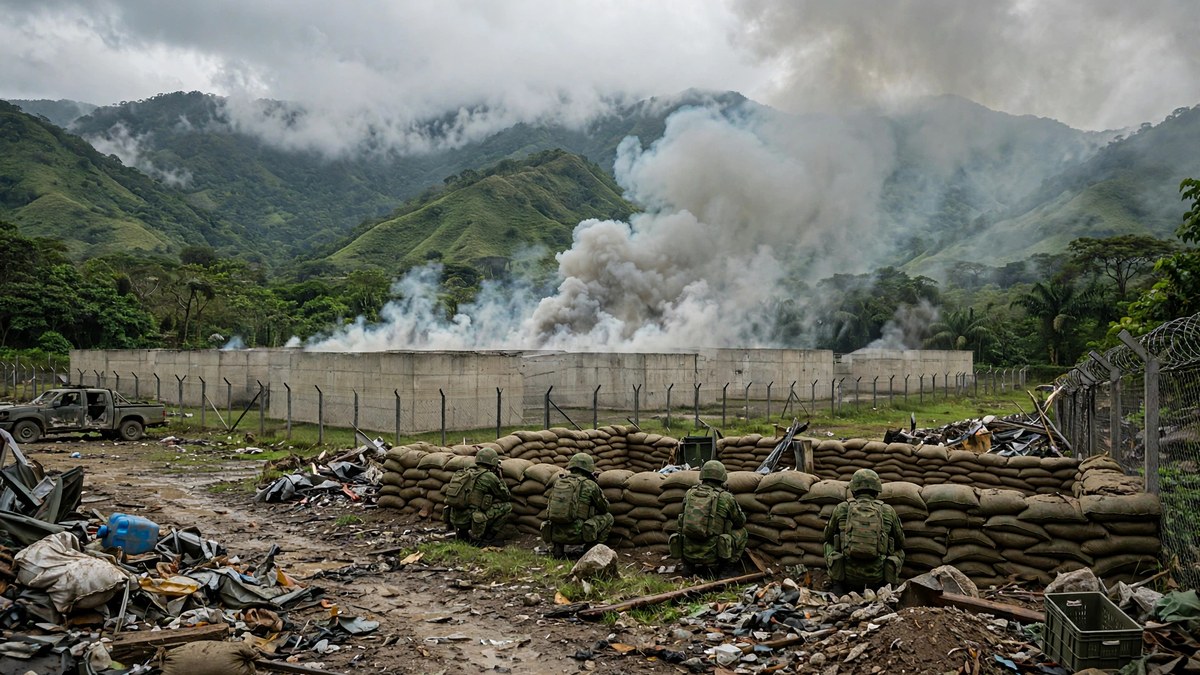
The attack hit the Cantón Militar in Santa Rosa del Sur, a small town in the foothills of the San Lucas mountains in Bolívar department, around midday on Saturday. The compound is home to the army’s 48th Jungle Battalion. Drones fitted with explosives struck the base, setting off three blasts. Video shared online showed smoke rising over the compound as soldiers took shelter behind sandbags.
The army’s First Division said three soldiers were killed and eight were seriously wounded. Other personnel were also hurt and were receiving medical care, but the army had not published a final casualty total. The Associated Press and Al Jazeera both reported at least 16 wounded, citing the armed forces.
Some Colombian outlets put the toll higher. The mayor of Santa Rosa del Sur, Milton Olaya, said 35 people were injured, and the newspaper El Colombiano reported five soldiers killed and 33 wounded. Neither figure has been confirmed by the army, and neither has been confirmed by any outside source.
No group has claimed responsibility, and the army has not named a suspect. The First Division said the strike breached international humanitarian law and that an air-supported operation was under way to find those behind it.
President Abelardo de la Espriella responded on X within hours. “Those who were behind this attack … will have nowhere to hide,” he wrote. “Every attack against our soldiers strengthens our resolve to defend Colombia.”
Why the Colombia drone attack matters
Santa Rosa del Sur sits in gold-mining country long fought over by armed groups — the Gulf Clan, the National Liberation Army (ELN) and smaller factions led by former FARC fighters. Control of the area means control of gold revenue, drug routes and the money armed groups take from local businesses.
The attack fits a wider pattern. Violence in rural Colombia has grown since de la Espriella, a conservative, took office in August. He ended peace talks with the remaining rebel groups and switched to a harder line: more air strikes, more troops in some cities and joint task forces to guard strategic assets, including a pipeline running from the Caribbean coast to central Colombia. His government says armed groups used ceasefires under the previous government to tighten their hold on rural areas.
The groups have answered with more attacks on the armed forces. Last week a base in Tolima province was hit with missiles made from gas canisters, killing four civilians, including a two-month-old baby. Police in the border city of Cúcuta have been hit several times with remotely activated bombs. Drones and missiles are now a weapon of choice for armed groups far beyond Colombia — a Houthi cruise missile aimed at Riyadh was intercepted this week.
The attacks are growing bolder and more frequent. State forces and illegal armed groups carried out 34 attacks with bombs or explosives in Colombia in the four weeks to October 16, a 9 percent increase on the same period last year, according to ACLED, a group that monitors armed conflicts.
Colombia’s 2016 peace deal with FARC led to the demobilisation of more than 14,000 fighters, but smaller groups have fought over the territory the rebels left behind ever since.
What happens next
The army’s search operation continues, and officials are expected to release a consolidated casualty count as the wounded are treated. Whether the toll rises above the three dead confirmed so far will depend on that update.
The question now is who the government blames. The ELN has a strong presence in southern Bolívar, and early reports pointed to the group, but no evidence has been made public and no claim has appeared. A formal accusation would test de la Espriella’s promise of a forceful response — and whether more air strikes follow.
The wider test is the president’s strategy itself. His hard line was meant to break the armed groups’ grip on the countryside. The Santa Rosa del Sur attack suggests they can still hit a fortified base in broad daylight. Military pressure is rising elsewhere too — fresh blasts were reported on Iran’s Hormuz coast this weekend.
Sources: Associated Press, Al Jazeera, El Colombiano, The Rio Times. Published: 8 November 2026, Kuala Lumpur time.