The early-morning tremor shook buildings across a wide stretch of central Japan — the strongest shaking Aichi Prefecture has felt in nearly 30 years.
Key Points
- A magnitude 5.7 earthquake struck western Shizuoka Prefecture at 1:04 a.m. on Sunday, 8 November 2026.
- Shaking reached upper 5 on Japan’s 0-to-7 scale in Chita City, Aichi Prefecture — the first jolt of that strength there since March 1997.
- More than 20 people were injured in Aichi and Shizuoka prefectures. Local media put the number at 22.
- No tsunami warning was issued, and no abnormalities were found at the Hamaoka nuclear power plant.
- Bullet trains were delayed and some local services stopped while tracks and stations were checked.
- Japan’s weather agency warned residents to brace for strong aftershocks over the next two to three days.
A magnitude 5.7 earthquake struck central Japan at 1:04 a.m. on Sunday, injuring more than 20 people across Aichi and Shizuoka prefectures, shattering shop windows and halting bullet trains.
What happened
The tremor hit at 1:04 a.m. local time on Sunday, with its epicentre in the western part of Shizuoka Prefecture, about 40 kilometres below the surface, according to the Japan Meteorological Agency. The United States Geological Survey measured the quake at magnitude 5.5.
The strongest shaking was felt in Chita City, in neighbouring Aichi Prefecture, where the agency recorded an intensity of upper 5 on Japan’s scale of zero to seven. That scale measures how strongly the ground shakes at each place, rather than the size of the quake itself. It was the first time a jolt of that strength had been observed in Aichi since March 1997. Shaking of lower 5 was recorded in parts of Aichi, Shizuoka, Gifu and Nagano prefectures, and the cities of Seto, Ena and Hamamatsu were among the places that logged it.
At upper 5, most people find it difficult to walk without holding onto something, and furniture that is not fixed down may topple over. At lower 5, dishes and books may fall from shelves. The shaking spread across a wide area, reaching Hamamatsu and the ancient capitals of Kyoto and Nara, as well as Yamanashi Prefecture, where Mount Fuji stands, and Gifu. It was not felt in Tokyo.
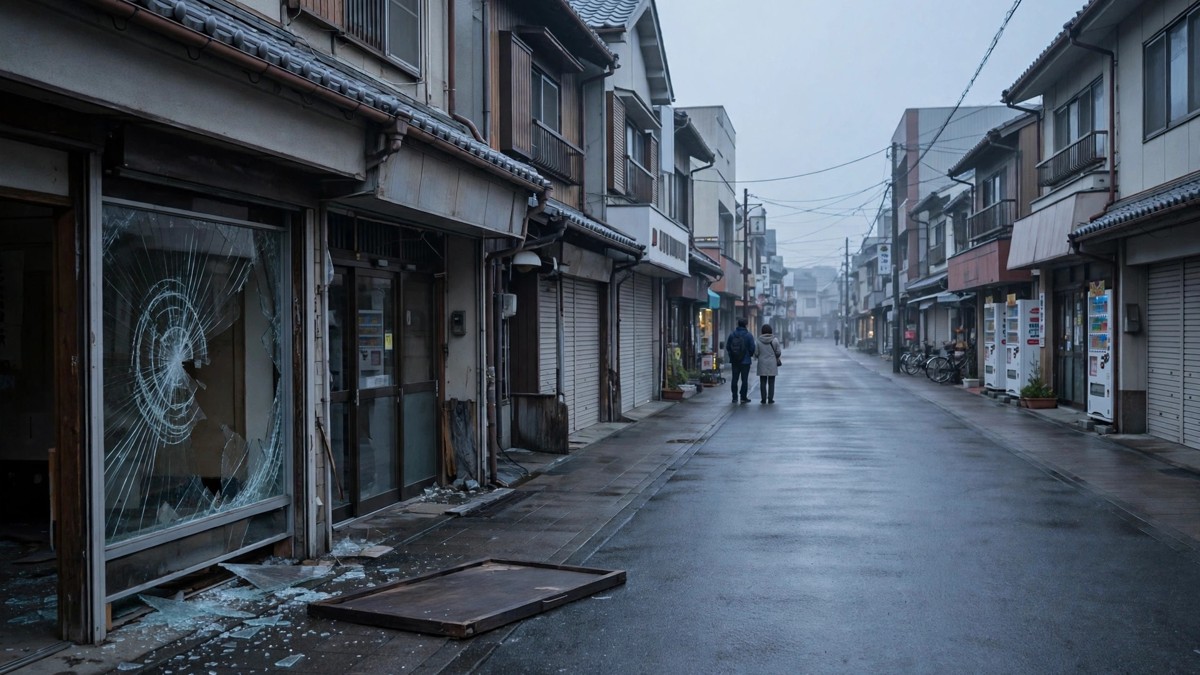
Japanese television showed shattered store windows, with shards of glass scattered across the streets. People ran out of buildings as the shaking hit, and some of the injured fell from stairs while trying to flee. Among those hurt, a woman in her 50s in Tokoname City was taken to hospital with a fractured ankle. In Toyota City, a man in his 40s and a woman in her 80s fell and hit their heads. Both were conscious when they were taken to hospital.
Prime Minister Sanae Takaichi confirmed the quake in a post on X. “At around 1:04 a.m. today, an earthquake struck with its epicentre in western Shizuoka Prefecture, and strong shaking with a maximum intensity of upper 5 on the Japanese seismic intensity scale was recorded in Chita City, Aichi Prefecture,” she wrote. She added that there was no risk of a tsunami.
No tsunami warning was issued. The Hamaoka nuclear power plant in Shizuoka reported no abnormalities, according to its operator, Chubu Electric Power Co. The central government set up a liaison office to coordinate the response.
The quake also hit transport. Tokaido Shinkansen bullet trains were delayed between Shizuoka and Gifu-Hashima stations while safety checks were carried out, and some local train services were suspended, the operators said.
Why the Japan earthquake matters
It was the second strong earthquake to hit Japan in two days, after a magnitude 6.1 earthquake struck off the coast near Tokyo on Friday evening. That quake caused no reported damage or injuries. This one, though smaller in magnitude, shook land directly beneath towns and cities — and that is what made the difference.
Japan sits on top of four major tectonic plates along the western edge of the Pacific “Ring of Fire”, and it is home to around 125 million people. The country typically feels hundreds of tremors every year and accounts for about 18 per cent of the world’s earthquakes. Its building codes are among the strictest anywhere, which is why the damage this time was measured in broken glass and bruises rather than collapsed buildings.
The injuries tell their own story. Almost all of those hurt were injured in falls — on stairs, on the street, or inside their homes — rather than by anything falling on them. It is a reminder that in a quake, the first seconds matter most: what is loose in a room, and what people do when the ground starts to move.
There is a larger question hanging over the region too. The Hamaoka plant sits near the projected source area of a possible Nankai Trough megaquake, the giant earthquake Japan has feared for decades. The weather agency said the chance that Sunday’s quake was linked to that much larger event was “low”. Agency official Ebita Ayataka said the tremor occurred in the projected epicentre area but was believed to be different from that larger earthquake.
What happens next
The weather agency has warned people to brace for possible strong quakes in the coming week, especially the next two to three days. Smaller aftershocks have already been reported. Ebita urged residents in areas that shook strongly to watch for further tremors and for rain, because of the higher risk of falling rocks and landslides.
Transport operators will keep checking tracks and stations before returning to a normal timetable. The injury count may still rise as hospitals and local authorities report in, and the first daylight hours will show whether the damage goes beyond the broken windows seen on television in the early morning.
Transport networks are often the first to feel a sudden shock. Earlier this week, a wave of bomb threats forced 27 planes to land across Europe, showing how quickly an alert can disrupt travel — and why authorities check infrastructure first after any jolt.
Source: NHK World-Japan, Kyodo News, Associated Press, Jiji Press via Nippon.com, The Insight International; Japan Meteorological Agency. Published: 8 November 2026, Kuala Lumpur time.