

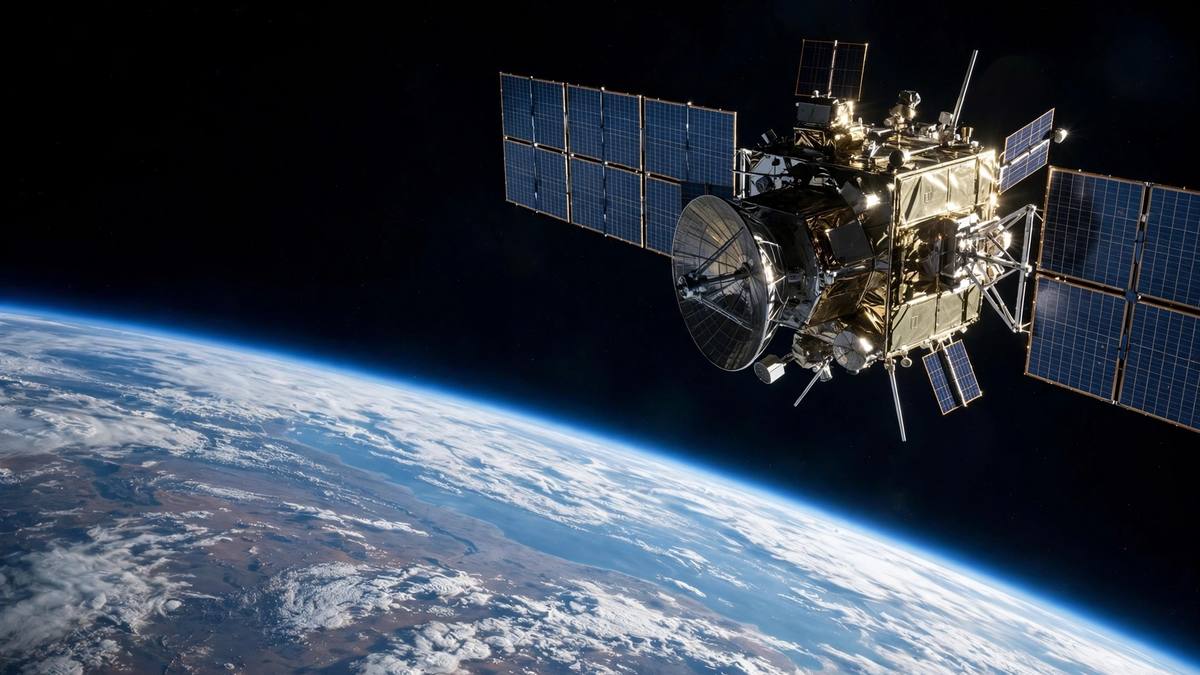
Russia may launch a satellite carrying a nuclear weapon into orbit before the end of 2026, according to Western intelligence assessments reported by German media on Monday.
If it happens, it would put the first nuclear weapon in orbit and break a treaty that has kept such weapons out of space for almost 60 years. The danger is not a bomb falling on a city below. A blast in orbit could cripple the satellites the world relies on for phone calls, navigation, weather forecasts and military operations.
Key Points
- NATO intelligence services believe Russia plans to launch a satellite carrying a nuclear weapon into space before the end of 2026, German media reported on Monday.
- The satellite, called Sputnik-S, was built several years ago and is being kept ready for launch near Moscow, according to the reporting.
- Germany’s military space command believes a launch could come as early as December, and the satellite could be ready for use soon after it reaches orbit.
- A nuclear blast in space could knock out around a third of the satellites in low Earth orbit within hours or days, the head of US Space Command has warned.
- Putting a nuclear weapon in orbit would break the 1967 Outer Space Treaty. Moscow rejects the claims, and no launch has been confirmed.
What happened
Reporters from the German newspaper Süddeutsche Zeitung and the public broadcasters WDR and NDR published their findings on Monday. They said intelligence services of NATO members had concluded that Russia intended to put the weapon into orbit this year. The three outlets said Western services, including Germany’s foreign intelligence service, the BND, and the German armed forces, had shared intelligence showing that the satellite, named Sputnik-S, was put together years ago and has been held near Moscow ever since.
Warnings about a launch had circulated among several NATO countries in early November, the investigation said. Those warnings said the satellite could be in orbit within 60 days. Germany’s military space command put December forward as the earliest likely month for a launch.
German military specialists have told senior officials in Berlin about the threat, among them Defence Minister Boris Pistorius, according to the outlets. Germany’s Defence Ministry would not discuss the details, saying its internal discussions were confidential.
Russia’s embassy in Germany told the journalists it knew nothing of any such plans and called the claims baseless, saying Russia’s work in space was peaceful and followed international law. Kremlin spokesman Dmitry Peskov also dismissed the reports on Monday, questioning the credibility of claims tied to sources that were not named. Reuters said the Russian embassy, the BND and NATO headquarters in Brussels had not replied when asked for comment.
Why it matters
The threat is not a bomb falling on a city. A nuclear explosion in space would send out a burst of radiation that can damage or destroy satellites across a wide area, including ones that have nothing to do with any war. Phone networks, satellite navigation, weather forecasting and military communications all run through the satellites that would be at risk.
Gen. Stephen Whiting, the head of US Space Command, has warned that a detonation could knock out around a third of the satellites in low Earth orbit within hours or days, with more failing over the following months. In testimony to Congress in March, he called a nuclear anti-satellite weapon indiscriminate, saying: “If detonated on orbit, [it] would immediately place at risk every country’s space capabilities in low Earth orbit.” In April, Whiting also said Moscow saw attacks on Western space systems as a way to offset the conventional military edge held by the United States and NATO.
The damage would reach far beyond the military. Banks, power grids and transport networks all depend on timing signals from space, and they could be disrupted if the satellites they rely on stop working.
An assessment published by US military intelligence in October said Russia was developing a satellite designed to carry a nuclear weapon, in breach of the Outer Space Treaty of 1967. That treaty, signed by both Russia and the United States, bars any country from placing nuclear weapons or other weapons of mass destruction in orbit. The same assessment warned that once such a satellite was in orbit, there would be almost no way to stop it being used. In April 2024, Russia vetoed a US-Japanese resolution at the UN Security Council that would have restated the treaty’s ban. Thirteen members of the council backed the draft; China abstained.
Russia’s record in space
American officials have warned about the programme for years. The New Voice of Ukraine reported that Washington first raised the alarm in public in February 2023. Russia denied in 2024 that it was building a weapon that could destroy satellites by setting off a nuclear explosion in space.
Moscow has already shown it can destroy satellites. In November 2021, Russia blew up one of its own dead satellites, Cosmos 1408, with a ground-launched missile. US Space Command said the test left behind over 1,500 fragments large enough to track, and NASA said astronauts and cosmonauts on the International Space Station had to take emergency safety steps because of the danger.
More recent attention has focused on two Russian satellites. German intelligence suspects Kosmos-2553, launched in February 2022, was built to test whether a satellite could survive the radiation thrown off by a nuclear blast in space. And in October, space-tracking firm LeoLabs spotted the Russian military satellite Kosmos-2612 moving close to ICEYE-X36, a Finnish commercial radar satellite whose images are used by Ukraine. The two craft came within 26 metres of each other on 19 October.
The warning comes as Russia’s war in Ukraine keeps producing incidents far from the front line. Russian missiles hit Poland earlier this month, and a Russian warship came under a drone strike off Benghazi.
What happens next
Nothing in the reporting points to a confirmed launch date. The German investigation describes an intelligence assessment of a possible deployment, and December is the earliest window its sources expect. NATO governments will be watching Russian launch sites for signs of preparation, and any launch would be visible to Western tracking networks within hours.
If a launch goes ahead, the diplomatic fallout would be immediate. The United States and its allies would have to decide whether to treat the satellite as a treaty breach and what pressure to apply on Moscow, which has already dismissed the claims. Until then, the question is whether the warnings of the past few weeks turn into a launch, and whether anyone can stop it if they do.
Sources: Reuters, Kyiv Post, The New Voice of Ukraine, New York Post, Militarnyi | 24 November 2026. The claim that Russia plans to launch a nuclear-armed satellite comes from Western intelligence assessments reported by German media, and has not been confirmed by any outside source.