

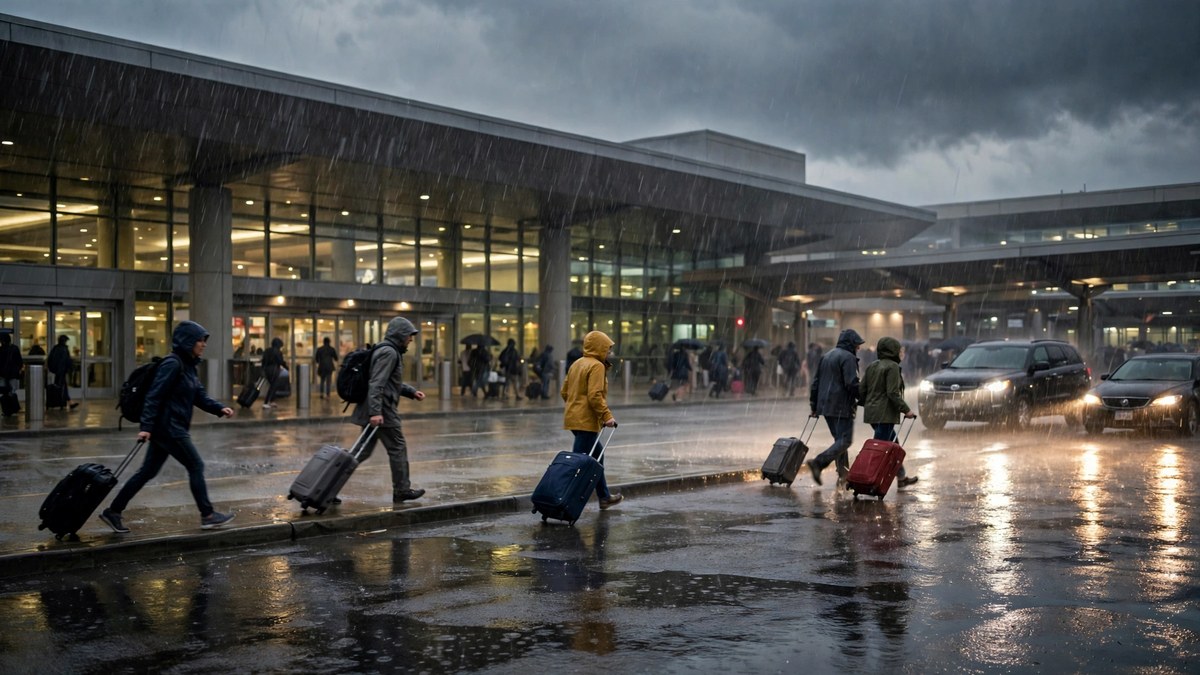
Thanksgiving storms on both coasts threaten travel for 81.5 million Americans this week, with a possible nor’easter due in the Northeast on Thursday and heavy rain in the West.
Key Points
- AAA projects 81.5 million Americans will travel at least 50 miles from home between Tuesday 24 November and Monday 30 November, including 72.9 million by car and 5.96 million on domestic flights.
- Sunday’s coastal storm had already delayed 141 flights and cancelled six at Boston Logan by 1 p.m. ET, according to FlightAware. Across the United States, 3,992 flights were delayed and 164 cancelled by the same time.
- Forecasters expect a second, stronger system to form off the Southeast coast late on Wednesday, then push into the Northeast for Thanksgiving Day. New York City could see gusts of 35 to 45 mph.
- The National Weather Service in Boston called it a potentially significant coastal storm for Thanksgiving into Friday, with coastal gusts possibly topping 50 mph and very high tides raising the risk of coastal flooding.
- From Tuesday, a Pacific storm carrying an atmospheric river reaches the West Coast, from Northern California to Washington, with heavy rain, strong winds and snow in the mountains. Delays are possible at Seattle and San Francisco airports and on Interstate 5 and Interstate 80.
- Thursday brings the 100th Macy’s Thanksgiving Day Parade, starting at 8:30 a.m. ET. Under city rules, the balloons stay grounded when sustained winds rise above 23 mph, or when gusts go past 34 mph, and the forecast gusts would exceed both limits.
What happened
The first storm arrived before the travel rush. A coastal system that had dumped record rain on Florida moved up the East Coast on Sunday, bringing heavy rain and gusty winds from the mid-Atlantic to New England.
In New York City, rain began early on Sunday afternoon, with the heaviest falls expected between about 5 p.m. and midnight and one to three inches in total. City emergency officials warned of gusts of 25 to 35 mph, with a few over 40 mph possible on Sunday night. Boston faced up to two inches of rain and gusts of up to 45 mph near the coast.
By 1 p.m. ET on Sunday, FlightAware counted 141 delayed flights in or out of Boston Logan, plus six cancellations. The nationwide tally by the same hour was 3,992 delayed flights and 164 cancelled.
Florida had already taken the worst of the rain. The National Weather Service put the storm total at Cocoa Beach at 24.81 inches from Tuesday to Saturday morning, with more than two feet falling in parts of Brevard County. On Friday morning, the St. Johns River at Cocoa rose to 18.66 feet, passing the 1953 mark of 17.55 feet, and forecasters expect it to hold near 18.8 feet into the middle of the week. Flooding along the river is expected to linger past Thanksgiving. Florida was already dealing with the same wet stretch further south, where flooding shut schools across Broward County last week.
Airlines faced a separate problem on Sunday. Delta Air Lines asked for a temporary ground stop on flights bound for its Atlanta hub after a failure in its automated weight-and-balance calculation system. The Federal Aviation Administration lifted the stop and replaced it with a broader ground delay. The setback came 10 days after a telecommunications failure forced the FAA to halt flights across the country for more than four hours on 13 November. Air travel has been disrupted elsewhere this week too, with a controllers’ strike grounding flights across Belgium.
Why it matters
The timing could hardly be worse. AAA’s holiday count stands at 81.5 million, down 121,000 from 2025, but still one of the busiest Thanksgiving periods on record. Driving accounts for the bulk of it: around 72.9 million people, close to nine in ten travellers. The industry group Airlines for America puts the flying total at close to 29 million for 20 to 30 November.
The heaviest travel days are Tuesday and Wednesday, exactly when the next systems arrive. Wednesday brings the threat of heavy rain and thunderstorms to Atlanta and Charlotte, two of the busiest hubs in the country, and delays there can ripple across the national network.
The Thanksgiving Day storm itself is still uncertain, and the uncertainty is the story. The European model and the newer AI-based forecasts put the storm nearer the coast, which would bring the worst of the rain and wind to the I-95 corridor. The American GFS model, by contrast, keeps the storm slower and further out to sea, which would hold the rain back from much of the Northeast. Meteorologist Ryan Hall warned that the gap between the two forecasts could decide whether Thanksgiving Day is mostly dry or marked by widespread disruption.
The parade is caught in the same forecast. This year is the 100th Macy’s Thanksgiving Day Parade. Among the 100 balloons are new ones: Bluey, Earl the Squirrel and Sorcerer’s Apprentice Mickey Mouse. The parade gets under way at 8:30 a.m. ET on Thursday. Under city rules, the balloons stay grounded when sustained winds rise above 23 mph, or when gusts go past 34 mph. Forecast gusts of 35 to 45 mph in New York City would exceed both limits.
What happens next with the Thanksgiving storms
Monday is the quiet day. The weekend storm should clear New England by the afternoon, and forecasters call Monday the calmest day of the week across the country.
Tuesday brings the next round. In the East, a storm develops in the Southeast overnight. In the West, a Pacific storm fed by an atmospheric river hits from Northern California to Washington state, with heavy rain, strong winds and mountain snow. A second, possibly windier Pacific storm could strike the same area on Wednesday, and the heaviest rainfall spreads across most of the West Coast on Thursday, continuing into Friday. Delays are possible along Interstate 5 between Seattle and San Francisco and on mountain routes including Interstate 80, as well as at Seattle and San Francisco airports.
On Wednesday, the eastern storm moves into the mid-Atlantic with rain and some wind, while heavy rain and thunderstorms hit Atlanta and Charlotte. Late on Wednesday, the system that could become the nor’easter forms off the Southeast coast. It moves up the East Coast on Thanksgiving Day, bringing heavy rain and strong winds from the mid-Atlantic to New England, with some snow or ice possible in the interior Northeast and the Appalachians. The National Weather Service in Boston warned of gusts possibly topping 50 mph along the coast and very high tides that could bring coastal flooding. The storm’s leftovers clear New England early on Friday.
Forecasters say another storm could form the weekend after Thanksgiving, but it is too soon to tell whether it will be a major system or a nuisance. For now, the advice is simple: check flight status before leaving home, allow extra time on the roads, and expect the forecast to change as the storm’s track firms up.
Sources: The Weather Channel, Fox News, Associated Press, National Weather Service, AAA, FlightAware, Washington Post | 23 November 2026