

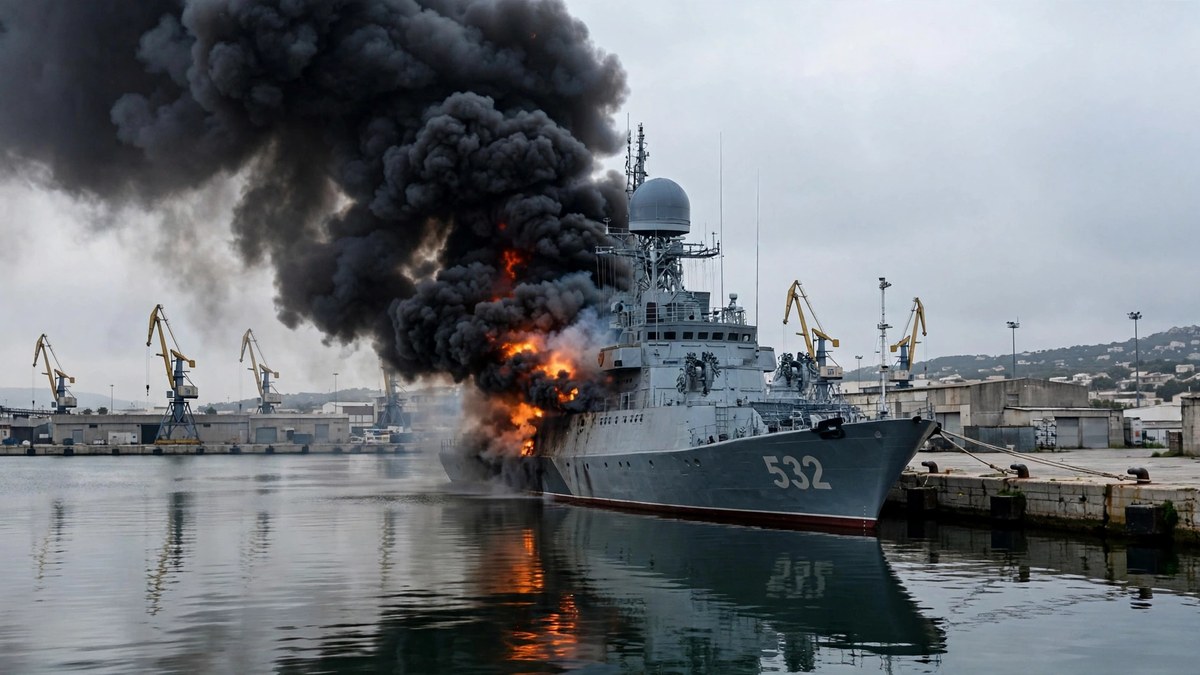
A Russian corvette was severely damaged in a suspected Ukrainian sea-drone strike at the Benghazi naval base in Libya on Sunday, Libyan officials said, in the second attack on a Russian ship in two days.
Key Points
- A suspected Ukrainian sea-drone strike hit the Russian corvette Merkury at Benghazi naval base before dawn on Sunday 22 November, Libyan military officials said.
- At least four sea drones were intercepted and destroyed, but two got through and struck the warship, setting it on fire.
- No deaths were reported. Medical sources said 10 people, Russians and Libyans, were slightly injured.
- The ship had stopped in Benghazi to take on fuel and supplies while sailing back to Russia.
- Libya’s eastern government called the strike a suspected drone attack, opened a joint investigation with Russia, and said Libya is not a party to the Russia-Ukraine war.
- It was the second Russian ship hit in two days, after the Sparta II cargo ship was struck in the Baltic Sea on Saturday.
What happened
Before dawn on Sunday, an explosion tore through a Russian ship docked at the Benghazi naval base in eastern Libya. Libya’s eastern-based government said its first findings pointed to a drone attack on the vessel, which had stopped at the port to take on fuel and supplies while sailing back to Russia under maritime cooperation agreements between the two countries.
Two Libyan military officials told the Associated Press the ship was the Merkury, a Russian Navy corvette, and that it had been badly damaged. The drones came from a facility in western Libya operated by Ukrainian forces, the officials said, citing the first findings of the investigation. Defences stopped at least four of the drones, but two reached the vessel and struck it, setting it on fire.
The fire was later brought under control, the eastern government said, and the port and naval base facilities, including warehouses, were safe, with normal operations resuming. Satellite pictures taken on Sunday showed a thick plume of smoke hanging over the port area.
No deaths were reported. Medical sources told Arab News that 10 people, Russians and Libyans, were slightly injured and were being treated in Benghazi. Medical sources who spoke to Reuters confirmed there were injuries but said the number and nationalities were not immediately known.
The eastern government did not name the ship or say who carried out the attack. It condemned the strike as a violation of Libya’s sovereignty and a threat to safety at sea, and said it would take legal and diplomatic steps against anyone found responsible. A joint inquiry with Russia has been opened to establish how the drones reached the ship, where they came from, and who ordered the attack.
In a separate incident on Sunday, a Maltese-flagged commercial vessel was targeted by a drone boat off the Benghazi coast, two Libyan military sources told Reuters. Libyan naval and air forces intercepted more than 20 drone boats off Benghazi during Sunday evening, the sources said.
Why it matters
The strike drags Libya deeper into a war it insists is not its own. The eastern government said: “The Libyan government will not allow Libyan ports, territory or territorial waters to be turned into an arena for settling scores or exporting international conflicts.” The government in Tripoli, in the west of the country, voiced the same warning, saying it rejected turning Libya into a theatre for outside powers.
It is also the second Russian ship hit in two days. On Saturday, the Russian cargo ship Sparta II was struck by drones in the Baltic Sea near Finland, in an attack Finland’s border guard linked to Ukraine. The Benghazi strike, more than 3,000 kilometres away, suggests the campaign against Russian shipping is widening, not slowing.
There is a pattern behind it. Ukrainian forces operating from western Libya, most of them drone specialists, struck a Russian tanker in the Mediterranean near Maltese waters in March, Libyan officials told the Associated Press at the time. Those forces work mainly from an air base in the coastal city of Misrata, and from facilities in Tripoli and Zawiya. Axios reported, citing a source with knowledge of the matter, that Ukraine’s SBU security service carried out the Benghazi strike. Neither Russia nor Ukraine has commented on the attack.
For Moscow, the damage is awkward as well as costly. The Merkury is a modern Steregushchiy-class corvette, and naval analyst H I Sutton said it was almost certainly destroyed, based on satellite images. If that holds, it would be the second ship of its class knocked out this year. A Russian Emergencies Ministry transport plane flew from Moscow to Benghazi hours after the blast, according to flight-tracking data.
Libya has been split since the 2011 uprising that toppled Moammar Gadhafi. A United Nations-backed government sits in Tripoli, while a rival administration runs the east from Benghazi. The country has become a focal point in the long rivalry between Russia and the West, and Sunday’s attack shows how easily a faraway war can wash up on its shores, as the strikes on two tankers near the Strait of Hormuz showed the same risk in the Gulf on the same weekend.
What happens next
On Monday, the UN Support Mission in Libya called for an immediate, independent and transparent investigation into the attacks at Benghazi Seaport and off the coast, warning against actions that could drag Libya into wider regional conflicts.
The joint Libyan-Russian investigation will try to establish how the drones reached the ship, where they were launched from, and who ordered the strike. Its findings will shape whether Libya presses the legal and diplomatic measures its eastern government has threatened.
Watch for Moscow’s response. Russia had not commented by Sunday evening, and no group had claimed responsibility. If the Merkury is written off, it will be a visible loss for Russia’s Mediterranean presence, and the flight of the Emergencies Ministry plane to Benghazi suggests Moscow is already dealing with the aftermath on the ground.
The wider question is whether the drone-boat campaign off Libya continues. More than 20 drone boats were intercepted off Benghazi on Sunday evening alone, and a commercial vessel was also targeted. Shipping through the eastern Mediterranean, already on edge after the Hormuz attacks, will be watching for the next strike.
Sources: Reuters, Associated Press, CNN, Arab News | 23 November 2026