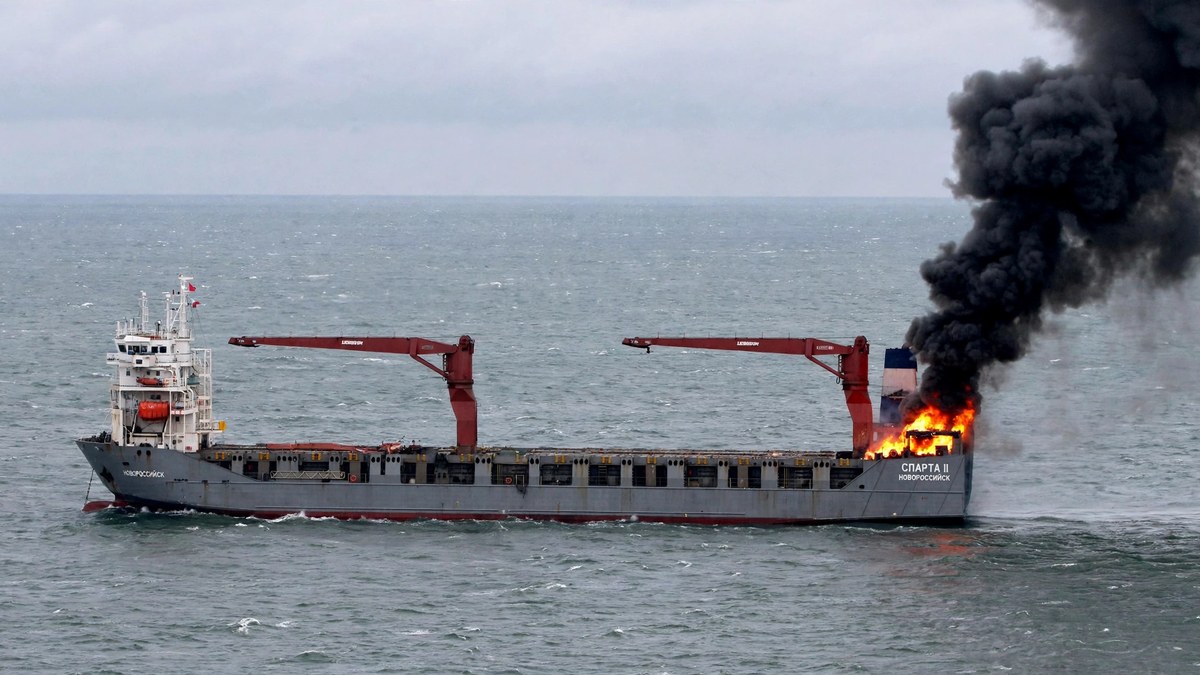
A Russian cargo ship with links to the military caught fire in the Gulf of Finland on Saturday after a suspected Ukrainian drone strike, forcing all 16 crew members to abandon the vessel.
Key Points
- Drones hit the Russian-flagged cargo ship Sparta II in the Gulf of Finland on Saturday morning; the vessel caught fire and drifted into Finnish waters.
- All 16 crew members evacuated onto lifeboats and were picked up by a nearby Russian ship; they were on their way back to Russia late on Saturday.
- Finland said Ukraine was likely behind the attack, although it was not clear why the ship was targeted. Ukraine has not commented.
- The ship is under US sanctions and owned by Oboronlogistika, a company that provides logistics for the Russian Defence Ministry. What it was carrying has not been confirmed.
- Hours later a Russian helicopter was suspected of briefly entering Finnish airspace during the rescue, and Finland’s prime minister said the war was “spilling over” into its neighbourhood.
What happened in the Gulf of Finland
Finland’s coast guard was alerted at around 08:50 local time on Saturday, after the Sparta II was hit about 50 kilometres west of Suursaari, an island in the eastern Gulf of Finland. Russian officials said two drones struck the vessel in international waters, roughly three nautical miles from Russia’s border. The strike set the rear of the ship alight, and flames and thick black smoke poured from the stern as the vessel drifted from international waters into Finnish territorial waters.
The Sparta II is a 121-metre roll-on/roll-off cargo ship that left St Petersburg on Friday, bound for Baltiysk, the port that serves the Russian exclave of Kaliningrad. It is owned by Oboronlogistika, a Russian shipping company that provides logistics services for the Russian Defence Ministry, and it is under sanctions from the United States and Ukraine. Open-source records list the vessel as suspected of carrying weapons from Syria to Russia, although Finnish officials said there was no confirmed information about what was on board this time.
All 16 crew members got off the ship onto lifeboats and were picked up by a nearby Russian vessel. Finland’s Border Guard said late on Saturday that they were on their way back to Russia. The fire was still burning late into the evening, and the ship was at anchor in Finnish waters off the southern town of Loviisa while firefighting continued. A Russian rescue ship, the Murman, joined the operation at the Border Guard’s request.
Russia’s Leningrad region governor, Aleksandr Drozdenko, said 80 drones had been shot down over the region overnight and lifted a drone threat warning. Finland, for its part, put temporary aviation and maritime restrictions in place across the eastern Gulf of Finland, to protect civilians and give its forces room to work if more drones had to be intercepted.
Why the Sparta II strike matters
Finland’s government did not treat this as an isolated incident at sea. Its armed forces said it was likely that Ukraine was behind the attack, although it was not clear why this ship had been picked out. Ukraine’s Foreign Ministry did not immediately respond to a request for comment.
Prime Minister Petteri Orpo wrote on X that the war was “spilling over into our neighbouring areas” and that Ukraine had the right to fight back against the aggressor. President Alexander Stubb called the events serious and said he was in close contact with the country’s foreign and security leadership. Sweden’s defence minister said Swedish combat aircraft, operating under Finnish command, had taken part in safeguarding Finland’s and NATO’s territorial integrity. Estonia sent a navy vessel to help with the rescue, firefighting and pollution response.
The strike fits a wider pattern. Ukraine has sent waves of military drones towards Russia’s north-western Leningrad region this year, and Finland’s military said only last week that it had detected a strike on a Russian warship in the same stretch of water. The region has been on edge since Russian missiles landed in Poland on Friday. Finland and Sweden are NATO’s newest members, joining in 2023 and 2024 after Russia’s full-scale invasion of Ukraine in 2022, and the incident has sharpened fears in the region that the war is reaching NATO territory. Merchant shipping has come under fire elsewhere too: two tankers were hit near the Strait of Hormuz in a separate attack.
What the Sparta II was carrying is still unknown. Ilja Iljin of the Finnish Border Guard said it could not be ruled out that there was military materiel on board. The ship’s military logistics link, and its sanctions history, are part of why the attack has drawn so much attention — and why it is different from an ordinary shipping accident.
Russia has previously described attacks on its commercial vessels outside its territorial waters as acts of terrorism and maritime piracy. Its embassy in Helsinki did not immediately respond to requests for comment.
What happens next
Firefighting on the Sparta II was still going on late on Saturday, and Finnish authorities said Russian vessels might eventually tow the wreckage home. The question of what the ship was carrying has not been answered, and neither has the question of why it was targeted. Ukraine has not claimed the strike, and Finland has not said what evidence points to Kyiv beyond its assessment that Ukraine was likely behind it.
Finland is also looking into a separate incident from the same day: a Russian helicopter was suspected of briefly violating Finnish airspace during the rescue operation. The defence ministry suggested the two events might be linked.
For Kaliningrad, the region the ship was sailing to, the governor said the incident posed no threat to supplies. For Finland and its neighbours, the incident has become a test of how far the war in Ukraine can reach into the Baltic — and what NATO’s newest members do when it arrives on their doorstep.
Sources: Reuters, CNN, BBC, Dawn, Al Jazeera | 22 Nov 2026