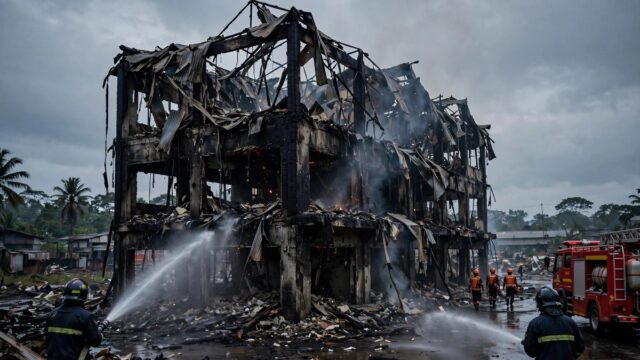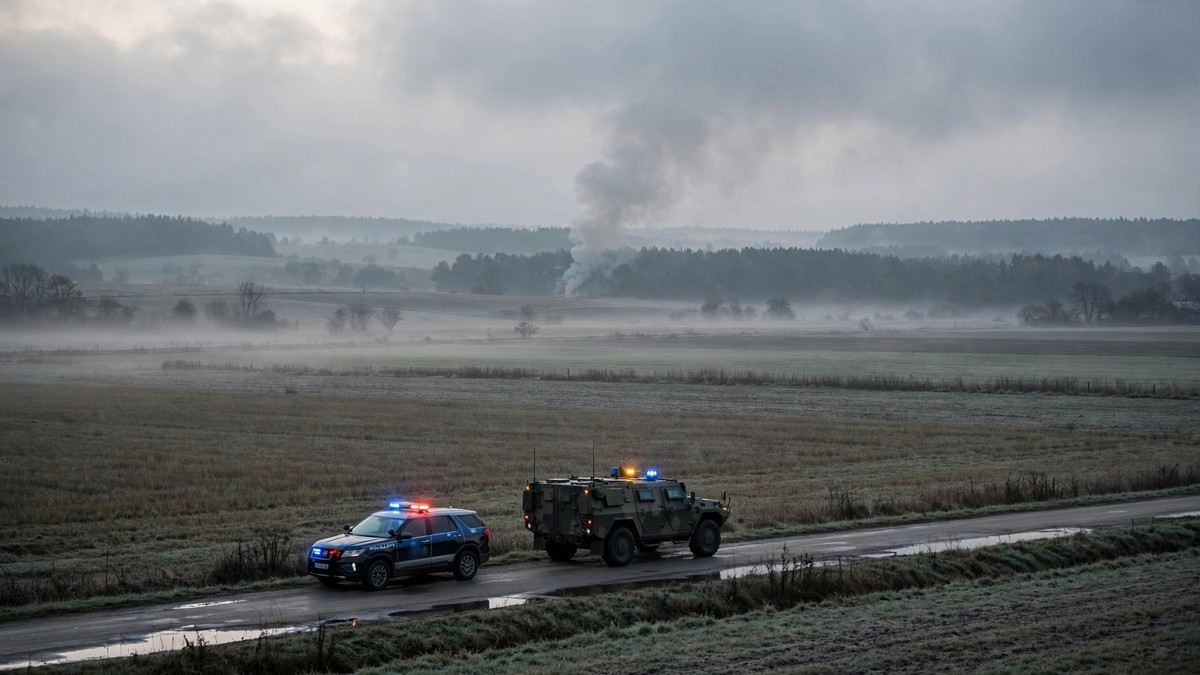
Russian missiles came down in Poland on Friday during a huge overnight attack on Ukraine, and Warsaw called the incursion a deliberate provocation as NATO fighter jets scrambled to meet the threat.
The incursion put Russian weapons on the soil of a NATO member during one of the largest air attacks of the war, at the same time as European troops were drilling nearby for a possible postwar mission in Ukraine. Nobody was hurt in Poland, and no damage was reported, but the prime minister said the timing left no room for doubt about intent.
Key Points
- Three Russian objects entered Polish airspace early on Friday: a confirmed Kh-101 cruise missile, a second suspected missile and a likely jet-powered drone.
- Nobody was hurt in Poland and no damage was reported, Polish officials said.
- The incursion came during a Russian attack on Ukraine involving more than 400 drones and 110 missiles, which killed at least eight people.
- NATO jets scrambled in response, and Poland will ask the alliance for more air defence. NATO chief Mark Rutte visits Warsaw on Saturday.
- France has called for a UN Security Council meeting. Russia has not commented.
- Hours before the missiles fell, President Trump had dismissed Russian incursions into Poland as “a couple of little missiles, by mistake”; Tusk said no one could now call it an innocent accident.
What happened
The objects came down in south-eastern Poland in the early hours of Friday, 20 November, while Russia was striking Ukraine with what President Volodymyr Zelenskyy described as one of its largest attacks since the full-scale invasion began. Poland’s defence minister, Wladyslaw Kosiniak-Kamysz, confirmed three separate airspace violations at a press conference later that day.
Investigators identified one of the objects as a Kh-101 cruise missile, which fell in fields near the village of Nowy Lipowiec, about 60 kilometres from the Ukrainian border, and caught fire. A second object, also believed to be a missile, came down near Rudnik nad Sanem, and a third, most likely a jet-powered drone, near Molodycz. Footage from a security camera in the nearby village of Chmielek showed a flash and an explosion in the distance.
Polish military officials said 11 objects had posed a possible threat to Polish airspace during the night, and three crossed the border. The Kh-101 spent about three minutes over Poland. Polish F-16s flew patrols with Swedish Gripen jets and a Dutch refuelling aircraft, while Patriot batteries around Rzeszow-Jasionka airport and near Swidnik were switched on. No shots were fired. A Swedish pilot could not see the target through poor weather, and Polish rules require a firm identification before firing.
The control tower at Rzeszow-Jasionka, a key transit point for military aid reaching Ukraine, was briefly evacuated and flights were held before resuming on Friday morning.
In Ukraine, Zelenskyy said Russia fired more than 400 drones and 110 missiles in the overnight assault. At least eight people were killed and nearly 30 injured. The barrage also damaged bridges and transport infrastructure across the country, and knocked out power, water and heating in parts of Kyiv.
The assault came hours after President Donald Trump, Xi Jinping and Vladimir Putin held a trilateral meeting in Shenzhen, and after Putin vowed to retaliate for Ukrainian strikes on the bridge linking occupied Crimea to Russia.
Trump called it a mistake — hours before the missiles fell
The incursion landed in the middle of a public row between Washington and Warsaw. On Thursday, as he flew back from China aboard Air Force One, President Donald Trump told Fox News that Russian drones and missiles had reached Poland “by mistake”, calling them “a couple of little missiles”. He was answering criticism from Tusk, who had objected to Trump calling Vladimir Putin “my friend” at their meeting in Shenzhen. Tusk replied on X: “God, protect us from such friends,” adding that Putin “is not and never will be our friend”. Trump’s remarks came before the overnight barrage — within hours, two more missiles and a drone were down on Polish soil. At his Friday press conference, Tusk said no one could now pretend the incident was “an innocent accident”.
Why it matters
Poland is a NATO member, and the alliance’s Article 5 treats an attack on one member as an attack on all. The clause is not triggered automatically. It is a political decision for all 32 members, and none has invoked it over the incident. Poland reported no injuries and no damage, which gives the alliance room to answer with words and reinforcements rather than force.
Warsaw is pointing to the timing. The objects came down while troops from 11 countries were taking part in Coalition of the Willing exercises near Nowa Deba, rehearsing for a possible postwar mission in Ukraine. The two-week exercise runs from 9 to 22 November. Prime Minister Donald Tusk called the link a hypothesis, but said nobody could call it an innocent coincidence. Kosiniak-Kamysz said the exercises, the visiting defence ministers and the chiefs of staff present made the overlap hard to dismiss as chance.
Russian weapons have crossed into NATO airspace before. Drones have repeatedly strayed over Poland and other states on the alliance’s eastern flank since 2022. In July, a Kh-101 came down near Tarnawa-Kolonia after a Polish F-16 scrambled. This time the scale was different: three objects at once, during one of the largest attacks of the war, and a public accusation of deliberate provocation from the prime minister himself.
The night also exposed how little time defenders have. Polish military officials said the objects flew at more than 800 kilometres per hour, too fast for radar operators to tell a cruise missile from a jet-powered drone. Crews had about three minutes to work out what the track was and whether it was safe to fire.
NATO Secretary-General Mark Rutte called the incursions “grave violations” of Polish airspace and said the incident was “clearly dangerous”. He said NATO jets had been scrambled in response and the alliance stood in solidarity with Poland.
What happens next
Rutte is in Warsaw today (Saturday) to discuss the response with Tusk, and Tusk said he expects practical decisions on strengthening air defence in the coming days and weeks. Several European defence ministers are expected in Poland over the weekend. Tusk said he had asked Rutte for recommendations on strengthening the alliance’s eastern flank.
France has called for a meeting of the United Nations Security Council. Britain’s prime minister, Andy Burnham, condemned the violation as “utterly unacceptable” at an EU-UK summit in Brussels, saying Europe would not be deterred from supporting Ukraine.
Poland will ask NATO for more support on its eastern flank. Polish defence outlets reported that the request includes airborne early warning aircraft and F-35 fighter jets. Tusk said Poland would also give the United States access to the missile debris. Poland also has the option of requesting NATO Article 4 consultations, a step it took after Russian drones crossed its airspace in September 2025.
Investigators are still working at the three sites. Polish officials said the Kh-101 had been manufactured near Moscow in the second quarter of 2026. Russia has not commented on the incident.
The investigation continues, and with it the question Warsaw is pressing on its allies: what NATO does when Russian weapons land on its territory.
Sources: Reuters, Associated Press, Al Jazeera, BBC, Kyiv Independent, SOFREP, Kyiv Post, Hromadske, LIGA.net, Firstpost. Published 21 November 2026.