Key Points:
- The USS Theodore Roosevelt entered US Central Command’s area of responsibility on Sunday 15 November; a US official confirmed the arrival on Monday, and CENTCOM later confirmed it on X as a scheduled deployment.
- It joins the USS George H.W. Bush and the USS George Washington, bringing three carrier strike groups to the region for the first time since April, and before that the 2003 invasion of Iraq.
- The flotilla counts 13 destroyers, two cruisers and a littoral combat ship, with more than 20,000 sailors and Marines.
- President Donald Trump has said new strikes are “quite unlikely” while keeping the option open; Iran says it will not wait to be struck first and has ruled out nuclear inspections until the war ends.
- Diplomacy remains stalled: Pakistan says a US reply to Iran’s two-day plan to reopen the Strait of Hormuz is still pending.
A third American aircraft carrier has arrived in the Middle East, in the largest US naval concentration in the region since the spring, as the war with Iran grinds on and talks to end it stay stuck.
The USS Theodore Roosevelt moved into US Central Command’s area of responsibility on Sunday, 15 November. A US official confirmed the arrival on Monday, and Central Command later confirmed it in a post on X, saying the carrier “is currently operating in the CENTCOM area of responsibility as part of a scheduled deployment”. The Pentagon had not formally confirmed the move when the first reports appeared.
The Roosevelt joins the USS George H.W. Bush, which arrived in April, and the USS George Washington, which arrived in August. Three carrier strike groups last operated together in the region in April. Before this year, the last time the United States had three carrier groups in the Middle East was 2003, when they supported the early phase of the invasion of Iraq.
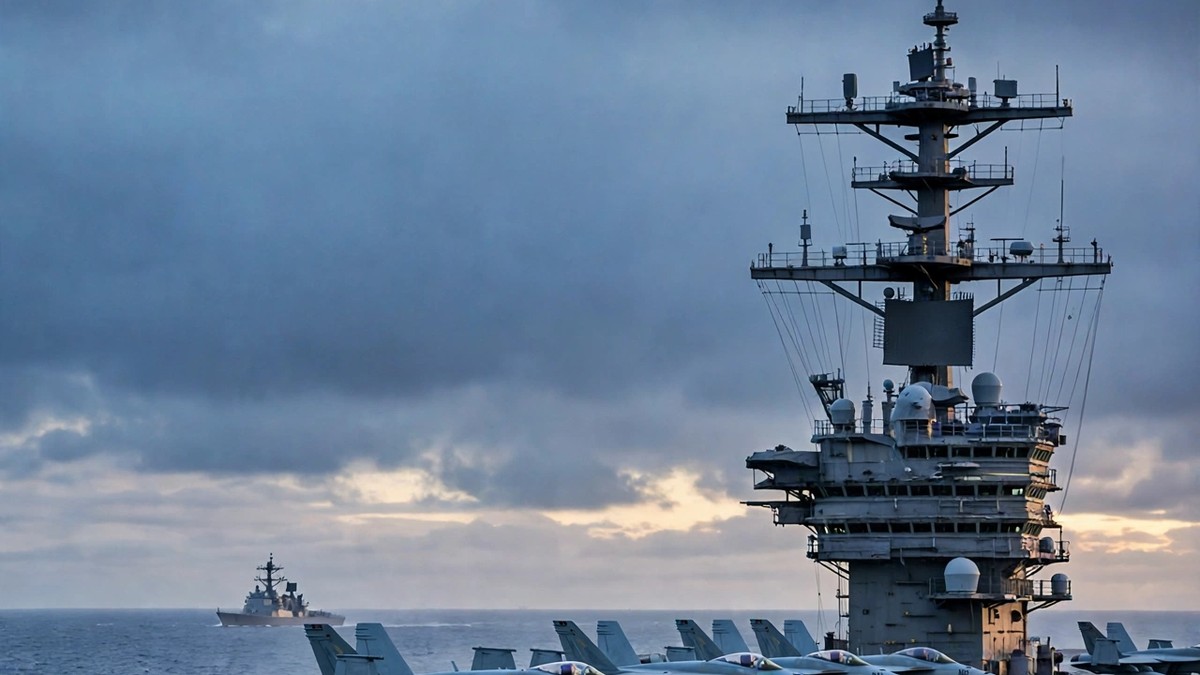
The ship left its home port of San Diego in September. It is a nuclear-powered carrier commissioned in 1986, carrying more than 5,000 crew and an air wing of over 60 aircraft, including F-18 fighter jets. The Makin Island amphibious ready group, carrying around 2,000 Marines, sailed with it.
What happened with the third US aircraft carrier
The wider flotilla in the Arabian Sea now includes 13 destroyers, two cruisers and a littoral combat ship, according to the US Navy. The Times of Israel put the total at more than 20,000 sailors and Marines and hundreds of aircraft. The Wall Street Journal reported that the carrier group and related deployments could involve another 9,000 to 10,000 US personnel in total, a figure the US military has not confirmed.
It is not yet clear whether all three carrier groups will stay. The Roosevelt had been expected to relieve the George Washington, which arrived in late August and itself relieved the USS Abraham Lincoln. US officials have said all three could remain if necessary.
The arrival was first reported by a US official speaking to Al Jazeera and to the Associated Press, and was also reported by The National, the Straits Times, the Jerusalem Post and the Hindu. USNI News, the specialist naval outlet, reported that the Roosevelt “chopped into US 5th Fleet on Sunday” and published a photograph of the carrier crossing the Indian Ocean on 15 November.
The move comes in a week of fast-moving developments. President Trump is travelling to Asia for talks with China’s Xi Jinping and Russia’s Vladimir Putin in Shenzhen, where he has said the leaders will also discuss Iran. Iran’s foreign minister, Abbas Araghchi, spent Monday in Islamabad, where Pakistan is mediating, and was due in Muscat on Tuesday for talks with Oman.
Why the third US aircraft carrier matters
The carrier’s arrival sharpens a contradiction at the heart of the war. Trump said last week, after meeting Qatar’s prime minister, that further military strikes against Iran were “quite unlikely” and that the military part of the war was “effectively over”. He added that the United States remained “locked and loaded” if conditions changed, and told his lead negotiator, Vice President JD Vance, “We don’t need a deal with Iran.”
Secretary of State Marco Rubio has argued that the economic campaign against Tehran is working, so a return to large-scale operations is likely unnecessary. The United States is enforcing a naval blockade of Iranian ports and has tightened sanctions, while a newer task force aims to cut off Iran’s trade by land and through the Caspian Sea.
Tehran reads the build-up differently. Deputy Foreign Minister Kazem Gharibabadi said Iran “will not wait for the US to attack first” and warned that Washington may be using diplomacy to buy time to prepare another attack. Iran has also said it will not let UN inspectors visit its damaged nuclear facilities until the war has ended and its conditions are met, after the International Atomic Energy Agency urged Tehran to take steps towards resuming inspections suspended since last year’s 12-day war with Israel.
US intelligence agencies estimate Iran still holds between 1,500 and 2,500 missiles despite months of American and Israeli strikes, according to the Wall Street Journal. That estimate helps explain why the carrier matters: it gives Trump more military options if he chooses to restart active hostilities, even as he publicly plays down the prospect.
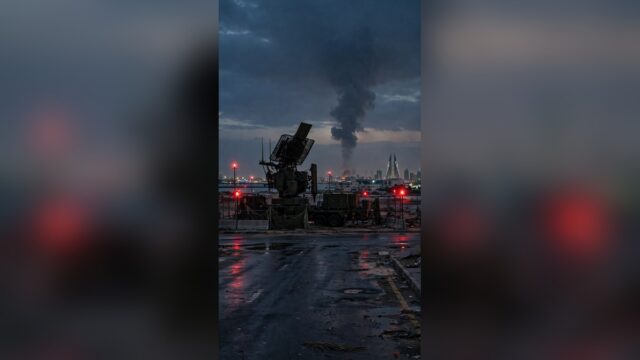
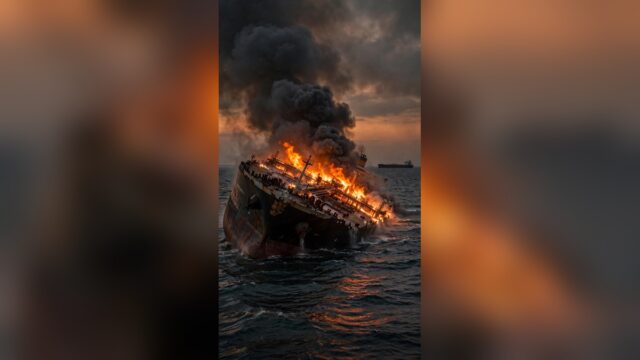
The context on the water is violent. Iran’s Revolutionary Guard says six tankers have caught fire or sunk in the Strait of Hormuz since Sunday after hitting naval mines, claims no outside source has confirmed. Britain’s maritime trade office confirmed on Monday that a tanker leaving the strait was hit by an unknown projectile and caught fire. On Sunday, Iranian drones attacked a US radar installation at a base in Bahrain, the first such attack on American military assets in a Gulf country in months. UN Secretary General Antonio Guterres has called for an end to the “neither peace, nor war” situation, saying a serious diplomatic process is needed.
What happens next
The first question is whether the third carrier is a relief or a reinforcement. If the Roosevelt replaces the George Washington, the build-up is routine rotation. If all three stay, it is a deliberate show of force — and a signal that Washington is keeping a strike option ready while talks drift.
Talks have not collapsed outright, but mistrust and maximal demands on both sides are squeezing what little room for a deal remains. Iran has proposed a two-day process to end the war and reopen the Strait of Hormuz, fast-tracked from an earlier seven-day plan, and says a 10-nation regional bloc has backed it. Pakistan’s foreign minister, Ishaq Dar, said on Monday that a response from the United States was still pending. Iran’s conditions include an end to the naval blockade, the lifting of sanctions, the release of frozen funds, an end to fighting on all fronts and a formal declaration that the war is over.
Overnight, air defences were activated in Isfahan in central Iran, according to the Mehr news agency via Reuters, which gave no cause. The report is a reminder of how thin the margin is: with three carrier groups, thousands of troops and a strait full of mines and warships, a single incident could turn a build-up into a battle.
Analysts quoted by Al Jazeera warned that both sides are caught in a dangerous game, each convinced that striking first may be safer than waiting. “The danger is that their efforts to deter another war could inadvertently ignite one that neither can win, contain or easily end,” said Ali Vaez of the International Crisis Group. For now, the carriers are in place, the talks are stalled, and neither side is backing down.
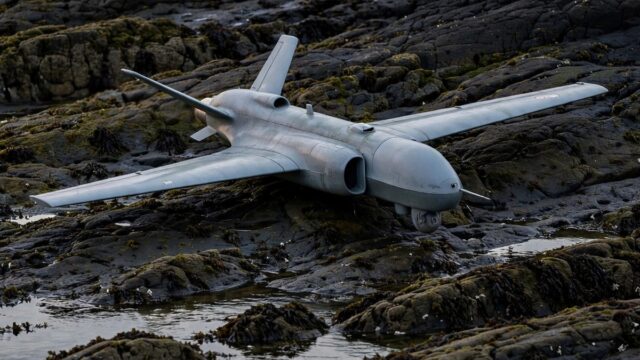
Iran says its navy seized a US drone intact near the Strait of Hormuz on Monday.
Iran claims a supertanker sank after hitting a naval mine in the strait on Sunday.
Sources: Associated Press, Al Jazeera, The National, USNI News, The Straits Times, The Jerusalem Post, Dawn, NDTV/AFP. Published 17 November 2026.