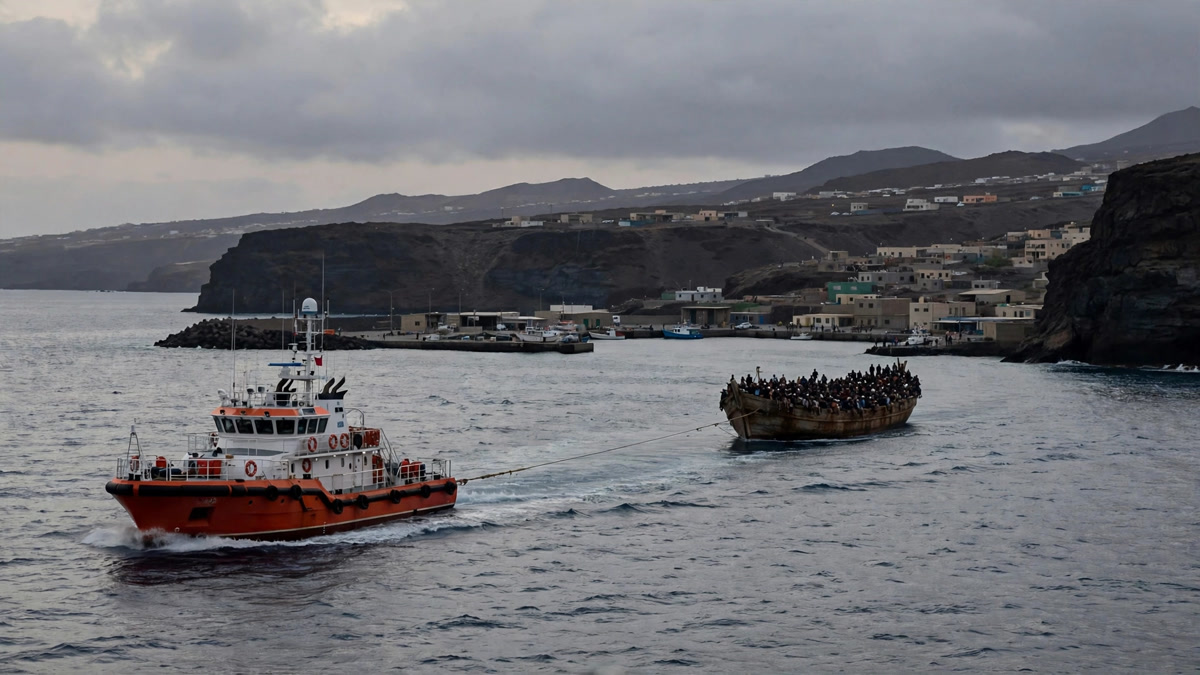
A record 1,488 migrants reached Spain’s Canary Islands on Saturday, the highest single-day total since 2020, as a surge of boats from West Africa strained rescue and reception services on El Hierro.
Key Points
- A total of 1,488 people were rescued from 14 boats on Saturday, passing the previous daily record of 1,461 set on 7 November 2020.
- A later provisional tally raised the day’s total to 1,580 people in 15 boats, after a final boat reached El Hierro late on Saturday night.
- Twelve of the boats landed on El Hierro, an island of about 11,400 people that has taken in 8,000 arrivals in five weeks.
- Most of those rescued came from Senegal, Gambia and Guinea-Conakry, after crossings that lasted four to seven days.
- Spain declared a migratory emergency in the Canary Islands on Tuesday and set aside 16.18 million euros in extra funding for reception and transfers.
What happened
The first boat of the day reached the port of La Restinga on El Hierro at 04:01. It carried 148 people from Senegal and The Gambia, including 18 women and 12 people believed to be minors, after six days at sea from Kayar in Senegal. More boats followed through the day, and by nightfall the count had passed every previous daily total on the route. Spanish reporting called it the biggest single day in the Atlantic route’s 32-year history.
Spain’s Maritime Rescue Service and the Guardia Civil sent eight vessels out to meet the boats. Six rescue ships, the Diphda, Acrux, Navia, Alpheratz, Mizar and Urania, worked with two Guardia Civil patrol boats, the Rio Tajo and the Rio Guadiato, to bring people ashore on three islands.
The largest single boat arrived at 17:26, carrying 240 people from Senegal, The Gambia and Guinea, among them 12 women and 36 children. They had spent six days at sea after leaving Gunjur in The Gambia. Two more boats arrived after dark, one carrying 214 people and another 171, including a six-month-old baby. The last boat of the day reached El Hierro at 23:07 with 92 people on board, among them a woman four months pregnant and an 18-month-old child.
In the first count released on Sunday morning, 1,488 people had been rescued from 14 boats. El Hierro took twelve of the boats. Gran Canaria took one, carrying 203 people, and Tenerife one more with 50. A later provisional tally, compiled from rescue service and quayside figures, put the day’s total at 1,580 people in 15 boats, including at least 120 women and 173 children. Counts from different agencies differed slightly while rescues were still being tallied.
The arrivals on Saturday followed 843 on Friday, taking the two-day total to 2,331 people, according to the EFE news agency. Boats were still arriving on Sunday. One from Senegal carrying 79 people was among the first, and ten rescue vessels were on duty across the weekend.
Why it matters
El Hierro took the weight of the day. Twelve of the fourteen boats in the first count landed there, and the later tally put the island’s share at 1,327 people. El Hierro is the smallest of the Canary Islands, home to about 11,400 people. In the five weeks before Saturday it had already received 8,000 arrivals, the BBC reported, and more than 3,300 people had landed there since the start of November alone.
A state of emergency is in force on the island, and its council has asked Madrid for extra staff and equipment. Its reception centre held 317 people before Saturday’s boats arrived, and 158 people were moved to Tenerife during the day to ease the pressure. A number of island residents have also demonstrated at La Restinga port against the continuing landings.
“El Hierro is a small island that understands what migration is. We are very united,” Alpidio Armas, president of the island’s governing council, told the BBC last week.
The surge has also put the wider archipelago under strain. Reception and emergency services on the smaller islands are stretched thin, and Madrid has moved to add beds in state-run centres and speed up onward transfers elsewhere in Spain. The record day also adds to the pressure on Spain’s government, which faced its first general strike in 14 years last week, over housing.
The Canary Islands route after a quiet year
Saturday’s record came after months in which arrivals had fallen sharply. In the first half of 2026, sea arrivals to the islands totalled just 3,708, down 67 percent on the same months of 2025. The January-to-October count stood at 13,327, a fall of 5.5 percent against the same stretch of 2025.
October changed the picture. More than 6,000 people arrived that month, close to half of the year’s total to the end of October. The pace then rose again in November. More than 3,200 people arrived in the first five days of the month, and over 4,200 were rescued between 2 and 6 November. Fernando Clavijo, president of the Canary Islands, said earlier this month: “We are looking at figures that remind us of 2024, when 47,000 people arrived on our shores.”
The Canary Islands are one of the main entry points for migrants reaching Spain by sea. Interior Ministry figures put total sea arrivals to Spain at just over 28,000 for January to October, with the Canary Islands accounting for more than 13,000 of them.
One of the world’s deadliest crossings
The sea journey from West Africa to the islands ranks among the most dangerous migration routes anywhere. At their nearest point, the islands sit around 105 kilometres off the African coast, but boats often take far longer routes to avoid patrols, and a crossing can last days or even weeks. Crossings usually increase in autumn, as calmer seas make the journey easier.
The danger was underlined again this month, when a boat that sank off Senegal killed 21 people. Between January and May 2026, 635 people died or went missing on the route, according to Spanish charity Caminando Fronteras. The charity recorded 1,906 deaths in 2025 and 9,757 in 2024.
What happens next
Spain’s Territorial Policy Minister, Angel Victor Torres, was due to visit El Hierro on Sunday to see the situation at the port of La Restinga and discuss the surge with local officials. The visit follows a meeting on Tuesday at which the Spanish government declared a migratory emergency in the Canary Islands and approved 15.18 million euros in extra funding to expand reception places and pay for transfers. A further 1 million euros was set aside to support Red Cross health and first-aid work, and a new rescue vessel, the Guardamar Caliope, was added to the fleet.
Transfers of new arrivals off El Hierro are continuing, and final figures for the record weekend may still change as the rescue service completes its count. Rescue services expect arrivals to continue while autumn seas stay calm.
Sources: Reuters, Associated Press, EFE, BBC, InfoMigrants | 15 November 2026