South Sudan’s election commission has moved the country’s first national elections since independence from December 22 to February 11, 2027, announcing the 51-day delay without giving a reason.
If it goes ahead, the vote will let South Sudanese pick their national leaders for the first time since the country broke away from Sudan in 2011. It has been put back again and again, and the latest delay comes days after the United Nations warned the country was not ready — with the election body short of money, the main opposition figure under house arrest, and party workers killed on the campaign trail.
Key Points
- Polling moves from December 22, 2026 to February 11, 2027. The commission gave no reason for the change.
- Voter registration runs from November 14 to 28 at 3,161 centres across the country.
- The commission has received $21 million of the $276 million it asked for to run the vote.
- The UN and the African Union warned that a rushed election could damage the country’s fragile peace.
- Riek Machar, the first vice-president, is still held at his home in Juba while his trial continues.
What happened
Saturday was also the day registration was due to open, and the commission put the new calendar out on social media that same day. It sets February 11, 2027 as polling day for the presidential and parliamentary elections, replacing December 22. The document gives no reason for the change.
“This is the timeline we have come up with after a thorough consultation with the stakeholders,” Josephine Achiro Fortelo, a commissioner and the commission’s spokesperson, told Reuters on Saturday, confirming the date had changed.
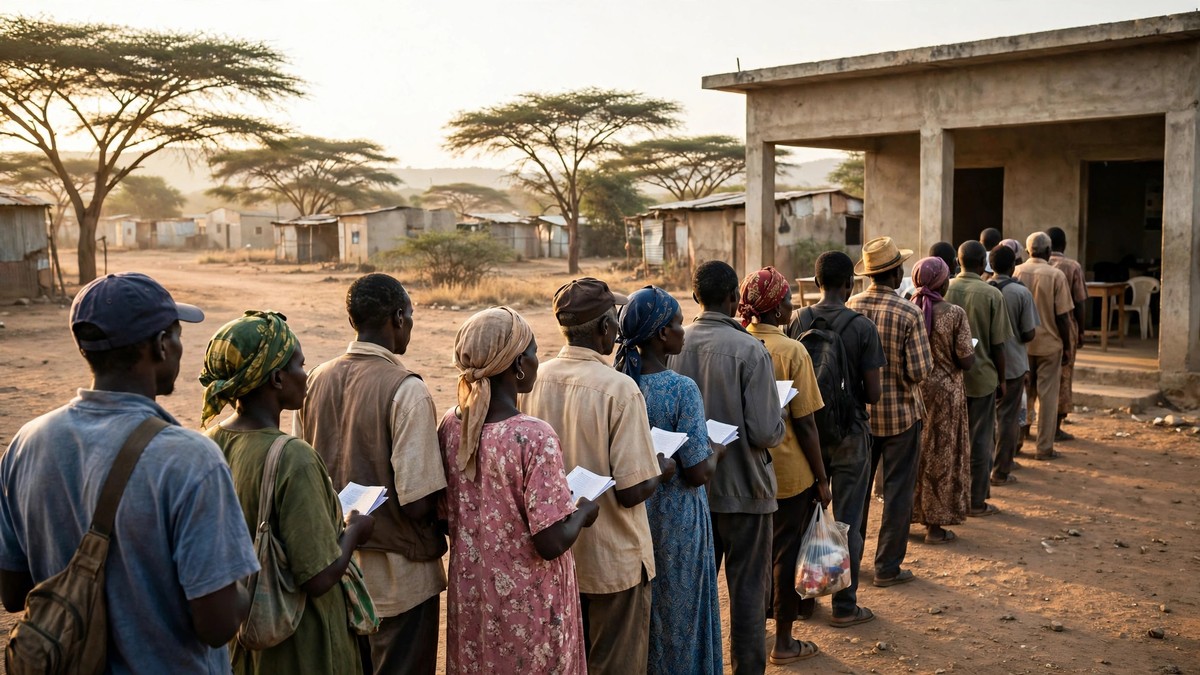
The day before the announcement, Gabriel Bol Deng, who chairs the commission, had told reporters in Juba that people could register between November 14 and 28 at 3,161 centres spread across the country’s 10 states and three administrative areas. He urged eligible citizens to register and asked political parties, civil society groups, community leaders and the media to help spread the word.
The new calendar lays out the road to polling day. The provisional voter register is due on November 29, and the final register on January 9. Candidate nominations run from December 14 to 20, with the final list of candidates expected between January 18 and 21. Campaigning runs for 45 days, from December 27 to February 9, followed by a day of silence on February 10. Counting at polling centres takes place on February 11 and 12, tallying is due to finish by February 15, and the final results are expected on February 16. The calendar allows 148 days, from February 17 to July 15, for election disputes to be settled.
Why it matters
South Sudan has never held a general election. Independence came in July 2011 after decades of civil war with Sudan, but within two years the country was fighting again, as forces backing President Salva Kiir clashed with those behind his rival, Riek Machar. A peace deal in 2018 ended five years of fighting that killed hundreds of thousands of people, and a transitional government of national unity was formed in 2020. The vote was first set for 2022, then pushed back in 2024, and the December date was the latest target before Saturday’s change.
Money is one problem. The commission has received only $21 million of the $276 million it requested to organise the elections, leaving a gap of $255 million.
Warnings have been piling up. Back in September, the United Nations Commission on Human Rights in South Sudan warned that the safeguards and conditions needed for a peaceful, credible vote were not in place. The Security Council heard the same message days earlier, when UN and African Union officials told it the country was not ready for a December vote and that a vote held too soon or run badly could break the fragile peace and restart the fighting.
“Elections must be a milestone in the transition, not its conclusion. Elections cannot substitute for political dialogue, confidence-building and continued implementation of the Peace Agreement,” Anita Kiki Gbeho, head of the United Nations Mission in South Sudan, told the Security Council on November 10. She also noted that Kiir’s ruling party, the Sudan People’s Liberation Movement, has been holding primaries while other registered parties have shown little electoral activity.
The African Union’s high representative for the Horn of Africa, Jakaya Kikwete, added his voice, warning that a badly run election could drag the country into a fresh crisis.
The politics are tense. Since March, Machar has not been allowed to leave his home in Juba. He is one of eight people on trial over an assault on the army base at Nasir, in the northeast — a case that carries charges of treason, murder and crimes against humanity. All eight deny the charges. Opposition groups have made his release a condition for joining political dialogue. September saw the transitional unity government dissolved and a caretaker administration take its place.
The South Sudan Civil Society Forum had already warned in a statement in late October that the time left was not enough for a fair, credible, peaceful and inclusive vote, and it urged an inclusive dialogue about how the election and the transition should be handled.
Violence has already touched the process. Two delegates from Kiir’s party died on Thursday when their group was attacked in Miri Loko village in Western Equatoria state on the way back from party primaries and congresses, officials said. Deng Dau Deng, who chairs the party’s high-level committee in the state, said it was the third attack of its kind to hit the primaries there. Veronica Lucy Gordon, one of the two killed, used to work as a journalist for the South Sudan Broadcasting Corporation and had recently been put forward as a candidate for a women’s seat in the National Legislative Assembly.
Edmund Yakani, who leads the Community Empowerment for Progress Organization, spoke out against the attack, saying people who disagreed with the delegates should argue their case through dialogue instead of turning to violence. Once the delay was public, Yakani pressed the commission to be open about its decisions. He pointed out that, on the morning registration was meant to start, voters still had not been told where the registration centres were.
Ministers had earlier stood by the December date, saying another delay would only stretch out transitional rule.
Elsewhere, voters have been going to the polls on schedule. A governor’s race in Alaska was settled this week, and Mississippi’s Senate contest also produced a winner.
What happens next
Registration runs until November 28, and the provisional register follows the next day. Nominations open on December 14, and campaigning starts on December 27. Polling is set for February 11, with final results expected on February 16.
Whether that date holds will depend on the money arriving, on security holding through the campaign, and on whether opposition groups take part. The commission has not said what happens if the funding gap stays open, or whether the February date is final. For now, South Sudan’s first election waits again — more than 15 years after independence, and more than two months later than planned.
Sources: Reuters, Arab News, The Eastleigh Voice, Moneycontrol. Published 15 November 2026.