Almost 1,200 Ukrainian drones flew at Russia overnight, in one of the biggest aerial attacks of the war — killing at least nine people and leaving a major Volgograd oil refinery on fire.
Key Points
- Russia’s Defence Ministry said its air defences shot down 1,198 Ukrainian drones overnight, in one of the largest aerial attacks of the war. Kyiv has not confirmed the scale of the operation.
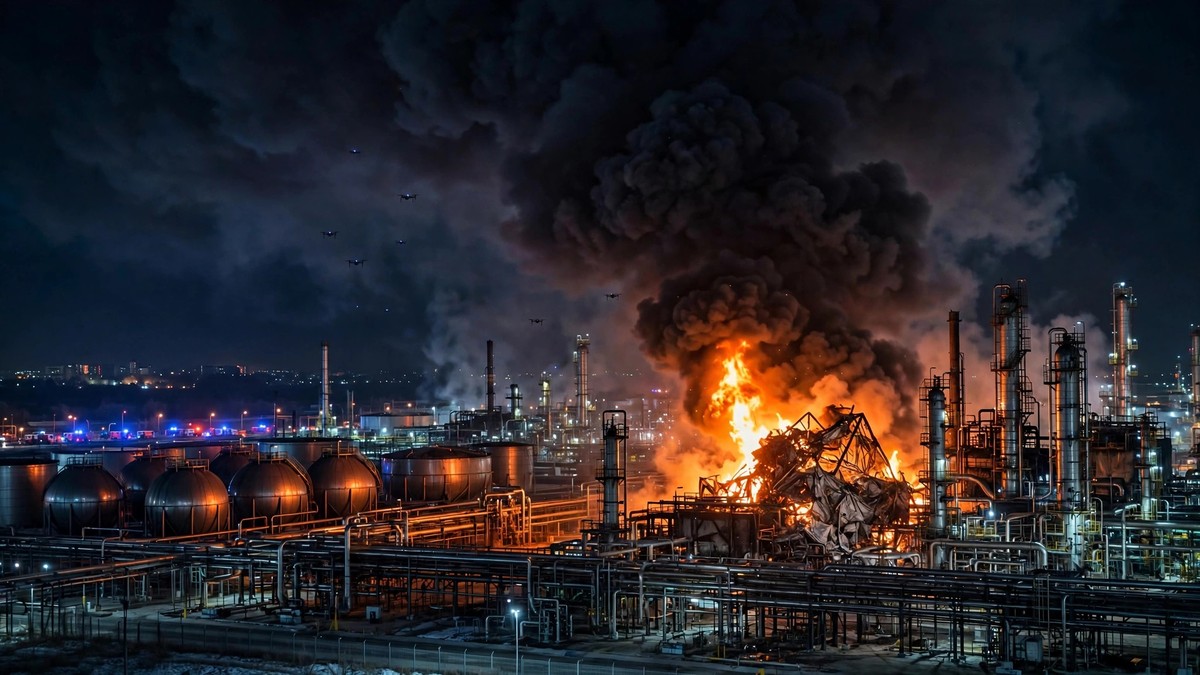
- At least nine people were killed in Russia, regional officials said, and Ukraine’s military said it hit a Lukoil refinery in Volgograd and set it on fire.
- Russia answered with 117 drones of its own, killing three people in southern Ukraine and wounding 30 in a strike on apartment blocks in Zaporizhzhia.
- The attacks came as US-led peace talks widened to cover European security, a shift that alarmed European leaders meeting in Dublin.
- Volodymyr Zelenskyy said limits on the Starshield satellite service were capping Ukrainian drones at 161 kph and weakening his country’s defences.
What happened in the overnight barrage
The barrage stretched from 8pm on Thursday to 8am on Friday, Moscow time. Russia’s Defence Ministry said its air defences intercepted 1,198 Ukrainian long-range drones over Russian regions, the Moscow area, Crimea and the Black Sea. That figure is Moscow’s claim and has not been confirmed from any other source.
The death toll in Russia was still being counted on Friday. Regional officials reported at least nine dead: four at an industrial site in the Samara region, four in Volgograd and one in the Bryansk border region, according to AFP. The Associated Press, citing local officials, reported seven killed, including a 12-year-old, and 17 wounded.
The heaviest damage was in Volgograd, in southern Russia. The regional governor, Andrei Bocharov, said four people were killed and two injured in an attack on the city’s southern industrial zone, the deadliest attack on the city so far. Falling drone debris set fires across the zone, according to local reports.
Ukraine’s General Staff said its drones hit the Lukoil refinery in Volgograd and started a fire, damaging four primary oil-processing units, a hydrotreating unit, a loading rack and six storage tanks. The plant can process roughly 14 million tonnes of crude a year — about one twentieth of all the oil Russia refines. Russian officials confirmed fires at an industrial site in the zone but did not name the plant, and Lukoil did not reply to a request for comment.
The refinery was not the only target. Ukraine’s military said Neptune cruise missiles hit the Ionos drone production site and the Aero-Hit service centre south-west of Volgograd, and the governor of Rostov region confirmed an attack on a production facility in Rostov-on-Don. Monitoring groups also reported a strike on an oil pumping facility in Samara, and Russian officials said drones heading for Moscow disrupted flights at several airports overnight. Two days earlier, Ukraine said it had hit the Omsk refinery, the country’s largest.
Russia struck back the same night. Ukraine’s air force said Moscow launched 117 drones, of which 80 were shot down or suppressed. Officials in Ukraine reported three deaths in the south, among them a 17-year-old boy. In Zaporizhzhia, a Russian strike on two apartment blocks left 30 people wounded, six of them children. A hospital in Kyiv was set ablaze. More than 3,200 medical facilities in Ukraine have been hit since 2022, the World Health Organization said in August.
Russian attacks on energy infrastructure also cut power across 12 Ukrainian regions, about half of the country, First Deputy Energy Minister Artem Nekrasov said. Russian forces have gone after Ukraine’s power grid in every winter of the war.
Why it matters
The barrage is part of a campaign against the fuel that powers Russia’s war. Since late October, Kyiv has hit Russian refineries far more often — a shift that followed the collapse of an energy ceasefire Trump had announced. Serhiy Vakulenko, a senior fellow at the Carnegie Russia Eurasia Center, counted nine refineries hit by drones in the past two weeks, among them all five of the country’s largest plants. Together, those plants turn out about 55% of the petrol Russia produces. Industry sources told Reuters this week that the attacks had temporarily cut about 30% of Russia’s refining capacity. Kyiv claimed last month it had knocked out more than half of that capacity.
The fighting also ran alongside a shift in the diplomacy. After two days of talks in Abu Dhabi, the American envoys Steve Witkoff and Jared Kushner briefed Putin at the Kremlin and Zelenskyy in Dublin — and the talks grew to take in the continent’s security order, the arrangements drawn up after the Cold War ended. Moscow has long sought that change. European leaders, meeting in Dublin, were alarmed.
“Russia wants to talk about questions of European security architecture. We don’t need to talk about that. There is one,” German Chancellor Friedrich Merz said, referring to NATO. The EU’s top diplomat, Kaja Kallas, said Europe must insist on a ceasefire before the talks go further. “If we start to talk about what Russia is asking regarding the security architecture, we actually walk into the traps that Russia is setting us,” she said. Luxembourg Prime Minister Luc Frieden said Europe must take its fate into its own hands. “We cannot let neither the Americans nor the Russians decide about our future,” he said. The Institute for the Study of War said in an assessment that Moscow was aiming “to dismantle NATO and the post-Cold War European security architecture.”
Putin held his line on the central questions. He would not give back land his forces hold, and he warned that any foreign peacekeeping force sent to Ukraine would count as a “continuation of the war” — and a legitimate target.
Zelenskyy also used Friday to repeat a complaint about the Starshield satellite service, the military version of SpaceX’s Starlink system that Ukraine’s forces rely on. He said the caps hold Ukrainian drones to 161 kph (100 mph) along the whole front and in occupied territory, so interceptors cannot catch Russia’s fast jet-powered drones. “We still have no clear explanations,” he said. Kyiv has asked the State Department, the Pentagon and SpaceX for an explanation. Limits of this kind disrupted Ukrainian operations last month, and they came back on Thursday. Musk said in October that SpaceX had slowed Starlink in Ukraine for about a week, because the system was not to be used for attacks into Russia.
What happens next after the Ukraine drone attack
More talks are planned, according to Witkoff and Kushner, and Russia has agreed that Europe will take part. Zelenskyy said Europe will get an equal seat at the next round, though the Kremlin has not confirmed that Putin agreed to it. European leaders are now scrambling to name an envoy for the talks, while work continues on what could become the war’s largest prisoner exchange.
Putin ruled out giving up territory seized by his forces, so the two sides are still far apart: Kyiv and Washington say Europe will be there, Moscow has not confirmed it, and its demands stand. That leaves the next round at risk of opening with a row over the guest list itself.
On the ground, the fighting continues along a front of about 1,200 kilometres, where Kyiv’s defence leans on uncrewed aircraft and ground robots. With winter coming, repair crews in Ukraine face the same task they have faced every year of the war: keeping the lights on while Moscow keeps hitting the grid. Kyiv is also still waiting for answers from Washington and SpaceX on the Starshield limits, which Kyiv says are weakening its defences against Russian drones.
Sources: Associated Press; Reuters; AFP; The Kyiv Independent. Published 14 November 2026, 09:52 +08.