An Israeli airstrike hit the surgery wing of Nasser Hospital in Khan Younis early on Thursday, 12 November, killing six people, including a surgeon, and wounding at least 20 others.
Key Points
- An Israeli airstrike hit Nasser Hospital in Khan Younis early on Thursday, 12 November, killing six people, including a surgeon.
- Gaza’s Health Ministry said at least 28 people were wounded; civil defence and other outlets reported more than 20 wounded.
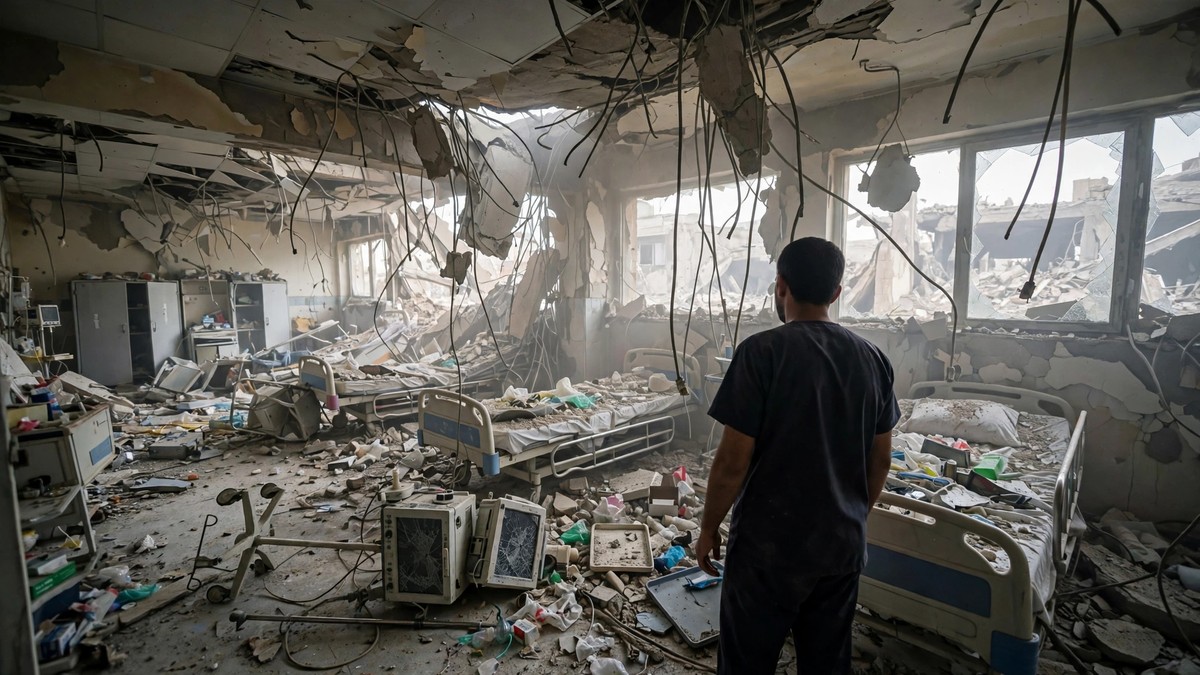
- The missile struck the surgery department on the second floor of the Al-Yasin building, wrecking the surgery ward and the intensive care unit.
- Israel’s military said it targeted Muhammad Abu Ismail, commander of Hamas’s Khan Yunis Brigade, and said the hospital was used as a command centre; it gave no evidence.
- Nasser is the largest hospital in southern Gaza and the only one still standing in Khan Younis, serving at least 500,000 people.
What happened at Nasser Hospital
A single missile fired from a warplane struck the Nasser Medical Complex shortly after midnight on Thursday, 12 November, according to eyewitnesses cited by the BBC. It hit the surgery department on the second floor of the Al-Yasin building, in the western part of Khan Younis, and tore vertically through several floors. The hospital’s director, Raed al-Dahshan, said the blast caused widespread destruction in the surgery department and the intensive care unit, and warned that the death toll could still rise.
Six people were killed, including general surgeon Rizk Abu Shaira. Gaza’s Health Ministry said at least 28 more were wounded, while civil defence put the wounded figure at more than 20. Most of those killed and injured were patients, including people who had been due to undergo surgery the following day, Al Jazeera reported. British surgeon Goher Rahbour, a volunteer at the hospital, was on the fourth floor of the surgical department when the missile hit. He said the blast shook the whole building and reduced the recovery area on the same floor to rubble. He had been operating alongside Abu Shaira only hours earlier. “Lovely guy, happy and smiling,” he said.
Inside the building, debris was scattered across hospital beds and medical equipment, and steel reinforcement bars dangled from ceilings where the missile had punched through. Early reports put the death toll at four, then five, before the hospital confirmed six dead.
Why it matters
Israel’s military said it carried out the strike jointly with the Shin Bet security service, targeting Muhammad Abu Ismail, the commander of Hamas’s Khan Yunis Brigade, along with other militants it said were hiding inside the hospital. It said Hamas had turned the complex into a headquarters and a command centre, storing weapons and running command rooms and observation posts there. It said advance warnings were issued and precision munitions were used. It provided no evidence for the claims, and Abu Ismail’s fate remained unclear hours after the strike.
Hamas condemned the strike as a war crime and said the claim that its fighters were inside the hospital was an attempt to cover up an attack on a civilian medical facility protected under international law. Gaza’s Health Ministry also called it a war crime and urged the international community to protect the territory’s health system.
Nasser is the largest hospital in southern Gaza and the only hospital still standing in Khan Younis, serving at least 500,000 people, according to Al Jazeera. It is one of the few medical facilities still working in the territory after a war that has wrecked much of its health system. This was the seventh time the complex has been struck in the past couple of years. In 2025, an Israeli strike on a gathering point for reporters at the complex killed five journalists, including AP contributor Mariam Dagga.
Hospitals and their staff are protected under international humanitarian law, although a hospital can lose that protection if it is used for military purposes. The strike also landed in the middle of a ceasefire that has held, in name, since October 2025. Since then, Gaza’s Health Ministry says 1,622 Palestinians have been killed and 5,878 wounded in Israeli attacks. The ministry puts the total killed since the war began on 7 October 2023 at 74,653, with 176,007 wounded.
The attack came as Gaza faces a separate crisis: heavy weekend rain flooded more than 70,000 tents for displaced families, affecting at least 106,000 people, according to UNICEF, and doctors have warned of a rise in meningitis cases as overcrowding and sewage-contaminated floodwater spread disease.
Israel’s politics are also in flux, with former military chief Gadi Eisenkot handed the mandate to form a new government. Read our report: https://worldpulsewire.com/2026/11/08/eisenkot-mandate-form-israel-government/
Washington’s support for Israel is itself under debate, with President Trump saying the US will stop 4 billion dollars in funding to Israel by year end. Read our report: https://worldpulsewire.com/2026/11/04/trump-says-us-will-stop-4-billion-funding-to-israel-by-year-end/
What happens next
The first question is whether the death toll rises. The hospital’s director has said he expects it to, given the nature of the injuries, and the wounded are being treated in a facility whose surgery and intensive care wards have just been wrecked.
The second is what the strike means for the ceasefire. Negotiations over the next stages of the US-brokered deal have made little progress, with the two sides unable to agree on terms for Hamas to disarm or for Israel to withdraw its troops. Israel currently controls roughly two-thirds of the Gaza Strip, and it says Hamas is trying to regroup and rebuild its arsenal, while Hamas says it remains committed to the agreement and accuses Israel of trying to undermine it.
The third is the humanitarian picture. The United Nations has appealed for waterproof tents to shelter hundreds of thousands of people exposed to flooding, and aid groups say they do not have the resources to cope while Israel continues to restrict the entry of essential supplies. Italy has launched a new emergency initiative worth 5 million euros to provide immediate assistance after the floods. Whether the hospital can keep treating patients while its wards are rebuilt will be the test of the days ahead.
Source: Associated Press, Reuters, Al Jazeera, BBC, Haaretz | 12 November 2026