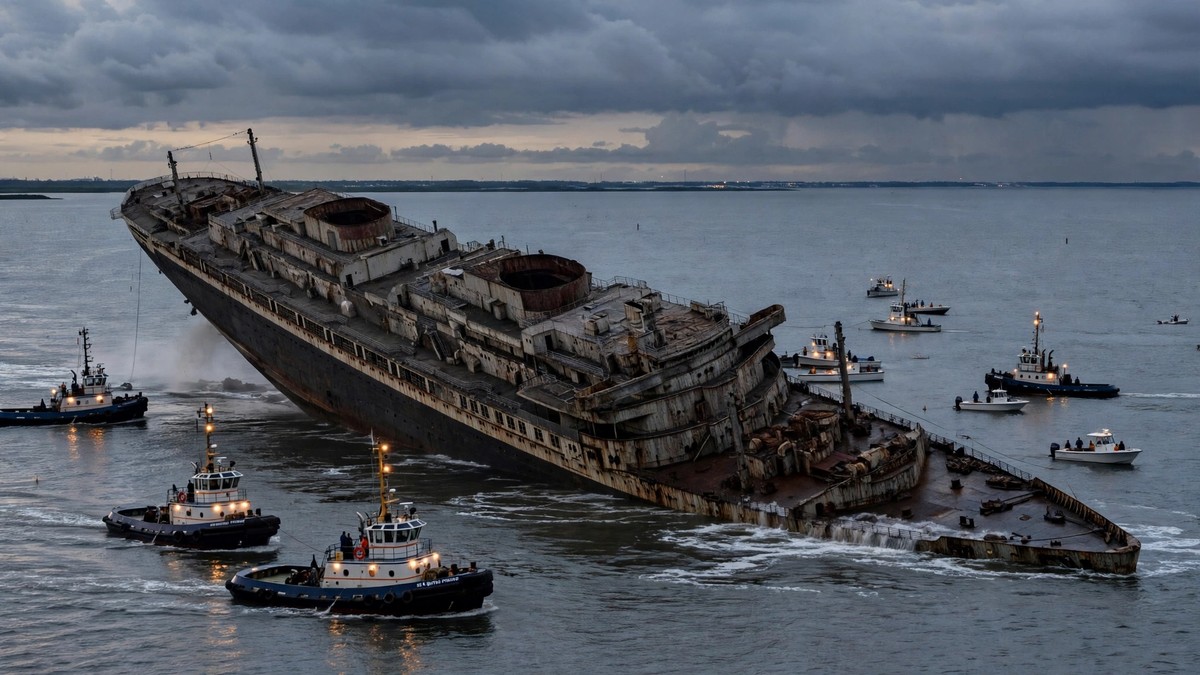
The SS United States, the fastest ocean liner ever built, sank off the Florida coast on Wednesday, 11 November, settling on the Gulf floor as the world’s largest artificial reef.
Key Points
- The SS United States sank off Destin, Florida, on Wednesday, 11 November, becoming the world’s largest artificial reef.
- The 990-foot liner settled on the Gulf floor at 9:59 p.m. ET, about seven hours after crews began flooding it.
- No explosives were used. Crews opened valves in the hull and cut holes so the ship would sink slowly and evenly.
- The ship rests in about 180 feet of water, with its upper decks roughly 50 feet below the surface, within reach of recreational divers.
- The sinking takes the record from the USS Oriskany, an 888-foot aircraft carrier sunk off Pensacola in 2006.
What happened to the SS United States
The end came slowly, then all at once. Crews began flooding the SS United States at about 2:40 p.m. ET on Wednesday, 11 November, opening valves in the hull so seawater could pour in. For hours the great ship barely moved. Then, in its final minutes, it tilted onto its side and slipped beneath the waves, settling on the Gulf floor at 9:59 p.m. ET — seven hours and 19 minutes after the flooding began.
The sinking took place about 22 nautical miles southwest of Destin-Fort Walton Beach, Florida, in the Gulf of Mexico. It was watched live by crowds on shore and by dozens of tugboats and recreational boats that had gathered around the ship for its final voyage. The operation had been moved forward by a day because strong winds were forecast for Thursday.
No explosives were used at any point. Months of preparation had stripped the ship of fuel, wiring, glass and anything that could endanger divers or marine life, and crews cut holes through the hull and decks so the vessel would flood gradually and evenly. Passageways were also cut through the interior to give fish and other sea life room to move in and out once the ship is on the bottom.
The ship now lies in water about 180 to 200 feet deep. Its upper decks sit roughly 50 to 60 feet below the surface, which puts them within reach of recreational divers. A court challenge to stop the sinking was rejected by US District Judge M. Casey Rodgers on 6 November, clearing the way for the operation to go ahead.
Why it matters
The SS United States was a marvel of its age. Launched in 1951 and designed by naval architect William Francis Gibbs, it was the largest passenger ship ever built in America and the fastest ocean liner in the world, crossing the Atlantic in less than four days. In its years of service it carried four presidents, the Mona Lisa, and a long list of film stars, before it was retired in 1969 as passenger jets took over the Atlantic crossing.
For nearly 30 years the ship sat rusting at a berth in Philadelphia, its future uncertain and the scrapyard a constant threat. Okaloosa County, on Florida’s Gulf coast, bought the vessel in 2024 as part of a project costing about $13 million, and towed it to a shipyard in Mobile, Alabama, to be cleaned and prepared for the sea floor.
For the people who cared for the ship, the sinking was bittersweet. Susan Gibbs, head of the SS United States Conservancy and the designer’s granddaughter, said before the operation that she felt “a complex mix of sorrow but gratitude and pride and hope.” Her organisation sold the ship to the county, and she said: “We felt that reefing was by far the more dignified solution.”
The reef is also a bet on tourism. Artificial reefs already bring roughly $10 million to $12 million a year in economic benefits to Okaloosa County, according to the county’s tourism director, Jennifer Adams, who expects that figure to climb and the county to recover its investment in “a couple of years.” The county has sunk hundreds of artificial reefs, and Florida as a whole has created more than 4,000 since 1940. Plans are already in place to sink five or six more reefs after this one.
Florida has been in the headlines this week for another reason: investigators recovered the cockpit voice recorder from the Learjet crash that killed nine people in the state. Read our report on that recovery: https://worldpulsewire.com/2026/11/10/florida-jet-crash-voice-recorder/
The sinking also comes as shipping lanes elsewhere face strain — attacks in the Strait of Hormuz have thinned traffic there this month. Read our report on that disruption: https://worldpulsewire.com/2026/11/06/hormuz-attacks-surge-shipping-thins-out/
What happens next
Divers are expected to start visiting the wreck almost immediately. Recreational divers were due to be able to reach the ship from dawn on Thursday, 12 November, and local dive operators are already taking bookings. The top decks are open to divers with basic Open Water certification, while the deeper hull and interior — the engine room, the pool, the long corridors — are a job for technical divers with the right training and gas.
“We anticipate the SS United States is going to be super popular,” said Savanna Christy, owner and instructor at ScubaTech, a dive centre in Destin. Wreck diver Karen Flynn, who has booked a charter to visit the ship, said: “There’s something about looking out over that bridge … and seeing the nose of the bow and then seeing just the blue out in front of it. That is going to be a spectacular shot.”
The new reef joins the USS Oriskany, the 888-foot aircraft carrier sunk off Pensacola in 2006, as the second-largest artificial reef in the world. The two wrecks sit about 13 nautical miles apart, close enough that divers could visit both on a single day trip.
Marine life is expected to move in quickly. Snappers, groupers, amberjack, sharks, turtles and small reef fish should all take up residence on and around the hull, and over time the steel will be covered in the growth that turns a wreck into a living reef. Divers are warned, though, that nothing may be taken from the site: Florida law treats removing objects from a wreck as a crime, and the unwritten rule is to leave the wreck exactly as it is found.
Source: Reuters, NPR, USA Today, Pensacola News Journal, DeeperBlue | 12 November 2026